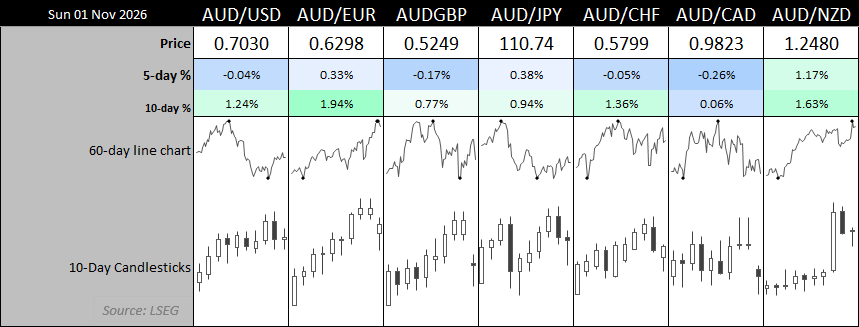
The Australian dollar's rally faltered late last week as hot US producer prices and rising crude oil fuelled concerns over further Fed tightening. With another RBA hike widely expected, traders will focus on how hawkish Governor Bullock sounds, while US midterm elections, ISM PMIs and nonfarm payrolls provide further catalysts for AUD/USD volatility.
View related analysis:
- EUR/USD Short Squeeze Underway as Yields Drag US Dollar Lower
- Bank of Canada Hikes as Inflation Risks Intensify: AUD/CAD In Focus
- Gold Bulls Treat $4,000 as a Bargain Once Again
- Australian Dollar Outlook: AUD/USD Screams Sentiment Extreme Into Fed, CPI
RBA Hike, US Midterms and Payrolls Set the Stage for AUD/USD Volatility
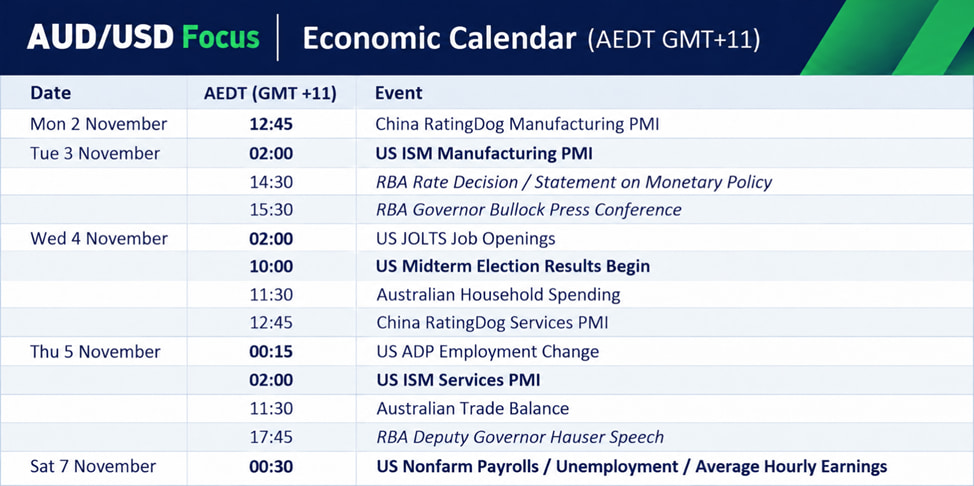
Australia This Week: Economic Data and Events for AUD/USD Traders
RBA Rate Hike: Inflation Upgrades and 5% Peak in Focus
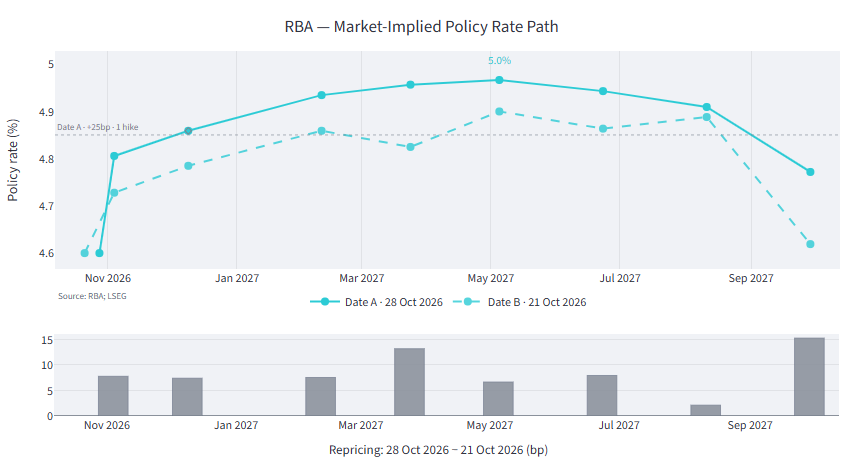
The RBA is widely expected to raise the cash rate by 25bp on Tuesday, although the bigger question for AUD/USD traders is how hawkish Governor Bullock sounds on the path beyond November. Rate expectations have firmed notably over the past week, supported by hawkish RBA comments to lawmakers and another sticky CPI report.
The RBA cash rate futures implied a more hawkish path over the past week, with traders now pricing a peak cash rate of around 5.0% in 2027. That leaves the Australian dollar sensitive not just to the hike itself, but to whether the RBA’s updated guidance and forecasts justify expectations for further tightening.
My expectation is for a hawkish tone, although Bullock will likely emphasise that future decisions will be made on a meeting-by-meeting basis. While another hike in December cannot be ruled out, I suspect the RBA will prefer to assess the impact of its recent tightening before acting again, making February the more likely opportunity. Household spending data on Wednesday being the first post-RBA meeting data in line for scrutiny.
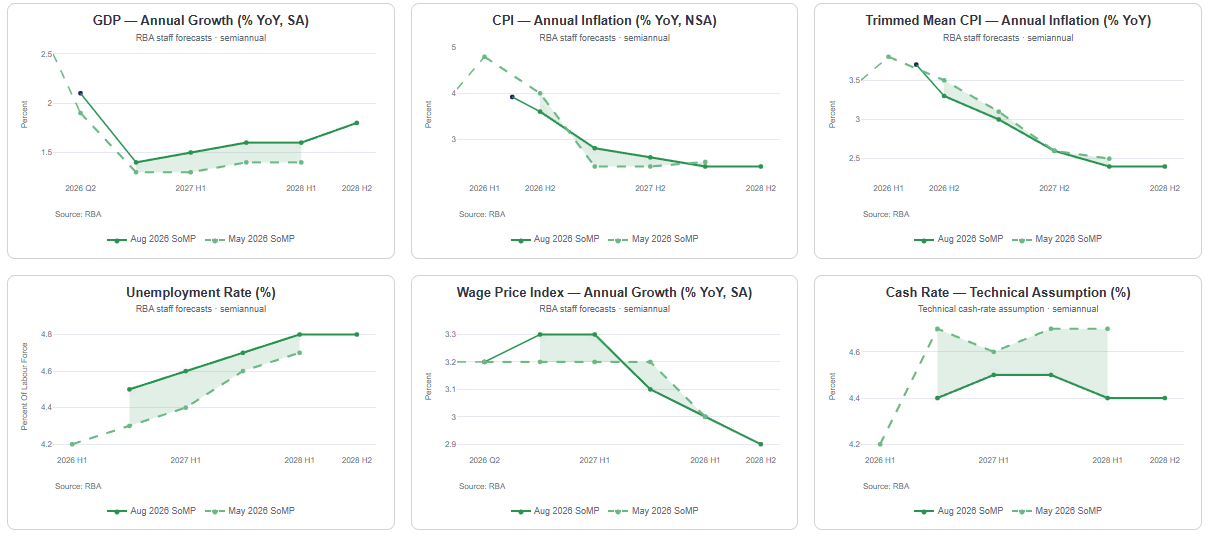
The November Statement on Monetary Policy is also likely to contain upgrades to inflation and the cash-rate track. In the August SoMP, the RBA’s forecasts for both inflation and the technical cash-rate assumption were lower than in May, but September’s hotter CPI figures suggest those projections are now too low and may need to be revised higher.
US Midterm Elections: How a Blue or Red Victory Could Move AUD/USD
Democrats are favoured to win the House and potentially the Senate in Tuesday's midterm elections, with results arriving during Wednesday's Asian session.
A Democratic sweep could limit Trump's fiscal expansion plans, potentially weighing on Treasury yields and the US dollar. This could support AUD/USD, although concerns over political gridlock or tougher regulation could dampen risk appetite.
An unexpected Republican sweep could lift equities on expectations of further stimulus and tax cuts. However, higher inflation expectations and Treasury yields could also strengthen the US dollar, limiting the Aussie's upside.
With a Democratic victory increasingly priced in, the bigger market reaction may come from a surprise result. Watch US yields, DXY and Wall Street for directional confirmation.
This content was created by an affiliate of FOREX.com and represents the views and opinions of the author/speakers, not the views and opinions of FOREX.com, StoneX Group Inc., or its subsidiaries. The content has not been independently reviewed by FOREX.com.
US ISM PMIs and Nonfarm Payrolls: Inflation Remains the Main Concern
US ISM Manufacturing and Services PMIs are due early Tuesday and Thursday respectively, followed by Friday's nonfarm payrolls report.
Inflation remains the Fed's primary concern, making the ISM prices-paid components particularly important. Both remain elevated, with September's manufacturing index at 77.9 and services at 74. Further increases could reinforce hawkish Fed expectations, supporting yields and the US dollar.
Growth and employment remain secondary concerns, although September's disappointing 29k payroll increase warrants attention. Friday's NFP report is expected to show 65k jobs added, with unemployment steady at 4.2%.
Average hourly earnings will also be closely watched for signs of persistent wage inflation. Softer prices and wage growth could ease pressure on US yields and support AUD/USD, particularly if the RBA delivers a suitably hawkish message earlier in the week.

AUD/USD Technical Analysis: Australian Dollar vs US Dollar
AUD/USD Correlations: Short-Term Relationships Flip as Volatility Builds
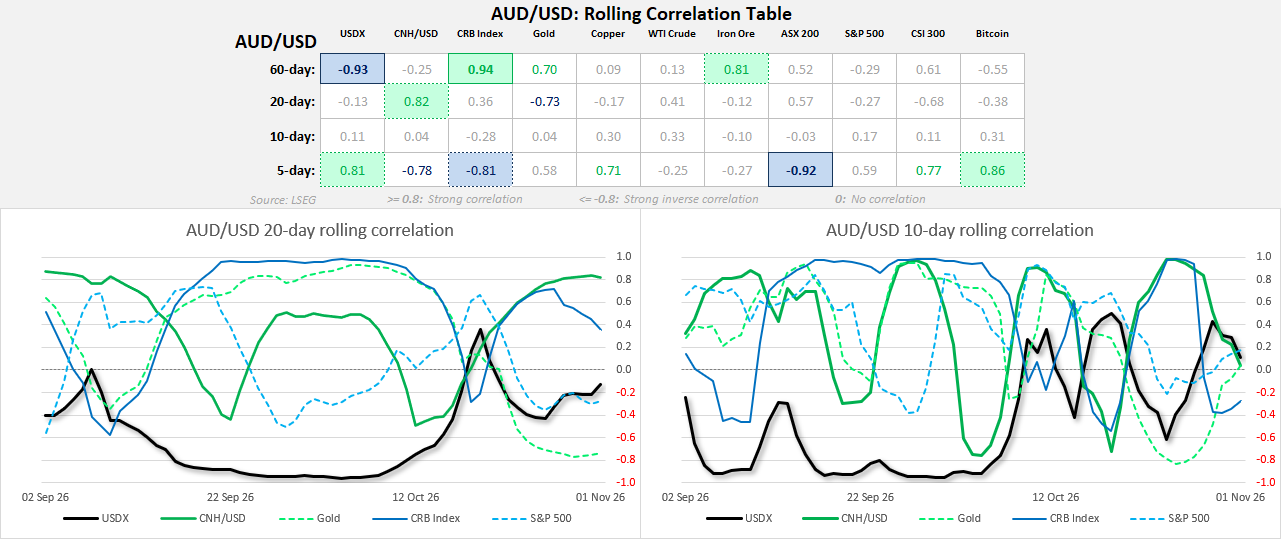
- Most 10-day correlations have collapsed towards zero, only for several five-day relationships to strengthen sharply or reverse direction, suggesting rapidly shifting market sentiment.
- Risk signals are mixed. AUD/USD has recently tracked the S&P 500, Bitcoin and CSI 300, while moving sharply against the ASX 200.
- AUD/USD retains a strong inverse 60-day correlation with the US dollar, yet the five-day relationship has turned strongly positive, making DXY less reliable as a near-term guide.
- The yuan's positive 20-day relationship has turned sharply negative over five days, while the CSI 300 has strengthened. China's PMIs could help clarify the picture.
- Commodity correlations have also shifted. The CRB Index has turned strongly negative over five days, copper is positively correlated, while iron ore offers little directional guidance.
Source: LSEG
AUD/USD Futures Positioning | COT Report
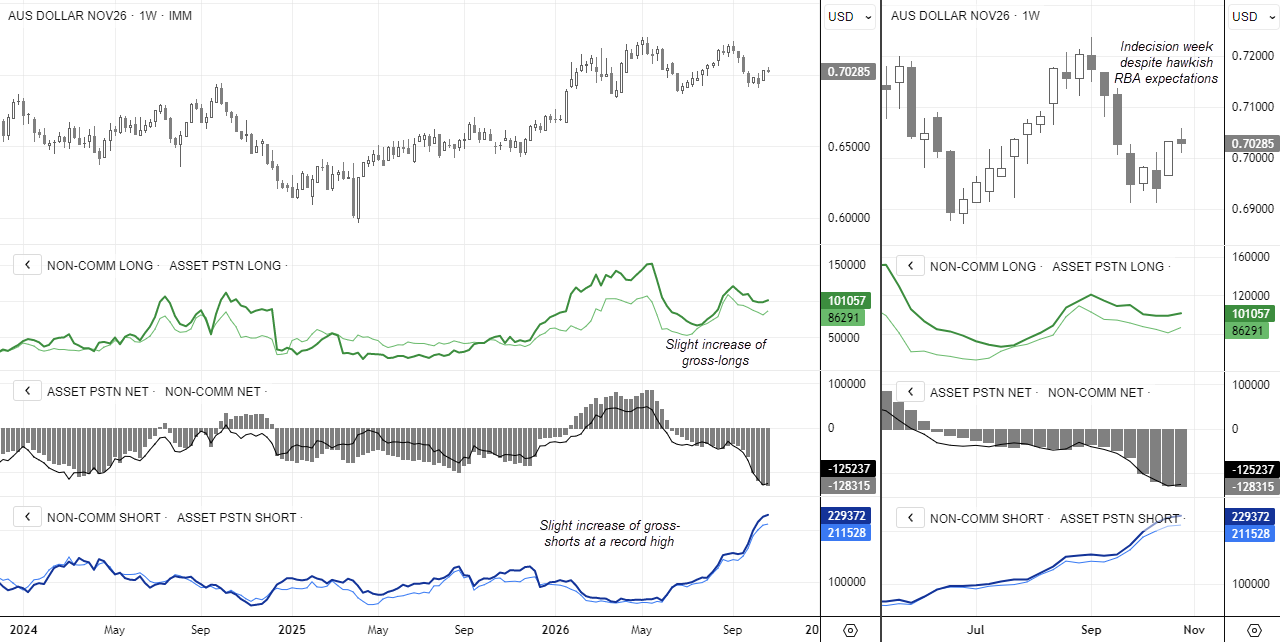
While only minor adjustments were made among futures traders last week, they remained heavily net-short ahead of the sticky inflation report and hawkish RBA comments. This suggests some of those bears were shaken out of their record-short positions. Note the slight uptick on gross-longs among asset managers and large speculators, in line with recent momentum since bears failed to break AUD/USD below neckline / trend support.
Source: CFTC (COT) CME, LSEG
For traders wanting a deeper understanding of futures positioning, I’ve also published a guide on how to read and interpret weekly COT data in forex markets.
AUD/USD Technical Outlook: Volatility Rises as Bulls Eye 71c
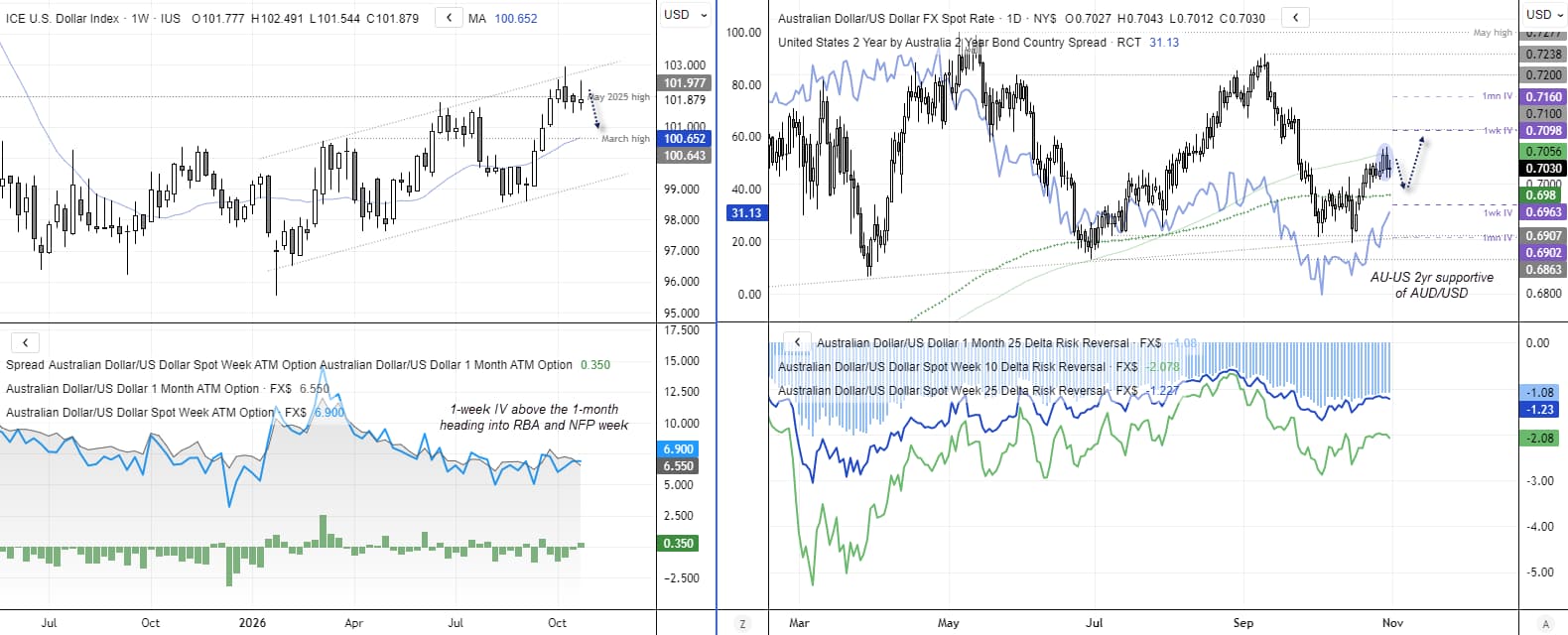
We have a few mixed signals heading into this week, despite a busy economic calendar. A dark cloud cover pattern formed on Friday, showing a reluctance to push above the 200-day SMA for now, although the Aussie remains above the 200-day EMA. The AU–US two-year yield spread is pointing higher in support of AUD/USD, though headline risk reversals are a touch lower, suggesting slightly greater demand for puts (downside protection) relative to calls (upside bets). One-week implied volatility has also risen above one-month volatility, highlighting the importance of this week's events.
Source: ICE, TradingView
Structurally, I suspect AUD/USD remains in buy-the-dip mode overall. And perhaps a dip could arrive earlier in the week if the RBA is less hawkish than already expected – which is a possibility. But if that is met with slightly softer, or at least non-accelerating, prices-paid readings in the ISM reports and an OK NFP report, perhaps the US dollar can pull back further and help AUD/USD head towards 71c, near the upper one-week implied volatility band.
Australian Dollar Performance