
Over the past five trading sessions, the price of WTI crude has fallen by about 2.7%, establishing a new consistent bearish bias in short-term price movements. For now, selling pressure remains relevant, driven by concerns over a potential decline in global demand, which could sustain a bearish outlook in the coming sessions.

Is Consumption at Risk?
Since the first comments suggesting a renewed escalation in the U.S.–China trade war, WTI crude has shown a steady downward trend. The trade tensions have raised doubts about global oil demand, which could weigh on market appetite for crude in the coming weeks.
Although there have been diplomatic efforts to resolve the conflict, there is still no clarity on when the world’s two largest economies might reach an agreement. In the coming days, a meeting between the Chinese Vice Premier and the U.S. Treasury Secretary is expected to take place, which could determine whether progress is made toward more concrete trade accords and whether the 100% tariff on Chinese goods, scheduled for November 1, can be avoided.
In this context, the fact that the United States and China—the world’s two largest oil consumers—are involved in this conflict adds further uncertainty. The U.S. consumes around 19 million barrels per day, while China consumes roughly 16.4 million barrels, according to data from late 2024.
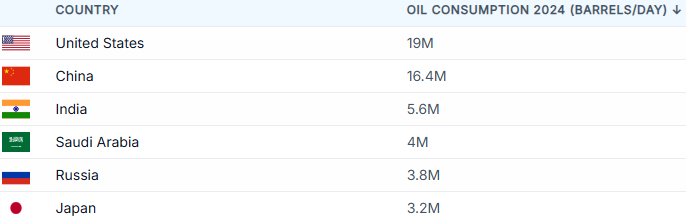
Source: Worldpopulationreview
If the trade conflict escalates, it could lead to a more aggressive tariff war, hurting the economic growth outlook in both countries. As they are the largest consumers of crude, any slowdown in their economies would put global oil demand at risk.
Additionally, while OPEC+ continues focusing on gradually increasing production throughout 2025, the combination of rising supply and weakening demand could lead to a structural imbalance between supply and demand. This would keep selling pressure on WTI crude, especially if no tangible progress is made on trade negotiations. As long as this uncertainty persists, the bearish trend is likely to dominate in the short term.
What’s Happening with Oil Market Confidence?
The CBOE OVX Index has begun to rise in the short term, approaching the 40-point level, reflecting an increase in implied volatility for crude oil. This uptick suggests growing uncertainty about oil’s future and the potential for sharp price swings, which could lead to deeper short-term corrections.
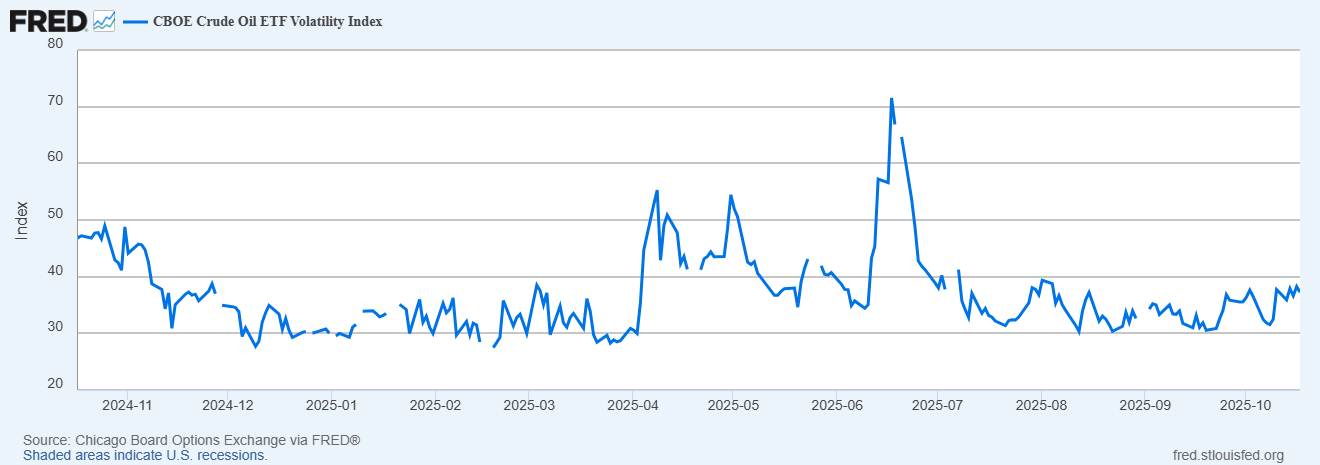
Source: CBOE
The sustained rise in the OVX can be interpreted as a signal of market distrust, as higher volatility tends to drive rapid declines in crude prices. As long as the market does not perceive price stability, the OVX will likely continue climbing, reinforcing the idea that oil remains a risk asset amid ongoing uncertainty about future demand. This may limit short-term demand and strengthen a temporary bearish bias.
WTI Technical Outlook
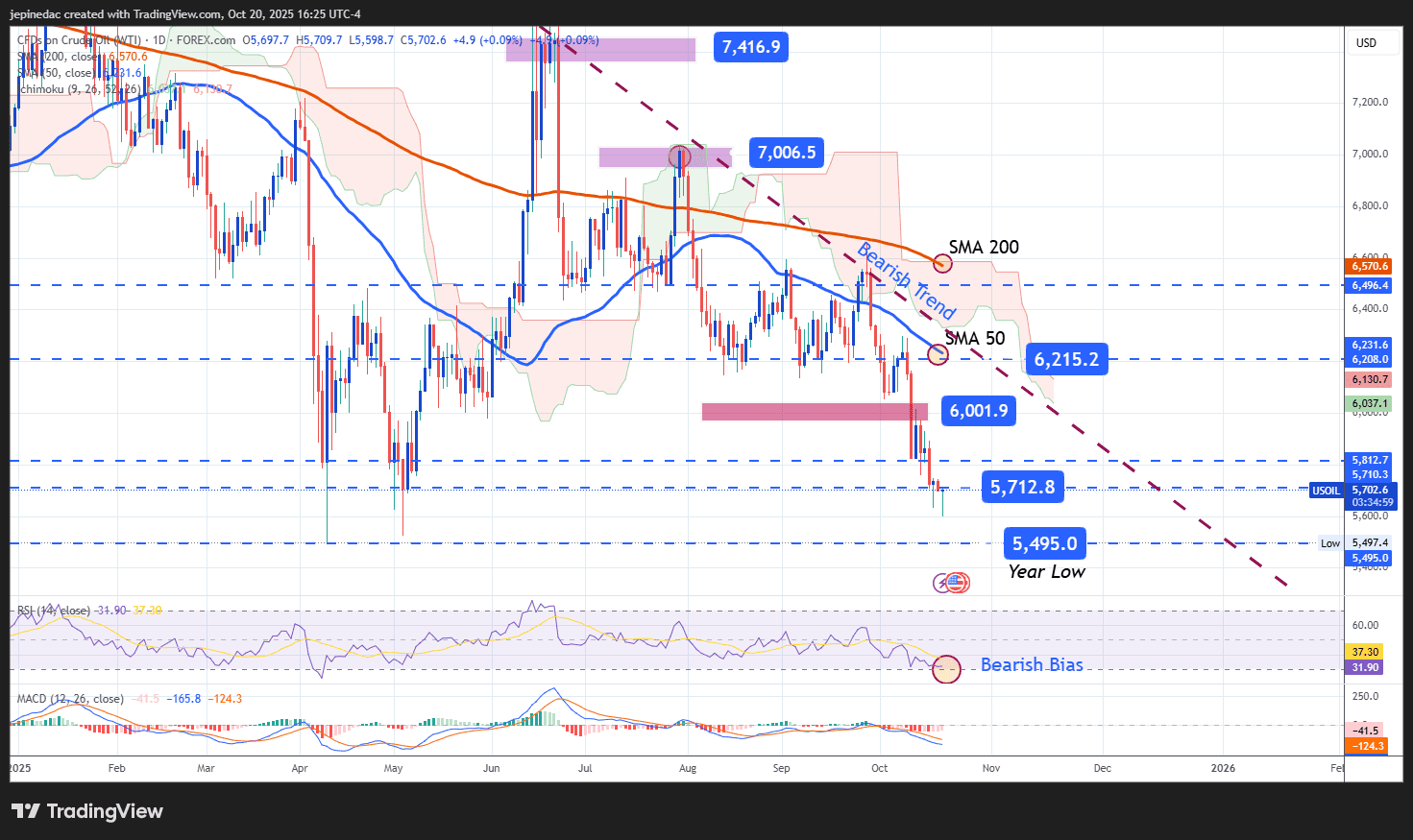
Source: StoneX, Tradingview
- Consistent Downtrend: Since late June, WTI has maintained a steady bearish trend, with prices oscillating below the $60 level. So far, there are no meaningful bullish corrections that could threaten this trend. As long as selling pressure remains dominant, the bearish bias is expected to persist in the broader outlook.
- RSI: The RSI remains below the 50 level, indicating that selling momentum has dominated over the past 14 sessions. However, the indicator is gradually approaching the oversold zone (level 30), which could signal a potential imbalance in market forces and open the door for technical rebounds in the short term.
- MACD: The MACD histogram remains below the neutral line (0), reflecting a consistent bearish tone. If it continues moving away from neutrality, selling pressure could intensify further in the coming days.
Key Levels:
- $60 – Major Resistance: A key psychological level. A sustained breakout above this point could challenge the current downtrend and trigger renewed buying pressure.
- $57 – Near-Term Barrier: Represents the most recent retracement zone. If WTI consolidates around this level, it could trigger short-term bullish corrections.
- $55 – Key Support: Corresponds to the yearly lows and remains the most important selling barrier. A sustained break below would confirm a stronger bearish acceleration in the short term.
Written by Julian Pineda, CFA – Market Analyst
Follow him on: @julianpineda25