
- RBNZ holds policy steady despite 88% hike probability
- Narrow 4–3 vote leaves December live
- OIS markets strip out one full hike by mid-2027
- NZD/USD tests support, AUD/NZD breaks to multi-year highs
RBNZ shocks markets with surprise hold
The RBNZ may no longer be led by Adrian Orr, who had a reputation for delivering significant policy shocks, but his legacy lives on with the Bank stunning markets and economists by keeping its overnight cash rate unchanged at 2.75% following its October monetary policy meeting.
Markets had priced in an 88% probability of a 25-basis-point hike, making the decision a significant surprise.
The decision triggered an immediate knee-jerk decline in the Kiwi against all major crosses, although the outcome itself was a close-run affair with the Committee voting 4–3 in favour of keeping rates steady.
Governor Anna Breman, Carl Hansen, Rebecca Williams and Prasanna Gai voted to hold, citing weaker-than-expected inflation, subdued wage growth, stable inflation expectations and ongoing weakness in domestic demand. They also wanted more time to assess the impact of the previous two rate increases.
In contrast, Paul Conway, Karen Silk and Hayley Gourley favoured an immediate 25-basis-point hike, arguing that persistent core inflation and increasingly broad-based price pressures risked becoming entrenched. They also believed acting sooner could reduce the need for more aggressive tightening later.
This content was created by an affiliate of FOREX.com and represents the views and opinions of the author/speakers, not the views and opinions of FOREX.com, StoneX Group Inc., or its subsidiaries. The content has not been independently reviewed by FOREX.com.
Politics, inflation expectations and December decision
The decision to wait means the RBNZ avoids raising rates just ten days before New Zealand's general election, which will be held on November 7. Even though it maintains publicly that political considerations play no role in its decisions, we know that's often not the case.
It also provides more time to assess not only the impact of previous tightening, but also how inflation expectations are evolving, with the RBNZ's own Survey of Expectations due on November 17. Historically, this has been an important data point the Bank has often leaned on heavily when evaluating policy settings.
Despite the shock decision in October, all members maintained that further tightening was likely to be required, conditional on the economic outlook. However, while that sets the scene for a third hike of the cycle in December, when fresh forecasts and an updated cash rate track will be released, what's clear from the last two meetings is that the RBNZ is nowhere near as markets, with traders previously looking for more than four hikes by the middle of next year.
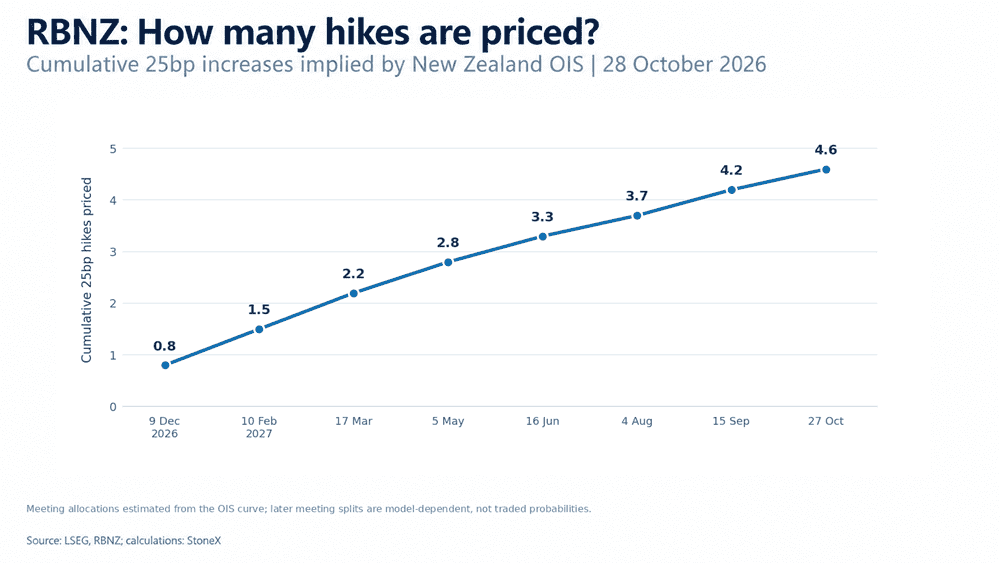
Source: LSEG
On the back of the decision, markets have stripped one full hike out of the OIS curve, reflecting the dovish surprise. However, even after that repricing, swaps traders still put around an 80% probability on a 25-basis-point hike in December to 3%, with another three moves expected by June next year.
While still a very hawkish outlook, this is the second consecutive time the bank has delivered a dovish surprise. As such, even after today's rate recalibration, the risk remains that traders are still overestimating how much tightening will be delivered this cycle, even as the inflationary pulse from high energy prices and a weaker New Zealand dollar continues to feed into the New Zealand economy.
NZD/USD tests major support
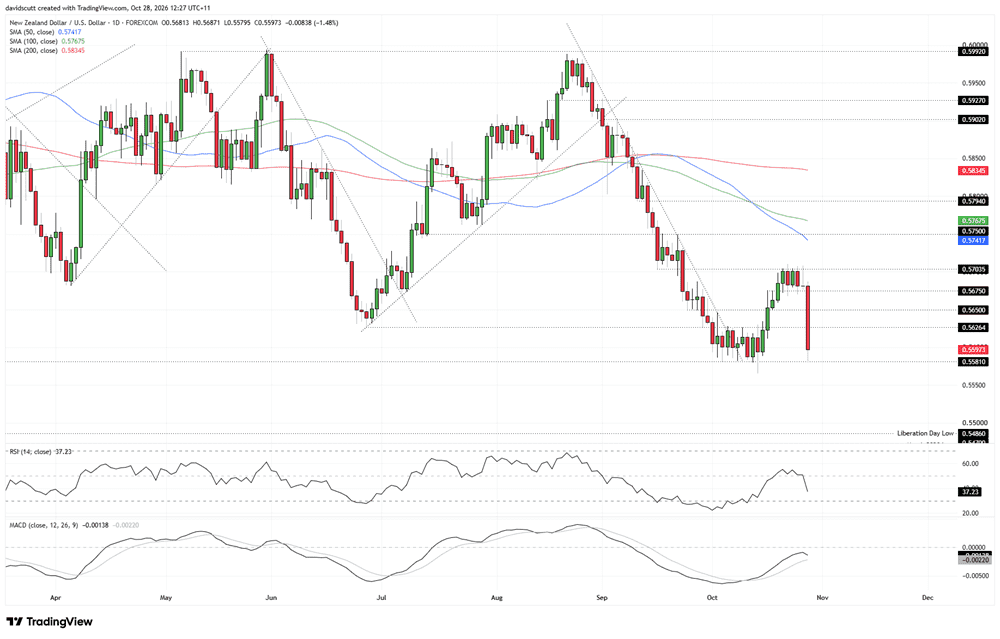
Source: TradingView
On the back of the decision, NZD/USD fell like a stone, cascading through known support levels before the move eventually stalled at 0.5581 support, for now. However, given the dovish shock, and with momentum clearly building on the downside, traders should be alert to the risk of a break of this support zone, which, if sustained, may open the door for a run towards the Liberation Day low of 0.5486, set in April last year, with the pandemic lows located just beneath at 0.5470.
We're talking about some significant historical levels here.
Should 0.5581 support continue to hold, as was the case earlier this month, 0.56264 and 0.5650 are the two immediate levels overhead to watch.
While the RBNZ decision is still reverberating across markets, my experience is that shocks from monetary policy decisions often fade fairly rapidly, putting emphasis on other factors such as the Fed meeting later in the session and tech earnings from Microsoft and Alphabet tomorrow morning, given the dollar has been showing a tendency to move in line with AI sentiment more recently.
AUD/NZD surges to multi-year highs
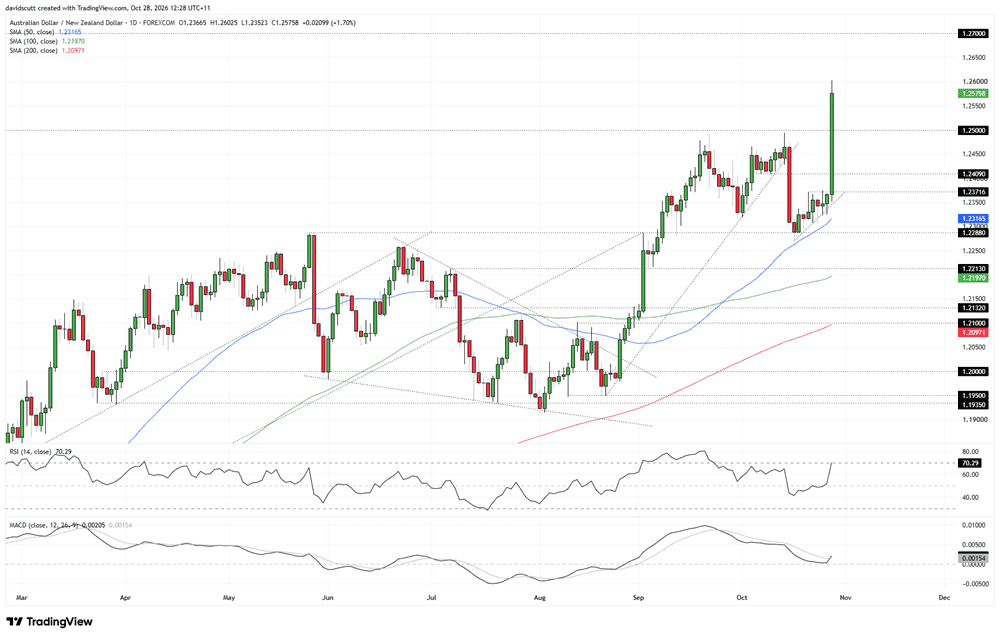
Source: TradingView
Along with the RBNZ's dovish shock, a hot Australian CPI report for September, which has gone close to cementing the prospects for back-to-back rate increases from the RBA on Tuesday next week, has seen AUD/NZD surge to fresh multi-year highs, taking out a key resistance zone running from 1.2490 to 1.2500 before the move eventually stalled above 1.2600.
The latter is now the immediate focal point overhead, with 1.2500 the first downside level of note. Beyond 1.2600, 1.2700 is the level to watch, with the pair having done plenty of work on either side of it going back more than a decade.
The message from the oscillators is one of rebuilding upside strength. RSI (14) has shot higher and is now sitting around 70, while MACD has staged a bullish crossover in positive territory, reinforcing the signal. That favours buying dips and breakouts.