
A potential record IPO from Anthropic and Meta's announcement of plans to raise up to $95 billion to fund its AI infrastructure expansion helped reignite enthusiasm towards AI-related investments on Monday, sparking a sharp rebound in technology stocks on Wall Street.
As we highlighted in our USD/JPY weekly outlook over the weekend, sentiment towards AI investment is becoming an important driver of broader market movements. That relationship was evident again on Monday, with the recovery in technology stocks coinciding with a rebound in Treasury yields and the dollar, helping USD/JPY build on Friday's bullish reversal and return to its 50-day moving average.
Anthropic IPO sparks renewed enthusiasm for AI
Anthropic's public IPO filing on Monday revealed plans for a Nasdaq listing that could value the company at around $1.5 trillion.
Unlike earlier this year, when investors seemed willing to overlook enormous valuations, mounting losses and questions over return on investment, there's now far greater scrutiny, it seems, of the sums being poured into the technology and whether those investments will pay off.
Yet even with that, the news was enough to spark a sharp rebound in AI-related stocks on Wall Street, coming just ahead of a series of major technology earnings announcements later this week, headlined by Alphabet, Microsoft, Amazon and Intel.
Adding to the enthusiasm was Meta's announcement that it plans to raise up to $95 billion in equity to fund its enormous AI infrastructure expansion, with chipmakers Nvidia, AMD and Broadcom expressing interest in purchasing up to $5 billion of shares between them.
It's another example of the circular financing arrangements becoming commonplace in the AI industry, where chipmakers are helping fund the very companies buying their products. Whatever the longer-term concerns about the sustainability of these circular financing arrangements, you cannot dispute the fact that they continue to support demand for the chips and infrastructure underpinning the AI investment boom.
Even with the recent market wobbles, the show rolls on.
Semiconductors lead the AI rebound
Source: TradingView
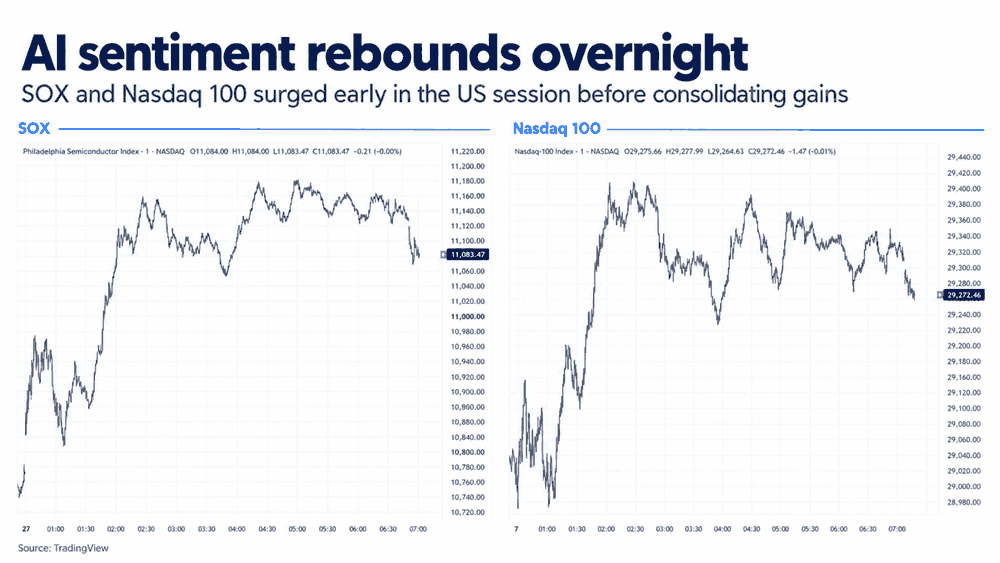
As the chart above shows, the Philadelphia Semiconductor Index (SOX) and Nasdaq 100 surged early in Monday's US session, before consolidating those gains into the close.
While neither managed to hold its session highs, the strength of the rebound was another reminder of just how quickly sentiment towards the AI trade can shift, even with concerns surrounding valuations, financing and returns still hanging over the sector.
Treasury yields and dollar recover
The revival in AI-related sentiment coincided with a rebound in US Treasury yields and the dollar towards the back end of North American trade.
Benchmark 10-year Treasury yields rose just over two basis points from earlier lows, which appeared to have been influenced by sharp declines in crude oil futures early in the session. There was also a sizeable rally in French government bonds after Moody's surprised markets on Friday by leaving the country's credit rating unchanged, likely compounding downward pressure on global yields.
Yet even with those influences, we still saw a rebound in US yields and the dollar towards the close, including against the yen.
While the moves were modest, they were consistent with the relationships we highlighted over the weekend, where sentiment towards AI investment appears to be influencing broader perceptions of the US economic growth outlook, with implications for Treasury yields, the Fed policy outlook and the dollar.
Major risk events still to come
The rebound in AI sentiment comes at the start of an already enormous week for financial markets, with interest rate decisions from the Federal Reserve and Bank of Japan, along with earnings announcements from Alphabet, Microsoft, Amazon and Intel.
As we discussed in our weekend outlook, guidance on AI capital expenditure and expected returns from those investments could prove just as influential for USD/JPY as the central bank decisions themselves, given how closely the pair has been tracking shifts in AI sentiment and US Treasury yields recently.
To read our full USD/JPY week ahead preview, click here.
USD/JPY bulls eye return to former trading range
Source: TradingView
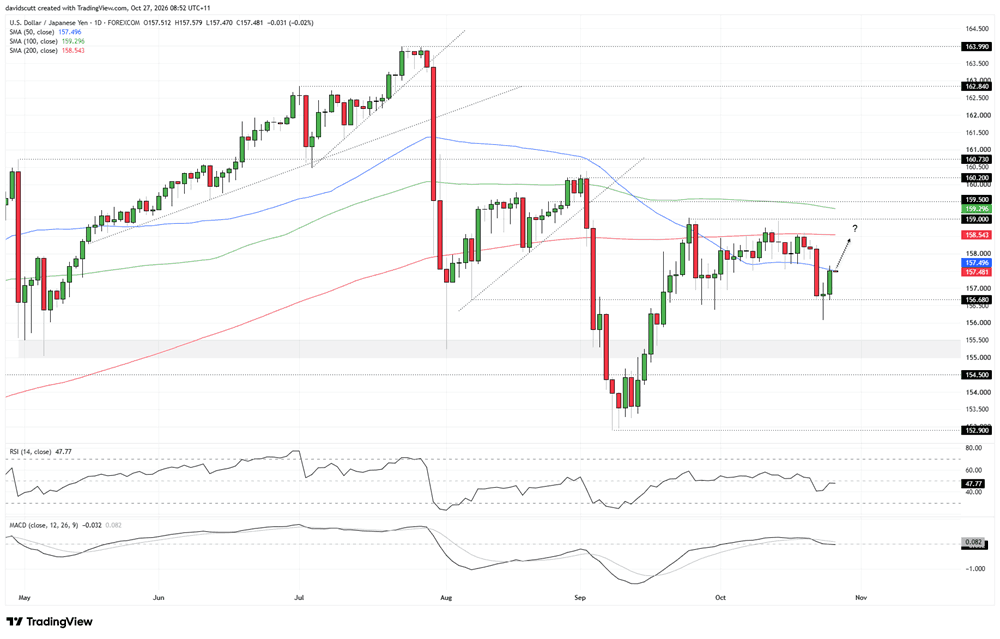
As flagged over the weekend, upside risks in USD/JPY materialised on Monday, delivering a bullish candle that took the price back to the 50-day moving average, which had acted as the lower boundary of the narrow trading range prior to last week's breakdown.
The scale of the move completed a three-candle morning star pattern, and while it did not arrive after a pronounced downtrend, it suggests directional risks may be shifting higher once more.
If USD/JPY breaks cleanly above the 50-day moving average, it may see bulls set sail for the 200-day moving average, found today at 158.54. Having acted as the upper boundary of the previous trading range, it comes across as a logical upside target, with resistance at 159.00 the next level above that, followed by the 100-day moving average and 159.50.
For those latter levels to be revisited, it would likely require a large, sustained rebound in AI sentiment and/or a hawkish surprise from the Federal Reserve or dovish surprise from the Bank of Japan, given the factors that have been influencing the pair recently.
Of course, just because a bullish reversal pattern has printed doesn't necessarily mean it will play out, hence the need for confirmation. If USD/JPY is unable to break cleanly above the 50-day moving average, it may allow traders to establish shorts with a tight stop above the moving average for protection, initially targeting 156.68, which has been a prominent support level dating back to early August this year.
Beneath that, Friday's low around 156.10 is the next downside level of note, followed by a more pronounced support zone between 155.50 and 155.00.
The message from the oscillators is now entirely neutral. RSI (14) has rebounded on the daily timeframe to trade just beneath the neutral 50 level, while MACD is running parallel to its signal line, just in positive territory. That puts more emphasis on the price action rather than retaining a specific directional bias.