



USD/JPY Update: Japanese yen struggles to recover ahead of NFP
The trading week is almost over, and one of the main factors still standing out is the lack of strength in the Japanese yen. So far, USD/JPY has remained mostly neutral, moving by only around 0.1% over the last two sessions, without showing a clear recovery from the Japanese currency.
Share this:

The trading week is almost over, and one of the main factors still standing out is the lack of strength in the Japanese yen. So far, USD/JPY has remained mostly neutral, moving by only around 0.1% over the last two sessions, without showing a clear recovery from the Japanese currency.
For now, the buying pressure that has built up over recent weeks remains relevant, even ahead of tomorrow’s US NFP release. This report could put additional pressure on the yen if employment figures support expectations of a more aggressive Federal Reserve, keeping slow but consistent buying pressure in USD/JPY over the medium term.


NFP day is approaching
Tomorrow, June 5, 2026, the US NFP employment report will be released. Now, the market expects 85,000 jobs to have been created in May, below the previous 115,000 reading. This continues to point to a possible slowdown in the US labor market, especially considering that March payrolls were close to 185,000, followed by 115,000 in April, with an even lower figure now expected for May.
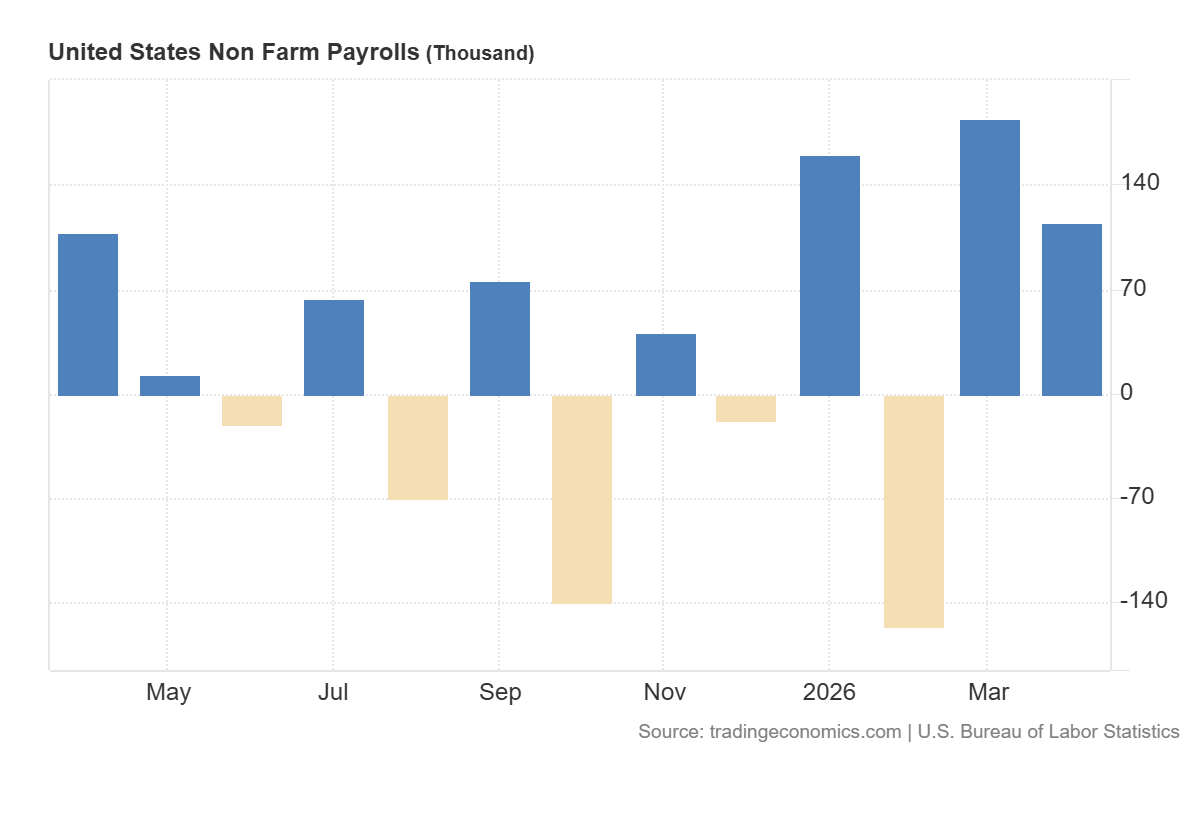
Source: TradingEconomics
The release will be important because this cooling in employment has been one of the factors limiting expectations of a more aggressive Federal Reserve. For now, the CME Group probability table shows that, through the end of 2026, markets still assign a probability above 45% that interest rates will remain unchanged around the 3.75% reference level. Expectations for potential hikes become more relevant toward March 2027, where the probability of a move toward a new level near 4.00% is already above 40%.
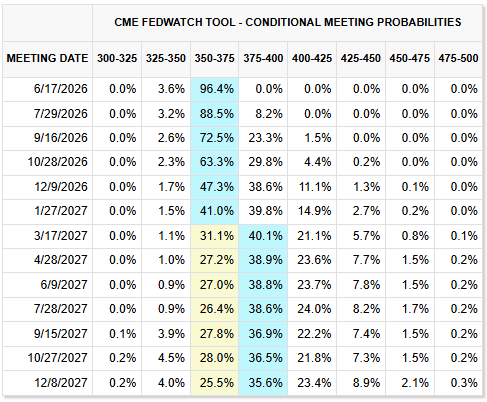
Source: CMEGROUP
Against this backdrop, the rate differential between the United States and Japan remains one of the main drivers behind dollar strength against the yen. While the US benchmark rate stands at 3.75%, Japan’s reference rate is only 0.75%, leaving a wide gap in favor of the dollar.
This makes any data capable of shifting Fed expectations especially relevant. If tomorrow’s employment report comes in above forecasts, it could suggest that the labor market slowdown is starting to moderate, giving the Fed more room to keep its focus on the 2.00% inflation target. That could strengthen expectations of a more restrictive US policy stance and increase the appeal of dollar-denominated assets, making it harder for the yen to recover consistently.
On the other hand, a much weaker-than-expected jobs report could reinforce the view of a more cautious Fed and give the yen some room to recover. Even then, rather than triggering strong selling pressure in USD/JPY, this scenario could lead to a more noticeable phase of indecision over the coming sessions.
Could potential tariffs have an impact?
This week, markets also received updates around a possible new tariff plan from the United States. The initial proposal includes 10% tariffs on products and services from countries such as England and Canada, and up to 12.5% for economies such as Japan and China. Although these measures have not been fully implemented and more clarity is still needed, the announcement has revived trade war risks and could increase uncertainty around the currencies of potentially affected countries, including the Japanese yen.
This is not a positive catalyst for yen demand. Japan is an export-driven economy, so a renewed tariff threat could hurt foreign trade expectations and create some hesitation toward yen-denominated investments in the short term. In addition, during this type of environment, the US dollar is often seen as a more stable currency, which could also make it harder for the yen to regain ground.
If recent comments continue moving toward a more relevant trade conflict, pressure on the yen could remain in place. This backdrop could also continue to support buying pressure in USD/JPY over the coming sessions.
Technical outlook for USD/JPY
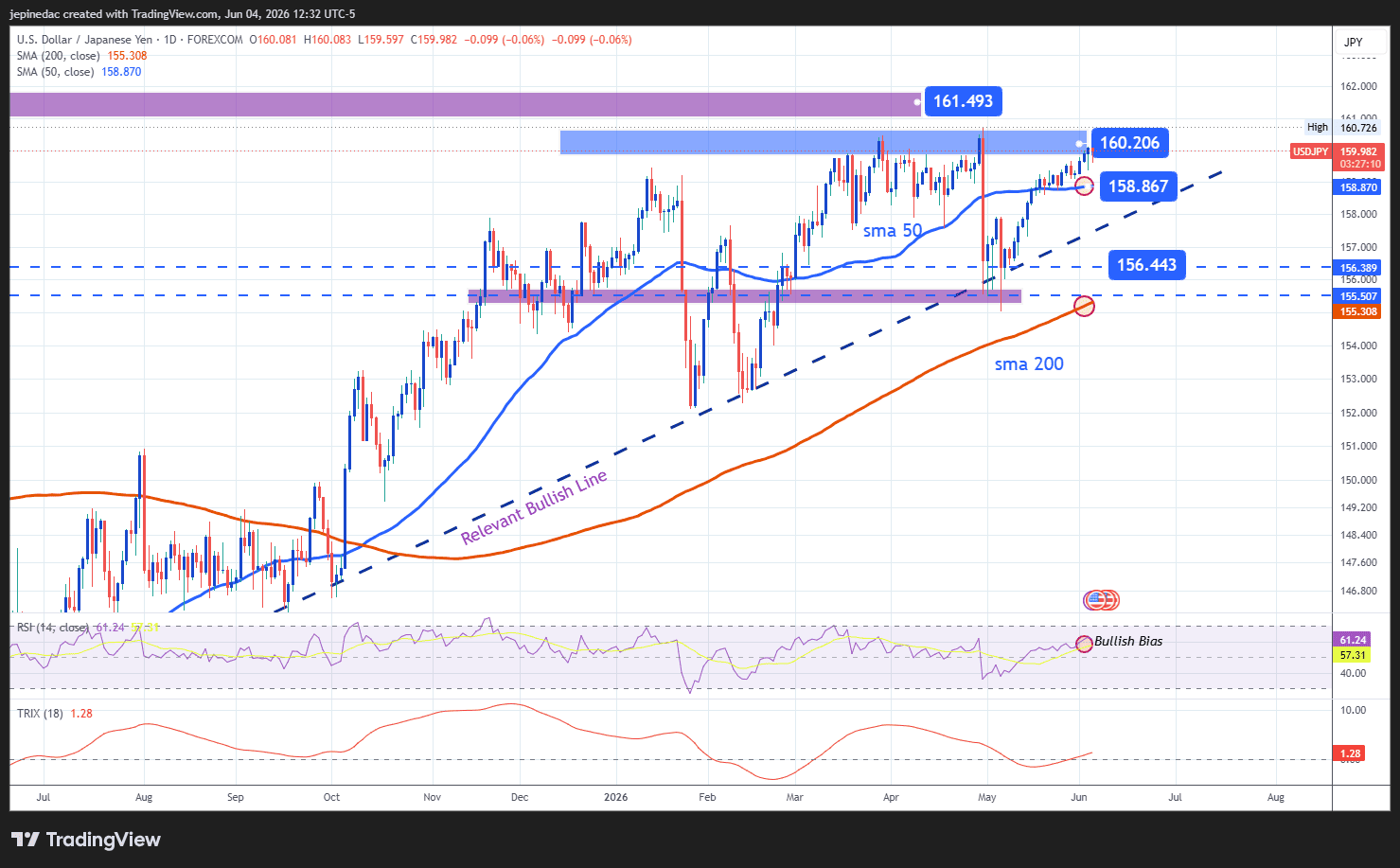
Source: StoneX, Tradingview
- The bullish trend is approaching key highs: For several months, the most important technical structure in USD/JPY has been a long-term bullish trendline. So far, with no major selling corrections, this remains the dominant technical pattern. The latest price recovery has brought the pair back toward key highs near 160 yen per dollar. If buying pressure continues to stabilize, this bullish structure could continue to dominate the chart over the coming weeks.
- RSI: Now, the RSI continues to hold above the neutral 50 level, suggesting that average momentum over the last 14 sessions still reflects a relevant buying bias. If this behavior continues, bullish pressure could remain in place over the coming sessions.
- TRIX: A similar picture can be seen in TRIX, as the indicator line has moved back above the neutral 0 area. This reflects a relevant buying bias in the average strength of long-term moving averages and also confirms the importance of the current buying pressure.
Key levels:
- 160.000 – Key resistance: A relevant psychological level that coincides with recent highs. A move toward this area could reinforce the current buying bias and open the door to an extension of the bullish trendline over the coming weeks.
- 158.867 – Near-term barrier: A neutral area aligned with the 50-period moving average. Price action that remains too close to this level could reinforce a phase of indecision or even lead to the formation of a short-term range.
- 156.443 – Main support: A nearby low that coincides with the base of the long-term bullish trendline. A move toward this level could start putting this structure at risk and highlight a more dominant selling bias over the following sessions.
Written by Julian Pineda, CFA, CMT – Market Analyst
Follow him on: @julianpineda25
Latest market news




Open an account in minutes
Experience award-winning platforms with fast and secure execution.
Economic calendar
Web Trader platform
Our sophisticated web-based platform is packed with features.
Related articles
AUD/USD Bears Tighten Their Grip Into AU Jobs, RBA Minutes
AUD/USD falls below 68 cents as US dollar strength and peak RBA rate expectations put Australian jobs data and RBA minutes in focus.
Australian Dollar Forecast: AUD/USD Breaks Multi-Month Range, Hits 10-Month Low 11 14 2026
Aussie bears are closing in on major technical support, with next week's Australian employment data raising the stakes for a pivotal reaction.

USD/JPY Weekly Outlook: Bulls Eye Higher Range After Historic Rate Shock
A historic US rate shock has sent USD/JPY above 160, but with intervention risks rising and few major economic catalysts ahead, AI sentiment could hold the key to the next move.

The information on this web site is not targeted at the general public of any particular country. It is not intended for distribution to residents in any country where such distribution or use would contravene any local law or regulatory requirement. The information and opinions in this report are for general information use only and are not intended as an offer or solicitation with respect to the purchase or sale of any currency or CFD contract. All opinions and information contained in this report are subject to change without notice. This report has been prepared without regard to the specific investment objectives, financial situation and needs of any particular recipient. Any references to historical price movements or levels is informational based on our analysis and we do not represent or warranty that any such movements or levels are likely to reoccur in the future. While the information contained herein was obtained from sources believed to be reliable, author does not guarantee its accuracy or completeness, nor does author assume any liability for any direct, indirect or consequential loss that may result from the reliance by any person upon any such information or opinions.
Futures, Options on Futures, Foreign Exchange and other leveraged products involves significant risk of loss and is not suitable for all investors. Losses can exceed your deposits. Increasing leverage increases risk. Spot Gold and Silver contracts are not subject to regulation under the U.S. Commodity Exchange Act. Contracts for Difference (CFDs) are not available for US residents. Before deciding to trade forex, commodity futures, or digital assets, you should carefully consider your financial objectives, level of experience and risk appetite. Any opinions, news, research, analyses, prices or other information contained herein is intended as general information about the subject matter covered and is provided with the understanding that we do not provide any investment, legal, or tax advice. You should consult with appropriate counsel or other advisors on all investment, legal, or tax matters. References to FOREX.com or GAIN Capital refer to StoneX Group Inc. and its subsidiaries. Please read Characteristics and Risks of Standardized Options.