



Bond markets are imploding: Central concern for markets
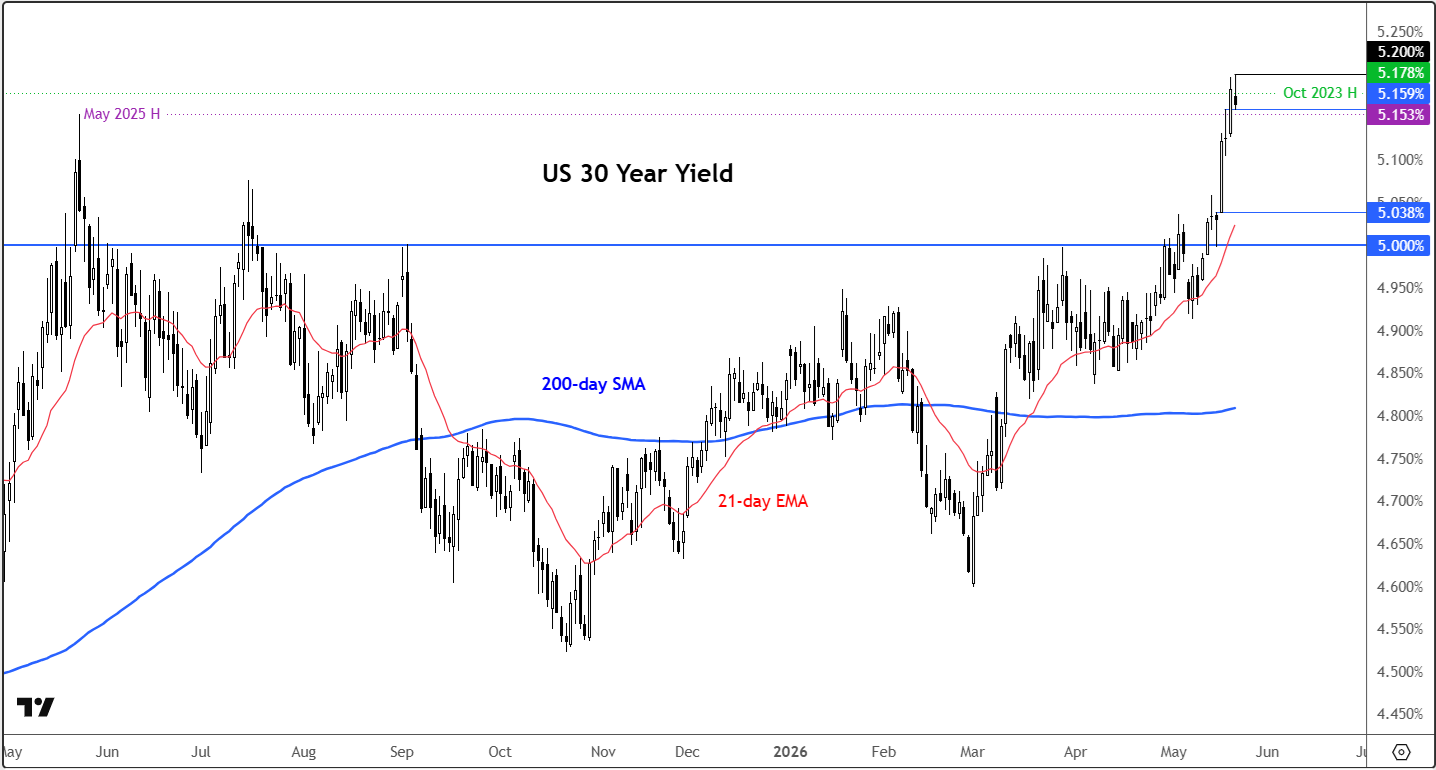
The US 30-year Treasury yield briefly climbed to 5.20% today, its highest level since 2007, before retreating modestly alongside softer oil prices. But the broader trend remains troubling. Before the escalation of the US-Iran war, markets had been moving steadily towards a softer inflation outlook, with markets pricing in further easing of US monetary policy. But roughly three months later, yields soared due to a substantial repricing and all to do with the closure of the Strait of Hormuz.
Share this:

The US 30-year Treasury yield briefly climbed to 5.20% today, its highest level since 2007, before retreating modestly alongside softer oil prices. But the broader trend remains troubling. Before the escalation of the US-Iran war, markets had been moving steadily towards a softer inflation outlook, with markets pricing in further easing of US monetary policy. But roughly three months later, yields soared due to a substantial repricing and all to do with the closure of the Strait of Hormuz. Even so, US technology stocks have surged higher, and the Nasdaq 100 has only recently pulled back from its all-time highs again. But the risk of a deeper correction is there now with yields surging. Any correction in the equity markets should provide further support to safe haven US dollar.
Iran conflict could drag on as US Senate advances measure to limit Trump's Iran war powers
Initially, investors believed the conflict would remain contained and that disruption to the Strait of Hormuz would prove temporary. Instead, shipping flows through one of the world’s most important energy corridors remain severely restricted, keeping energy markets under sustained pressure. For as long as this remains the case, the path of least resistance for yields and the dollar will remain to the upside.
The pressure is certainly growing on Trump after the Senate approved a procedural vote yesterday related to a war powers resolution. If this is adopted, the war powers resolution would severely restrict Trump’s war powers in Iran. This only increases Iran’s negotiation powers, which may mean even a longer stalemate in the situation and much higher energy prices.
Inflation pressures are feeding back into rates markets
With crude oil holding at these elevated levels for an extended period, both inflation and inflation expectations have moved sharply higher once again. Producer price inflation in the US has accelerated to 6.0%, while consumer inflation has climbed to 3.8%, both reaching their highest levels since 2023. When inflation becomes more persistent, lenders demand higher long-term yields to compensate for the erosion of purchasing power. This should mean even higher bond yields, which is bad news for risk and good for the dollar.
Inflation could accelerate further in the coming months. Jet fuel prices have surged, meaning higher plane ticket prices. Meanwhile petrol costs remain elevated too which is very bad for the US consumer reliant on private transport - that’s almost everyone. And then you have fertiliser prices soaring sharply, which will eventually work their way through food prices. So, supply chains and consumer prices alike will feel the pressure which should be bad news for everyone.
This is turn means that the fiscal backdrop in the United States continues to deteriorate. Treasury issuance is increasing rapidly at precisely the same moment investors are demanding higher compensation to hold longer-dated debt.
The combination is difficult for bond markets to absorb smoothly. Not only will mortgage rates go up for consumers, but the debt servicing costs will increase sharply for the government, which would need to be financed by issuance of even more debt at even higher yields, or by reducing budgets of other sectors of the economy.
But it is not just US bond yields rising. We have seen a big shift in global yields as a result of the Iran conflict.

It is a messy situation to say the least.
Will markets force Trump to accept a bad deal to end the conflict?
As mentioned, the bond markets are approaching uncomfortable territory. Last year, yields were rising sharply when Trump unleashed tariffs, before he paused those and eventually settled for much lower rates. Now with yields rising to similar levels and higher in the case of 30-year, this raises an increasingly important question for investors: how high can yields realistically rise before Trump TACOs? Sustained yields above 5% would place growing strain on both public and private sector finances, raising risks of stagflation and potentially downgrading of US credit ratings. The pressure is certainly building, but will Trump do anything about it just yet?

Source for all charts used in this article: TradingView.com
-- Written by Fawad Razaqzada, Market Analyst
Follow Fawad on Twitter @Trader_F_R
Latest market news



Open an account in minutes
Experience award-winning platforms with fast and secure execution, and enjoy tight spreads from 0.5 pts on FX and 0.3 pts on indices.
Economic calendar
Web Trader platform
Our sophisticated web-based platform is packed with features.
Related articles
USD/JPY Weekly Outlook: Volatility Has Left the Building
The yen has ignored broad dollar weakness, falling Treasury yields and renewed market turbulence. Yet its relationship with US interest rates remains intact. So why is USD/JPY going absolutely nowhere fast?
Gold Analysis: XAU/USD Ends the Week Without a Clear Trend
The trading week is coming to an end, and a sense of neutrality remains evident around gold's short-term price action. Over the last five trading sessions, the metal has posted a move of barely -0.3%, a situation that continues to highlight a growing phase of indecision and reflects a clear lack of direction across the market.

Swiss Franc Forecast: USD/CHF Seven-Week Rally Reverses From Yearly Highs 10 16 2026
A sharp rejection from fresh highs has shifted momentum in favor of USD/CHF bears, raising the stakes for a critical support test.

This report is intended for general circulation only. It should not be construed as a recommendation, or an offer (or solicitation of an offer) to buy or sell any financial products. The information provided does not take into account your specific investment objectives, financial situation or particular needs. Before you act on any recommendation that may be contained in this report, independent advice ought to be sought from a financial adviser regarding the suitability of the investment product, taking into account your specific investment objectives, financial situation or particular needs.
StoneX Financial Pte. Ltd., may distribute reports produced by its respective foreign entities or affiliates within the StoneX group of companies or third parties pursuant to an arrangement under Regulation 32C of the Financial Advisers Regulations. Where the report is distributed to a person in Singapore who is not an accredited investor, expert investor or an institutional investor (as defined in the Securities Futures Act), StoneX Financial Pte. Ltd. accepts legal responsibility to such persons for the contents of the report only to the extent required by law. Singapore recipients should contact StoneX Financial Pte. Ltd. at 6826 9988 for matters arising from, or in connection with the report.
In the case of all other recipients of this report, to the extent permitted by applicable laws and regulations neither StoneX Financial Pte. Ltd. nor its associated companies will be responsible or liable for any loss or damage incurred arising out of, or in connection with, any use of the information contained in this report and all such liability is hereby expressly disclaimed. No representation or warranty is made, express or implied, that the content of this report is complete or accurate.
StoneX Financial Pte. Ltd. is not under any obligation to update this report.
Trading CFDs carries a high level of risk that may not be suitable for some investors. Consider your investment objectives, level of experience, financial resources, risk appetite and other relevant circumstances carefully. The possibility exists that you could lose some or all of your investments, including your initial deposits. If in doubt, please seek independent expert advice. Visit www.forex.com/en-sg/terms-and-policies for the complete Risk Disclosure Statement.