





EUR/USD Forecast: The Euro Retreats Amid New Central Bank Outlooks
At the start of the new trading week, the EUR/USD began to lose ground with a decline of about 0.6%, as markets digest the implications of the Jackson Hole Symposium and the shifting expectations around central banks.
Share this:

At the start of the new trading week, the EUR/USD began to lose ground with a decline of about 0.6%, as markets digest the implications of the Jackson Hole Symposium and the shifting expectations around central banks. For now, uncertainty over the direction of monetary policy has drained the euro of its bullish momentum, and as long as this uncertainty persists, a neutral bias may continue to dominate in the coming sessions.
What’s Next for Central Banks?
Comments from Christine Lagarde reflected a highly neutral tone regarding the outlook for the European Central Bank (ECB). At Jackson Hole, she stressed the need to continue monitoring key economic indicators and highlighted the role of migration in supporting recovery after the pandemic, which has contributed to stability in economic data. She also noted that high interest rates have helped bring inflation down to a point where a neutral stance could now be appropriate in the short term.
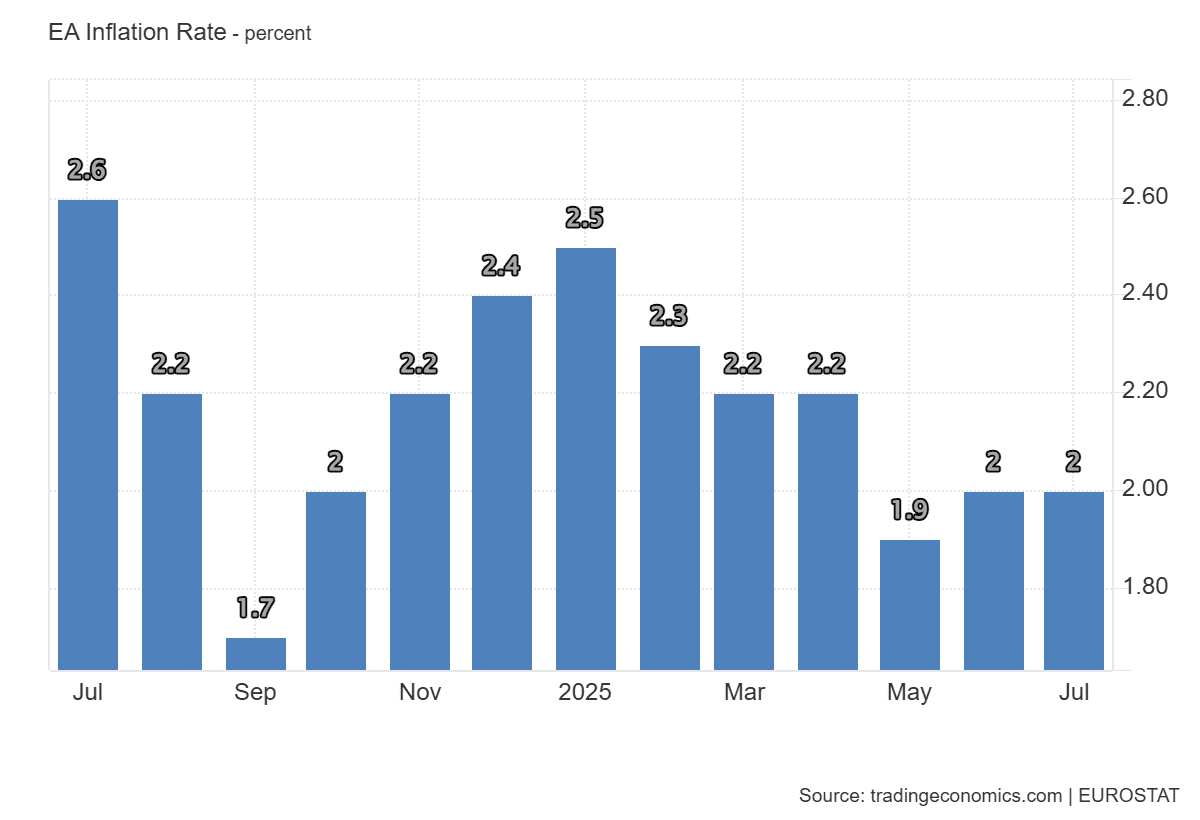
Recent data supports this view: the July annual CPI in Europe stood at 2%, in line with the ECB’s target. This reinforces Lagarde’s message that inflation is no longer the primary concern in the short term.
Source: TradingEconomics
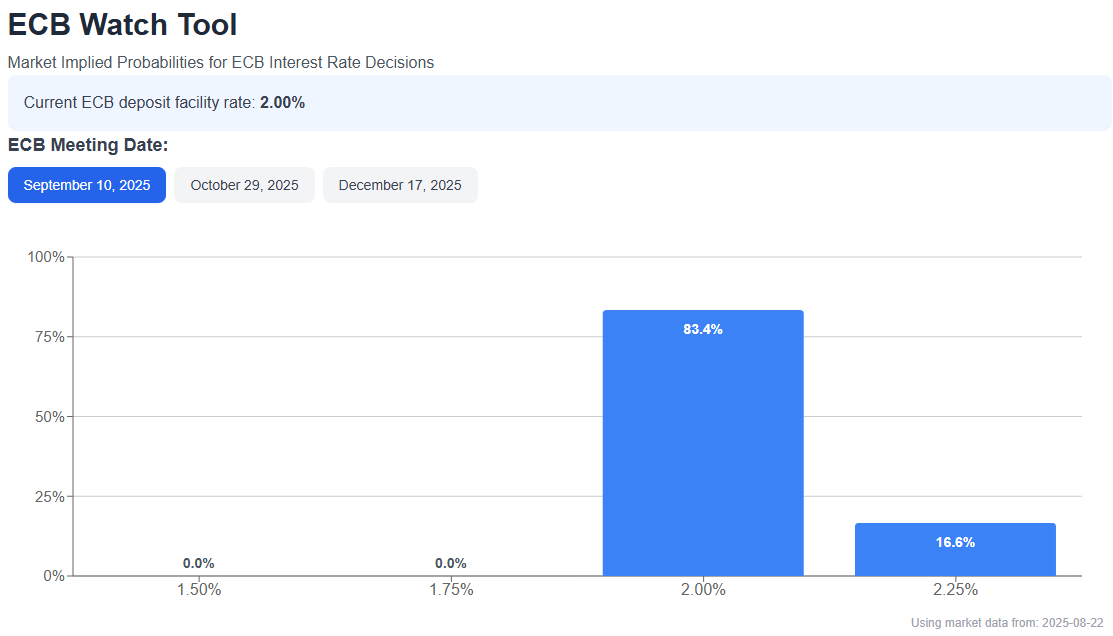
In line with this, expectations suggest the ECB will hold policy steady. Current probability models show an 83.4% chance that at the next meeting, scheduled for September 10, the deposit rate will remain at 2.00%, further consolidating the neutral stance in the short term.
Source: TradingEconomics
The biggest surprise, however, came from the United States. At Jackson Hole, it was suggested that inflation is becoming more contained and that employment and economic activity are now the Fed’s priority. This represents a shift in outlook, with the central bank potentially adopting a more flexible stance to reduce debt costs and stimulate consumption. Under this scenario, markets are considering that 2025 could mark the start of the first cycle of rate cuts by the Federal Reserve.
According to CME Group data, there is now an 86.3% probability that at the September 17 meeting, the Fed will begin cutting rates, lowering the benchmark from 4.5% to 4.25%. This would be the first confirmed shift toward a dovish outlook this year.
At the end of last week, the euro gained momentum on expectations that the Fed would finally move toward rate cuts. However, as this new week began, speculation has eased, and investors are now more focused on how both central banks’ new dynamics will play out. It’s worth noting that a significant divergence in interest rates remains: the U.S. holds at 4.5% while the ECB deposit rate stands at 2%, keeping dollar-denominated investments attractive and helping the dollar strengthen early this week. Still, with the Fed turning more dovish and the ECB holding neutral, the rate gap could narrow, reducing the appeal of U.S. fixed income and potentially supporting buying pressure on the euro in the weeks ahead.
EUR/USD Technical Outlook
Source: StoneX, Tradingview
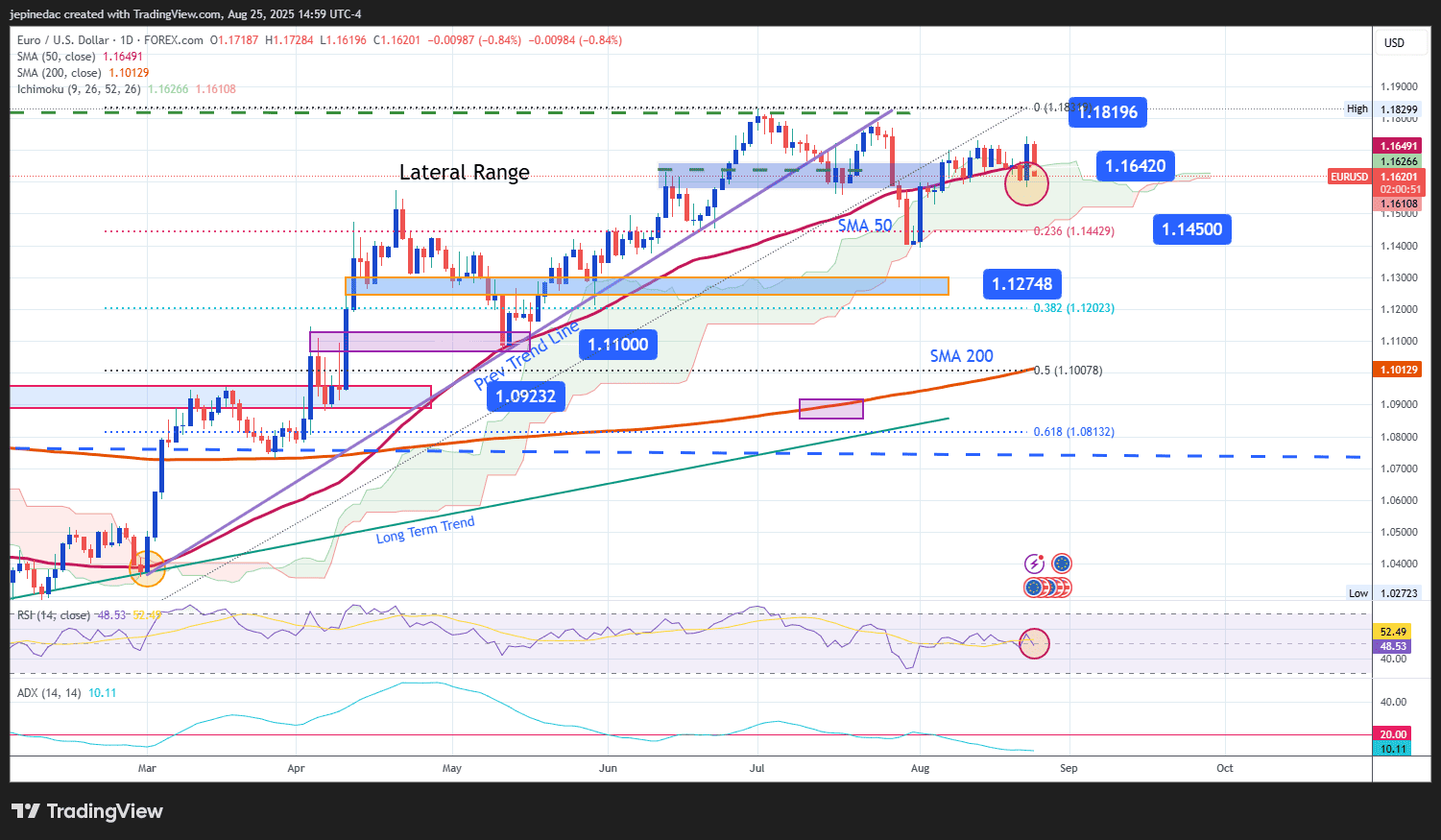
- Neutral Bias Persists: In recent weeks, EUR/USD has established a sideways range between 1.18196 as resistance and 1.1450 as support. Price action has not been strong enough to break out of this range, keeping neutrality as the prevailing short-term scenario.
- RSI: continues to hover around the neutral 50 level, signaling an ongoing balance between buyers and sellers. This suggests the sideways range could persist in the short term.
- ADX: remains below 20, showing that volatility is low on average. This supports the view that neutrality could dominate in upcoming sessions.
Key Levels:
- 1.18196 – Relevant Resistance: corresponds to this year’s highs and represents the most important barrier for buyers. A sustained breakout above this level would open the door to new highs and confirm a stronger bullish trend.
- 1.16420 – Near-Term Support: aligned with the 50-period SMA and the Ichimoku cloud, making it the most important short-term support. A breakdown here could trigger a more dominant bearish bias.
- 1.1450 – Critical Support: corresponds to the 23.6% Fibonacci retracement and represents the most important floor. A drop toward this level could confirm a structural shift into a more defined bearish trend.
Written by Julian Pineda, CFA – Market Analyst
Follow him: @julianpineda25




Open an account in minutes
Experience award-winning platforms with fast and secure execution, and enjoy tight spreads from 0.5 pts on FX and 0.3 pts on indices.
Economic calendar
Web Trader platform
Our sophisticated web-based platform is packed with features.
Related articles
What Stretched 10-Year Yields Mean for Major Currency Pairs in Q4
U.S. 10-year Treasury yields are nearing a long-term resistance zone with overbought RSI readings, raising near-term pullback risk for the dollar.

NFP Preview: Can the Jobs Report Overcome the Bond Market Meltdown Too?
Traders and economists expect the NFP report to show that the US created 90K net new jobs, with average hourly earnings rising 0.3% m/m (3.1% y/y) and the U3 unemployment rate at 4.1% - see what the leading indicators are suggesting!


EUR/USD, GBP/USD Outlook: RSI Hits 2020 Oversold Levels
EUR/USD, GBP/USD Outlook: The EUR/USD daily RSI has fallen to oversold levels last seen in 2020, raising the risk of a reversal across correlated currency pairs, including the US dollar and GBP/USD.
This report is intended for general circulation only. It should not be construed as a recommendation, or an offer (or solicitation of an offer) to buy or sell any financial products. The information provided does not take into account your specific investment objectives, financial situation or particular needs. Before you act on any recommendation that may be contained in this report, independent advice ought to be sought from a financial adviser regarding the suitability of the investment product, taking into account your specific investment objectives, financial situation or particular needs.
StoneX Financial Pte. Ltd., may distribute reports produced by its respective foreign entities or affiliates within the StoneX group of companies or third parties pursuant to an arrangement under Regulation 32C of the Financial Advisers Regulations. Where the report is distributed to a person in Singapore who is not an accredited investor, expert investor or an institutional investor (as defined in the Securities Futures Act), StoneX Financial Pte. Ltd. accepts legal responsibility to such persons for the contents of the report only to the extent required by law. Singapore recipients should contact StoneX Financial Pte. Ltd. at 6826 9988 for matters arising from, or in connection with the report.
In the case of all other recipients of this report, to the extent permitted by applicable laws and regulations neither StoneX Financial Pte. Ltd. nor its associated companies will be responsible or liable for any loss or damage incurred arising out of, or in connection with, any use of the information contained in this report and all such liability is hereby expressly disclaimed. No representation or warranty is made, express or implied, that the content of this report is complete or accurate.
StoneX Financial Pte. Ltd. is not under any obligation to update this report.
Trading CFDs carries a high level of risk that may not be suitable for some investors. Consider your investment objectives, level of experience, financial resources, risk appetite and other relevant circumstances carefully. The possibility exists that you could lose some or all of your investments, including your initial deposits. If in doubt, please seek independent expert advice. Visit www.forex.com/en-sg/terms-and-policies for the complete Risk Disclosure Statement.