





Nasdaq 100 forecast: Trump torpedoes equities with tariff threats
Nasdaq 100 forecast darkens after Trump’s latest tariff threats spark sharp market sell-off. The US president targets Apple and the EU in a double-barrelled trade offensive. Meanwhile, fiscal uncertainty compounds the pressure on risk assets.
Share this:
- Nasdaq 100 forecast darkens after Trump’s latest tariff threats spark sharp market sell-off
- Trump targets Apple and the EU in a double-barrelled trade offensive
- Fiscal uncertainty compounds the pressure on risk assets
The markets were in a fragile state to begin with – and now they’ve been hit by a full-blown geopolitical squall. US index futures were already facing headwinds from the recent rise in bond yields, but the latest salvo from Donald Trump sent them into a tailspin. Pre-market trading saw a sharp decline in Apple shares and major US indices after the US president took to social media with threats that could upend global trade dynamics. The latest developments darkens the Nasdaq 100 forecast again.
Trump reignites trade war fears
It all began suddenly, with a warning shot aimed squarely at Apple. Trump declared that unless iPhones sold in the United States are made domestically, a 25% tariff would be imposed. That was enough to rattle investors – but what came next turned a market stumble into a rout.
Moments later, Trump recommended a 50% tariff on all EU imports starting June 1. The reaction was swift and brutal: Germany’s DAX shed more than 500 points, and US index futures followed suit. Whatever optimism had been priced in around trade resolutions evaporated in seconds.
Here’s what Trump posted first:
"I have long ago informed Tim Cook of Apple that I expect their iPhone’s that will be sold in the United States of America will be manufactured and built in the United States, not India, or anyplace else. If that is not the case, a Tariff of at least 25% must be paid by Apple to the U.S. Thank you for your attention to this matter!"
Then came the EU broadside:
"The European Union, which was formed for the primary purpose of taking advantage of the United States on TRADE, has been very difficult to deal with..."
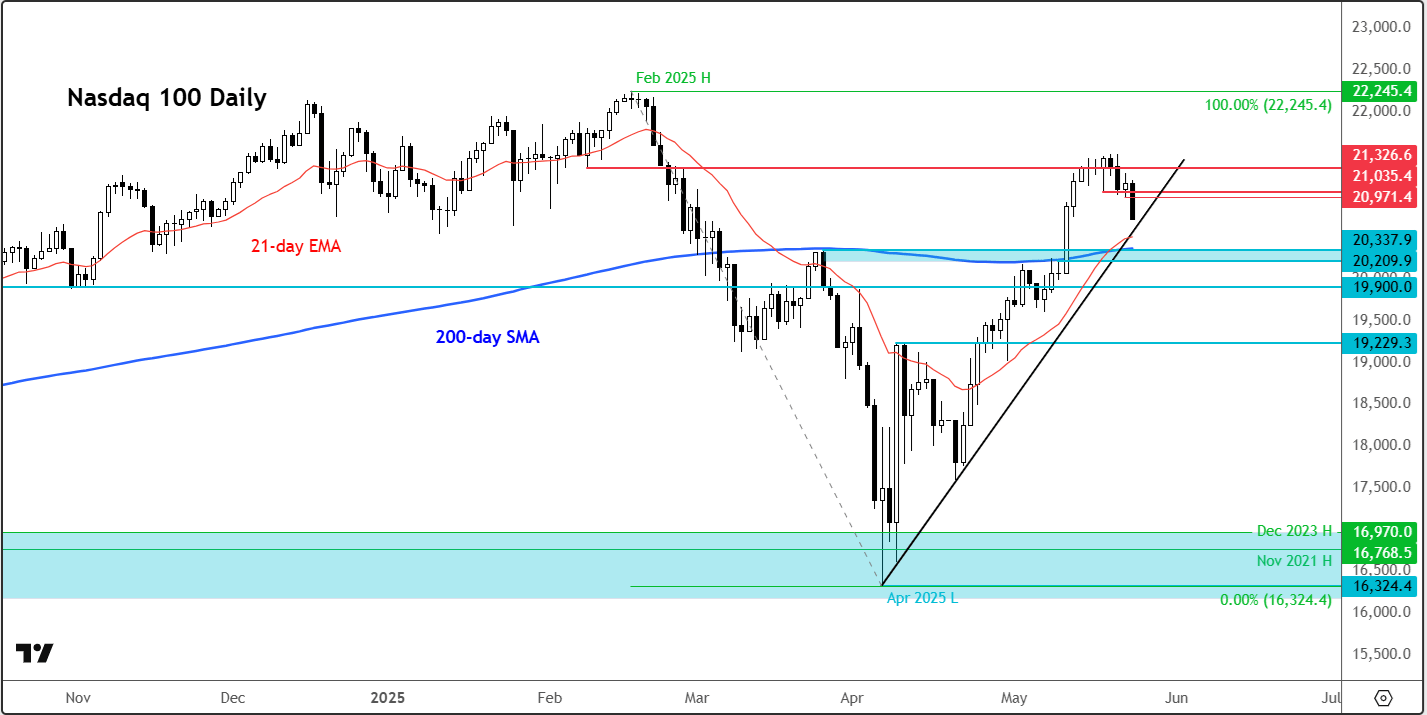
Markets, already skittish, buckled further under the weight of this renewed belligerence. The Nasdaq 100, which had recently enjoyed a 30% rebound from its April lows, found itself at a crossroads. What was previously regarded as a healthy breather in the uptrend may now mark the start of a more meaningful downturn.
Bond markets still casting a long shadow
Meanwhile, longer-dated US Treasuries managed to regain a bit of composure on haven flows, but this failed to offer any relief to risk assets. Should the bond sell-off resume – and there’s every reason to think it might – then yields will push higher, amplifying the strain on equities, especially those with lofty valuations like the tech-heavy Nasdaq 100.
The broader issue remains America’s unsustainable fiscal trajectory. Without a fundamental rethink of spending and taxation, the market is left contending with rising borrowing costs, widening deficits, and – inevitably – greater volatility. Trump’s latest tariff tirades may well be the spark.
Nasdaq 100 forecast: Caution replaces confidence
Source: TradingView.com
From a technical standpoint, our US Tech 100 chart, which is derived from the underlying Nasdaq 100 futures, had looked fairly resilient until this week. Despite pulling back slightly, the trend had remained broadly bullish, supported by strong momentum and higher lows. However, Thursday’s engulfing candle and today’s sell-off change the complexion of things.
This week’s earlier support at 20,970 - 21,035 region is now broken, so a deeper drop towards the trend line support has now started. Below the trend line, the 20,210–20,335 region – where the 200-day moving average also comes into play – is well within reach. Should that give way, the psychologically significant 20,000 level will come into play.
On the upside, bulls must reclaim the 20,970 - 21,035 range in the coming days and week to reassert control. Only then can we talk credibly about a push towards this week’s highs or even a new record high at 22,425. For now, however, the Nasdaq 100 forecast leans more defensive than optimistic.
-- Written by Fawad Razaqzada, Market Analyst
Follow Fawad on Twitter @Trader_F_R
How to trade with City Index
You can trade with City Index by following these four easy steps:
- Open an account, or log in if you’re already a customer
• Open an account in the UK
• Open an account in Australia
• Open an account in Singapore
- Search for the company you want to trade in our award-winning platform
- Choose your position and size, and your stop and limit levels
- Place the trade
Related tags:
Latest market news




Open an account in minutes
Experience award-winning platforms with fast and secure execution, and enjoy tight spreads from 0.5 pts on FX and 0.3 pts on indices.
Economic calendar
Web Trader platform
Our sophisticated web-based platform is packed with features.
Related articles
Gold weekly outlook: XAU/USD holds above $4,000 despite strong US jobs data
Gold has held above $4,000 despite a much stronger-than-expected October jobs report. Fawad Razaqzada explains why lower yields and the tech sell-off have supported the metal, and why next week's US CPI could decide its next move.
Australian Dollar Short-term Outlook: AUD/USD 3% Plunge Puts Multi-Month Range at Risk 11 6 2026
A sharp equity-led selloff has driven AUD/USD toward critical June-low support, with strong NFP data adding pressure ahead of next week’s U.S. CPI.

Nasdaq 100 forecast: Tech stocks rebound but AI concerns linger
The Nasdaq 100 rebound has run into former support as fears over AI regulation and spending linger. Fawad Razaqzada explains why he maintains a cautious forecast and where the key levels sit.
This report is intended for general circulation only. It should not be construed as a recommendation, or an offer (or solicitation of an offer) to buy or sell any financial products. The information provided does not take into account your specific investment objectives, financial situation or particular needs. Before you act on any recommendation that may be contained in this report, independent advice ought to be sought from a financial adviser regarding the suitability of the investment product, taking into account your specific investment objectives, financial situation or particular needs.
StoneX Financial Pte. Ltd., may distribute reports produced by its respective foreign entities or affiliates within the StoneX group of companies or third parties pursuant to an arrangement under Regulation 32C of the Financial Advisers Regulations. Where the report is distributed to a person in Singapore who is not an accredited investor, expert investor or an institutional investor (as defined in the Securities Futures Act), StoneX Financial Pte. Ltd. accepts legal responsibility to such persons for the contents of the report only to the extent required by law. Singapore recipients should contact StoneX Financial Pte. Ltd. at 6826 9988 for matters arising from, or in connection with the report.
In the case of all other recipients of this report, to the extent permitted by applicable laws and regulations neither StoneX Financial Pte. Ltd. nor its associated companies will be responsible or liable for any loss or damage incurred arising out of, or in connection with, any use of the information contained in this report and all such liability is hereby expressly disclaimed. No representation or warranty is made, express or implied, that the content of this report is complete or accurate.
StoneX Financial Pte. Ltd. is not under any obligation to update this report.
Trading CFDs carries a high level of risk that may not be suitable for some investors. Consider your investment objectives, level of experience, financial resources, risk appetite and other relevant circumstances carefully. The possibility exists that you could lose some or all of your investments, including your initial deposits. If in doubt, please seek independent expert advice. Visit www.forex.com/en-sg/terms-and-policies for the complete Risk Disclosure Statement.