


USD/JPY forecast: hot US CPI lifts the pair above its 200-day average
Hotter-than-expected US inflation has pushed USD/JPY above its 200-day moving average, putting 160 and the risk of Bank of Japan intervention back in focus. The breakout still needs to hold, and a failure could send the pair sharply lower.
Share this:

The USD/JPY has broken above its 200-day moving average after a hotter-than-expected US inflation report revived bets on further Federal Reserve rate hikes. The pair had spent several sessions coiling just beneath that average ahead of the data, and the CPI release has now supplied the catalyst, lifting Treasury yields and the dollar alike. With the breakout under way and 160.00 back in view, the near-term USD/JPY forecast is tilted to the upside.
- USD/JPY clears its 200-day moving average as hot CPI revives Fed hike bets.
- Higher Treasury yields keep the dollar supported against the yen.
- 160.00 is the next big test, and the level where the Bank of Japan may step in.
Watch the Full Video
Before turning to what the CPI numbers mean for the Fed and the Bank of Japan, let's have a quick look at the chart first.
Technical USD/JPY forecast and key levels to watch
From a technical analysis point of view, the picture has improved now that USD/JPY has pushed above the 200-day moving average and taken out the highs of its recent range. That said, the pair is not out of the woods just yet. The 200-day, those range highs and prior support all converge in the same zone, and USD/JPY needs to climb clear of it to confirm the breakout. If it does, a run towards the 160.00 handle is on the cards. A failed breakout, on the other hand, would carry more weight. Slip back below and a sharp move towards 157.00, possibly even 155.00, could follow in the days and weeks ahead.
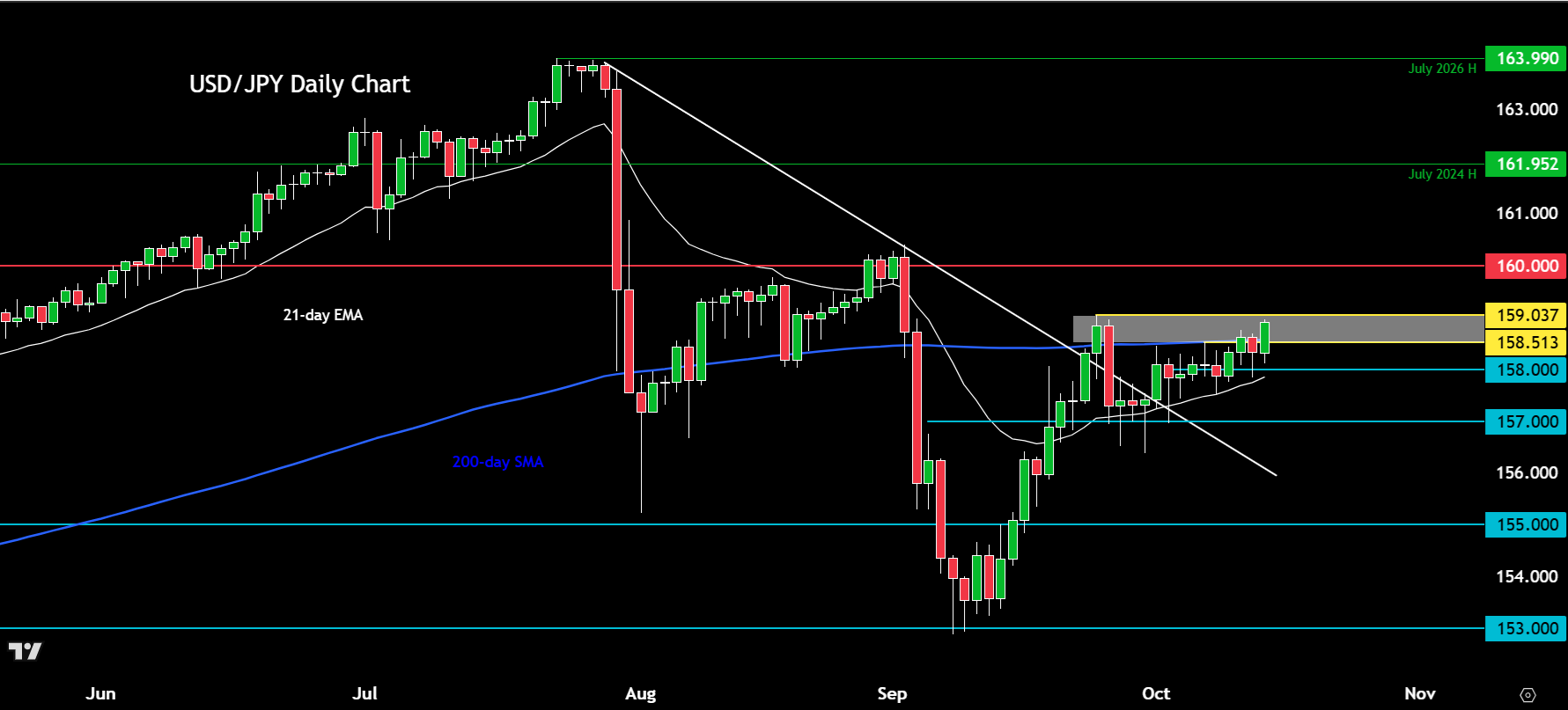
Much for the USD/JPY currency pair will now hinge on how far the market is prepared to push Fed pricing, and on how much yen weakness Tokyo is willing to tolerate.
Hot CPI strengthens the case for Fed hikes
Headline CPI rose to 3.7% year-on-year in September, up from 3.4% in August and ahead of the 3.6% consensus. Core CPI also came in hotter at 2.6%, while monthly core inflation held at 0.3% rather than easing to the expected 0.2%. A 9.1% surge in gasoline prices accounts for part of the overshoot, but price rises in recreation, used cars, education, airline fares, medical care and apparel suggest the pressure is broader, and potentially stickier, than a simple energy story.
The timing could hardly have been better for USD/JPY bulls. The pair had been treading water just below its 200-day moving average for several sessions, as if waiting for a reason to move. The CPI report provided one, and that tight range now looks less like indecision and more like a market gathering itself for a breakout.
Markets price a more hawkish Fed than the Fed itself
Rate expectations have shifted sharply. Markets now see around a 45% chance of an October hike, up from just 20% before the data, and roughly 85% for December, with at least three 25-basis-point hikes priced over the next 12 months. That is a good deal more aggressive than anything the Federal Reserve has been signalling. New York Fed President John Williams, for one, expects only one more hike this year and none in 2027.
Treasury yields and the dollar have both climbed, with the 10-year yield up around 4 basis points at 5.25%, and the yen is once again bearing the brunt. If elevated oil prices and a still-resilient US economy keep inflation on the boil, the market may have to price an even steeper path, and there are several Fed speakers still to come, including Chair Kevin Warsh.
Why the 200-day moving average matters for USD/JPY
The 200-day moving average is a significant technical indicator in any market, but USD/JPY has been unusually responsive to it, reacting each time it has come into play. That is why the break above it matters, and why a swift return below it would matter just as much.
The Bank of Japan is the main obstacle near 160
The 160.00 handle is a psychologically important level, and it is where the Bank of Japan may once again step in. That makes the upside less straightforward than the chart alone would suggest, as a push towards 160.00 would put intervention risk firmly back on the table.
Barring a major intervention, though, USD/JPY could certainly head a lot higher from there. With US yields rising and the market pricing several more Fed hikes, the yen's fate rests more with Tokyo than with the market. For now, the path of least resistance remains to the upside.

Frequently Asked Questions
Why is USD/JPY rising after the US CPI report?
Headline CPI rose to 3.7% in September, ahead of the 3.6% consensus, reviving bets on further Federal Reserve rate hikes. The resulting rise in Treasury yields has helped USD/JPY break above its 200-day moving average.
Could USD/JPY reach 160?
If the pair confirms its breakout above the 200-day moving average, a run towards the 160.00 handle is on the cards. That psychologically important level is where the Bank of Japan may once again step in.
Where could USD/JPY fall if the breakout fails?
A failed breakout would carry real weight. In that case, a sharp move towards 157.00, possibly even 155.00, could follow in the days and weeks ahead.
Related tags:
Latest market news




Open an account in minutes
Experience award-winning platforms with fast and secure execution, and enjoy tight spreads from 0.5 pts on FX and 0.3 pts on indices.
Economic calendar
Web Trader platform
Our sophisticated web-based platform is packed with features.
Related articles
USD/JPY forecast: hot US CPI lifts the pair above its 200-day average
Hotter-than-expected US inflation has pushed USD/JPY above its 200-day moving average, putting 160 and the risk of Bank of Japan intervention back in focus. The breakout still needs to hold, and a failure could send the pair sharply lower.
Australian Dollar Technical Outlook: AUD/USD Trend Break Faces Immediate Test 10 14 2026
AUD/USD is trying to hold a fresh trend break as renewed selling pressure tests whether the recovery can extend beyond the recent rebound.

Dow Jones outlook: CPI, oil and yields put the rally to the test
US index futures rebounded in the first half of Wednesday’s session, along with European indices ahead of the release of US CPI. Some slightly dovish remarks from the Fed’s Williams seem to have helped sentiment a little, but whether those comments will be backed by data remains to be seen. While slightly hotter than expected inflation data shouldn’t be enough for markets to price in an October Fed hike with more than a coin flip probability, it can nonetheless reinforce expectations of further tightening later in the year.
This report is intended for general circulation only. It should not be construed as a recommendation, or an offer (or solicitation of an offer) to buy or sell any financial products. The information provided does not take into account your specific investment objectives, financial situation or particular needs. Before you act on any recommendation that may be contained in this report, independent advice ought to be sought from a financial adviser regarding the suitability of the investment product, taking into account your specific investment objectives, financial situation or particular needs.
StoneX Financial Pte. Ltd., may distribute reports produced by its respective foreign entities or affiliates within the StoneX group of companies or third parties pursuant to an arrangement under Regulation 32C of the Financial Advisers Regulations. Where the report is distributed to a person in Singapore who is not an accredited investor, expert investor or an institutional investor (as defined in the Securities Futures Act), StoneX Financial Pte. Ltd. accepts legal responsibility to such persons for the contents of the report only to the extent required by law. Singapore recipients should contact StoneX Financial Pte. Ltd. at 6826 9988 for matters arising from, or in connection with the report.
In the case of all other recipients of this report, to the extent permitted by applicable laws and regulations neither StoneX Financial Pte. Ltd. nor its associated companies will be responsible or liable for any loss or damage incurred arising out of, or in connection with, any use of the information contained in this report and all such liability is hereby expressly disclaimed. No representation or warranty is made, express or implied, that the content of this report is complete or accurate.
StoneX Financial Pte. Ltd. is not under any obligation to update this report.
Trading CFDs carries a high level of risk that may not be suitable for some investors. Consider your investment objectives, level of experience, financial resources, risk appetite and other relevant circumstances carefully. The possibility exists that you could lose some or all of your investments, including your initial deposits. If in doubt, please seek independent expert advice. Visit www.forex.com/en-sg/terms-and-policies for the complete Risk Disclosure Statement.