





USD/JPY Analysis: The Yen Regains Strength Against the Dollar Ahead of the Weekly Close
In the last two trading sessions, the Japanese yen has strengthened by more than 1.5% against the U.S. dollar and USD/JPY is falling back below the 145 yen per dollar level.
Share this:

In the last two trading sessions, the Japanese yen has strengthened by more than 1.5% against the U.S. dollar and USD/JPY is falling back below the 145 yen per dollar level. Selling pressure on the dollar has remained active, driven by a recent decline in market confidence, which has temporarily favored the yen due to its role as a short-term safe-haven asset.
Is the Yen Still a Safe Haven?
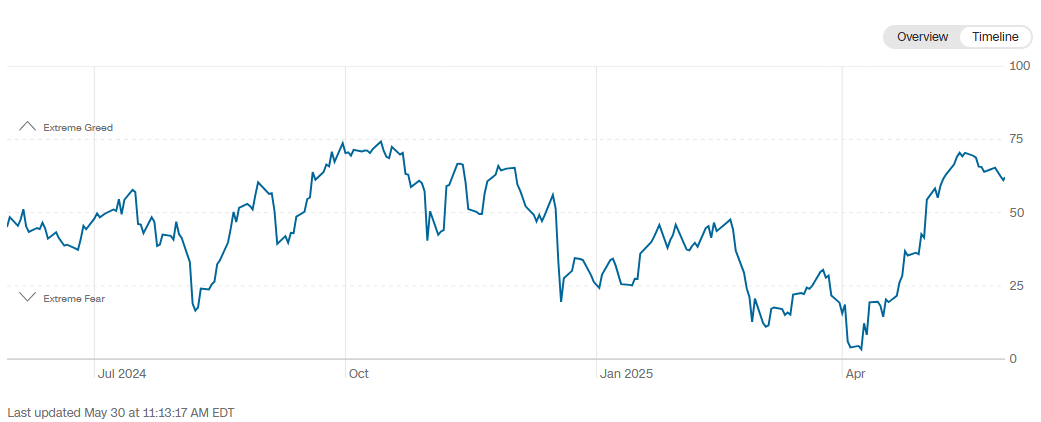
This week, key events related to the trade war have emerged. Initially, President Trump issued new threats against the European Union, and it was later revealed that the White House is facing legal hurdles in implementing its planned tariff policies. This situation has increased uncertainty about the outcome of the conflict and has already started to affect short-term market sentiment. This is evident in the recent performance of CNN’s Fear & Greed Index, which currently stands at 61 points, gradually moving closer to the “neutral” zone from prior “greed” levels. This decline may be interpreted as a broad decrease in market confidence.
Source: CNN
Given this context, it is important to highlight that the yen tends to appreciate in times of declining market confidence, reinforcing its role as a safe-haven currency. This has been reflected in the recent bearish performance of the USD/JPY pair. If sentiment continues to deteriorate, it could further strengthen buying pressure on the yen in upcoming sessions.
However, it should also be noted that Japan is facing a significant increase in public debt, which has now surpassed 200% of GDP. This extremely high level has raised concerns about the country’s fiscal stability, reducing demand for long-term bonds. While this hasn’t yet had a major impact on the yen, it could pose long-term risks to investor confidence, particularly if the government fails to present a clear solution to the debt issue in the coming weeks.
What’s Going on With Central Banks?
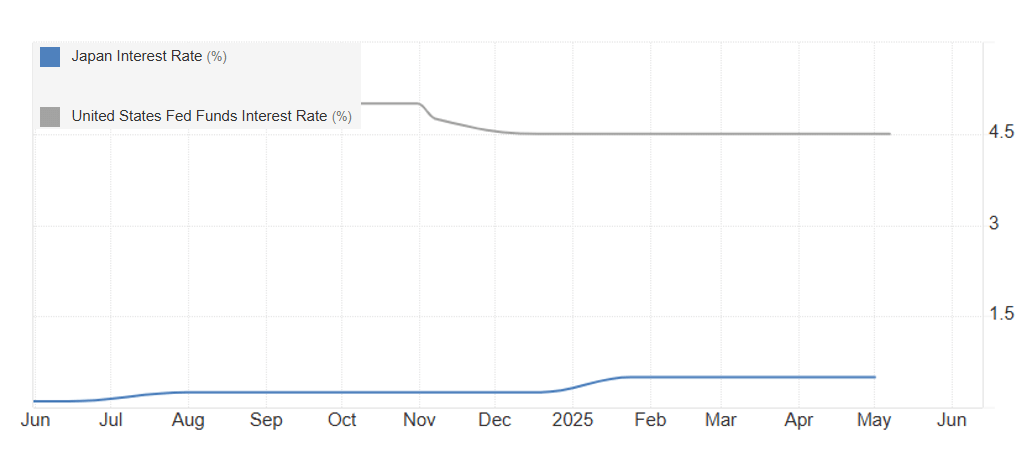
A sharp divergence remains between the interest rates set by the central banks of the United States and Japan. The Federal Reserve maintains a rate of 4.5%, while the Bank of Japan holds steady at 0.5%, marking a significant difference between the two.
Source: Trading Economics
For now, the Fed has indicated in recent statements that it will keep rates at their neutral level in the short term, while the BoJ has also suggested it may maintain a neutral stance to effectively control inflation. However, the higher yield offered by the Fed may continue to attract investment into U.S. dollar-denominated assets. If this rate divergence persists, it could boost demand for U.S. bonds as confidence stabilizes, potentially resulting in bullish pressure on the USD/JPY in the longer term.
USD/JPY Technical Outlook
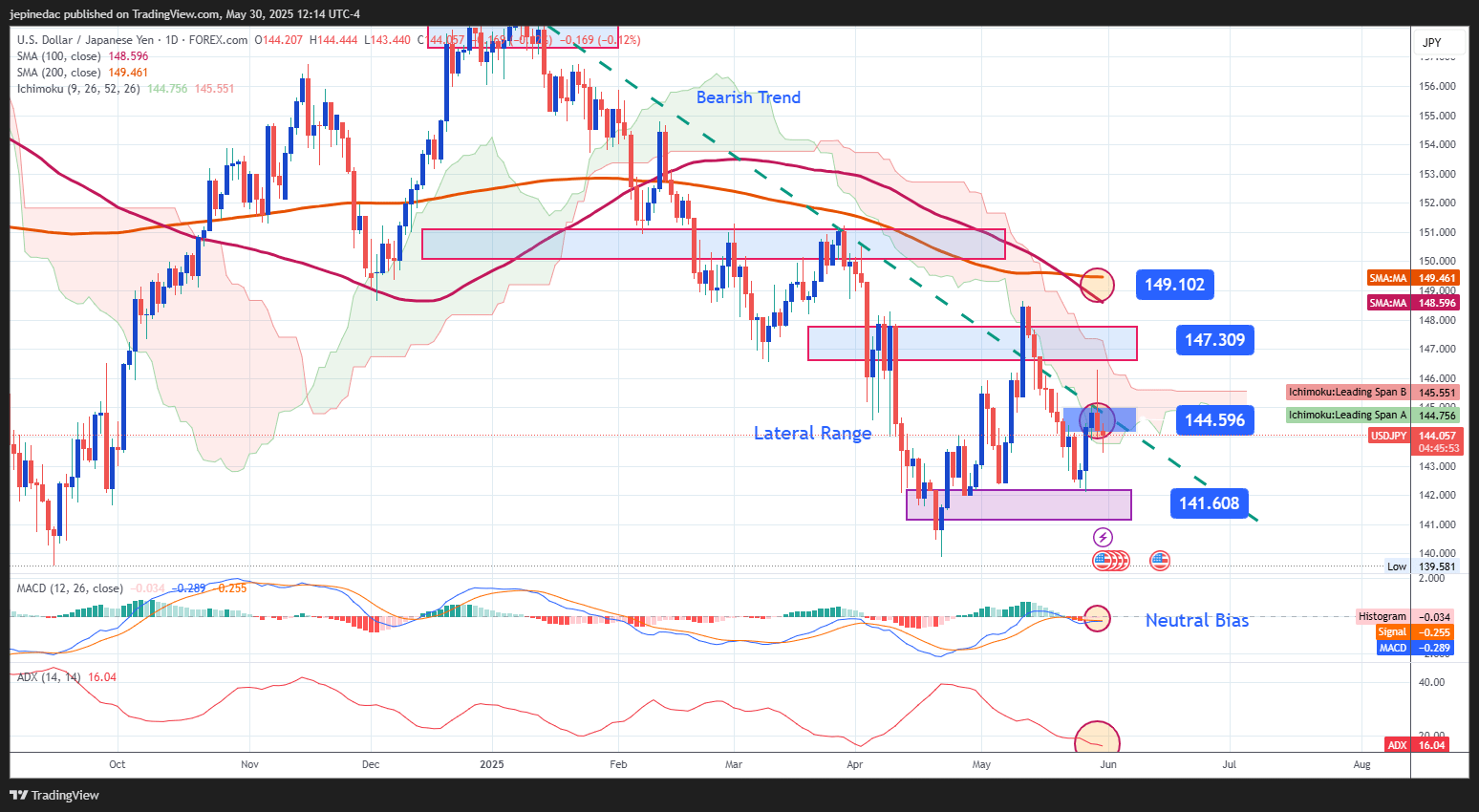
Source: StoneX, Tradingview
- Ongoing Bearish Trend: Since early January, the USD/JPY has followed a strong bearish trendline, reflecting dominant selling pressure in the long term. So far, bullish correction attempts have not been enough to break key levels, keeping the bearish trend as the most relevant technical structure. In recent sessions, the price has returned to the trendline, but it remains in a neutral zone with no clear breakout signals.
- MACD: The MACD histogram continues to hover around the zero line, indicating a lack of clear direction and reflecting uncertainty in the recent moving average momentum. This could prolong a sideways price action scenario in the short term.
- ADX: The ADX line remains below the 20 level, showing that the average volatility over the last 14 sessions has significantly decreased. This condition suggests that momentum at current resistance levels remains weak, which could continue in the coming sessions.
Key Levels:
- 144.596 – Current Barrier: This level aligns with the bearish trendline. If neutrality persists, further short-term downside corrections could occur.
- 147.309 – Major Resistance: This level marks recent highs. A breakout above it could challenge the prevailing bearish structure.
- 141.608 – Key Support: This level represents the most recent lows, consolidating as the main short-term support. A drop toward this area could reinforce the bearish trend.
Written by Julian Pineda, CFA – Market Analyst
Follow him at: @julianpineda25
Related tags:



Open an account in minutes
Experience award-winning platforms with fast and secure execution, and enjoy tight spreads from 0.5 pts on FX and 0.3 pts on indices.
Economic calendar
Web Trader platform
Our sophisticated web-based platform is packed with features.
Related articles

AUD/USD, NZD/USD face explosive CPI, RBNZ doubleheader
Aussie and Kiwi have gone remarkably quiet ahead of Australian inflation data and RBNZ decision. With substantial tightening priced and both events capable of generating major FX swings, Wednesday could deliver a volatility eruption in the antipodes.


USD/JPY bulls back in business as AI trade roars back
The AI investment boom rolls on, with Anthropic and Meta helping revive enthusiasm across Wall Street. USD/JPY has responded with a bullish reversal pattern, putting its former trading range back in focus ahead of major central bank decisions and technology earnings.

ECB Meeting Preview: EUR/USD Bears Face a Sentiment Test
Record euro shorts leave EUR/USD vulnerable to a short squeeze as traders assess ECB inflation risks, December rate hike expectations and Fed policy.

This report is intended for general circulation only. It should not be construed as a recommendation, or an offer (or solicitation of an offer) to buy or sell any financial products. The information provided does not take into account your specific investment objectives, financial situation or particular needs. Before you act on any recommendation that may be contained in this report, independent advice ought to be sought from a financial adviser regarding the suitability of the investment product, taking into account your specific investment objectives, financial situation or particular needs.
StoneX Financial Pte. Ltd., may distribute reports produced by its respective foreign entities or affiliates within the StoneX group of companies or third parties pursuant to an arrangement under Regulation 32C of the Financial Advisers Regulations. Where the report is distributed to a person in Singapore who is not an accredited investor, expert investor or an institutional investor (as defined in the Securities Futures Act), StoneX Financial Pte. Ltd. accepts legal responsibility to such persons for the contents of the report only to the extent required by law. Singapore recipients should contact StoneX Financial Pte. Ltd. at 6826 9988 for matters arising from, or in connection with the report.
In the case of all other recipients of this report, to the extent permitted by applicable laws and regulations neither StoneX Financial Pte. Ltd. nor its associated companies will be responsible or liable for any loss or damage incurred arising out of, or in connection with, any use of the information contained in this report and all such liability is hereby expressly disclaimed. No representation or warranty is made, express or implied, that the content of this report is complete or accurate.
StoneX Financial Pte. Ltd. is not under any obligation to update this report.
Trading CFDs carries a high level of risk that may not be suitable for some investors. Consider your investment objectives, level of experience, financial resources, risk appetite and other relevant circumstances carefully. The possibility exists that you could lose some or all of your investments, including your initial deposits. If in doubt, please seek independent expert advice. Visit www.forex.com/en-sg/terms-and-policies for the complete Risk Disclosure Statement.