


Bitcoin forecast: BTC/USD steadies as risk appetite returns for now
Bitcoin has steadied around 60,000 after a November slide driven by ETF outflows, weaker liquidity and regulatory doubts. Fawad Razaqzada explains why 65,000 is now the line in the sand.
Share this:

Bitcoin has steadied around the 60,000 level as risk appetite returns for now, with sellers struggling to force a sustained break below this key support. The cryptocurrency dipped under 60,000 but has held above it on a closing basis, suggesting bearish momentum may be fading. With 65,000 the line in the sand, the near-term Bitcoin forecast hangs in the balance, although a break higher would tilt it to the upside.
- Bitcoin dipped below 60,000 but has held above it on a closing basis
- A move above 65,000 could open the way to the 200-day average near 72,000
- A sustained drop below 60,000 could expose the 50,000 level next
Watch Bitcoin forecast video and insights into gold, silver and EUR/USD
Why has Bitcoin struggled this year?
Bitcoin’s struggles this year reflect a combination of shrinking market liquidity, competition for speculative capital and growing regulatory uncertainty in the US.
One of the biggest headwinds has been the withdrawal of money from the crypto ecosystem. US spot Bitcoin and Ether ETFs suffered around $3.9 billion in outflows between 30 October and 13 November, while stablecoin supply contracted by $10.7 billion following the major Binance hack in late October. Corporate buying has also slowed, with Strategy Inc. providing less support to the market. Together, these developments have weakened an important source of demand.
Bitcoin has also faced growing competition from AI-related investments and high-profile equity listings, including Anthropic’s IPO, as investors redirect capital towards other speculative opportunities.
Meanwhile, the Democratic sweep of both chambers of Congress in November’s midterm elections has raised concerns about the future of crypto-friendly legislation. In particular, progress on the CLARITY Act, which aims to establish a clearer regulatory framework for digital assets, now looks less certain.
Although Bitcoin initially rallied above $80,000 after the election, sentiment quickly deteriorated. The combination of weaker liquidity, competing investment opportunities and regulatory uncertainty has helped push Bitcoin down more than 20% in November.
But in recent trade, it has started to bounce back, raising questions whether this is merely an oversold recovery or the start of something more meaningful...
Crypto joins the recovery in risk assets
Bitcoin bounced back along with everything else on Wednesday afternoon, and held those gains on Thursday, as the sell-off in risk assets appeared to run its course. Investors have started to find value in equities, commodities and some currency pairs, and crypto has benefited from the same shift in sentiment.
A sharp fall in short-dated US rates helped, on views that the Federal Reserve may have to soften its tightening stance. Meanwhile, the dollar rally has stalled despite stronger-than-expected US data, suggesting much of the hawkishness is already priced in.
The Fed bar remains high for Bitcoin bulls
Calling a more durable recovery in Bitcoin is difficult, however. Third-quarter US growth came in at 4.3% quarter on quarter annualised, well above the 3.5% expected, while the labour market seems to be picking up and inflation is re-accelerating from levels well above target.
The Fed is therefore widely expected to hike by 25 basis points in December, with a January hike increasingly being priced in. That leaves the bar for a softer policy stance high, and Bitcoin's recovery reliant on improving risk appetite rather than help from the central bank.
Holiday trade before a big week for data
With the US out for Thanksgiving and a shortened session on Friday, Bitcoin may stay contained in the near term. Most US investors are likely to be away on Friday too, and with a thin economic calendar, big moves look unlikely. Even so, the improvement in risk appetite could support further gains.
Next week brings the ISM manufacturing PMI and JOLTS job openings on Tuesday and the ISM services PMI on Thursday, before next Friday's US jobs report. With a December hike fully priced in, the payrolls figures matter more for early 2027. Should the data come in as expected or beat, expectations of a January hike could firm up, which may weigh on risk assets, including Bitcoin. A softer reading could help the recovery gather pace.
Now let's have a look at the chart.
Technical Bitcoin forecast and key levels to watch
From a purely technical analysis point of view, the near-term Bitcoin forecast hangs in the balance despite the recovery. Bitcoin has been falling since its rally ran out of steam in September, but 60,000 has a long history as a key level. It was first tested in February, triggering a recovery that petered out around 80,000, before being retested in early June. A failed attempt to break below it in late June and early July led to a massive rally. This time, Bitcoin has dipped below 60,000, but the wicks of the recent candles show it has held its own on a closing basis, suggesting bearish momentum is fading. That, to me, shows some bullish characteristics.
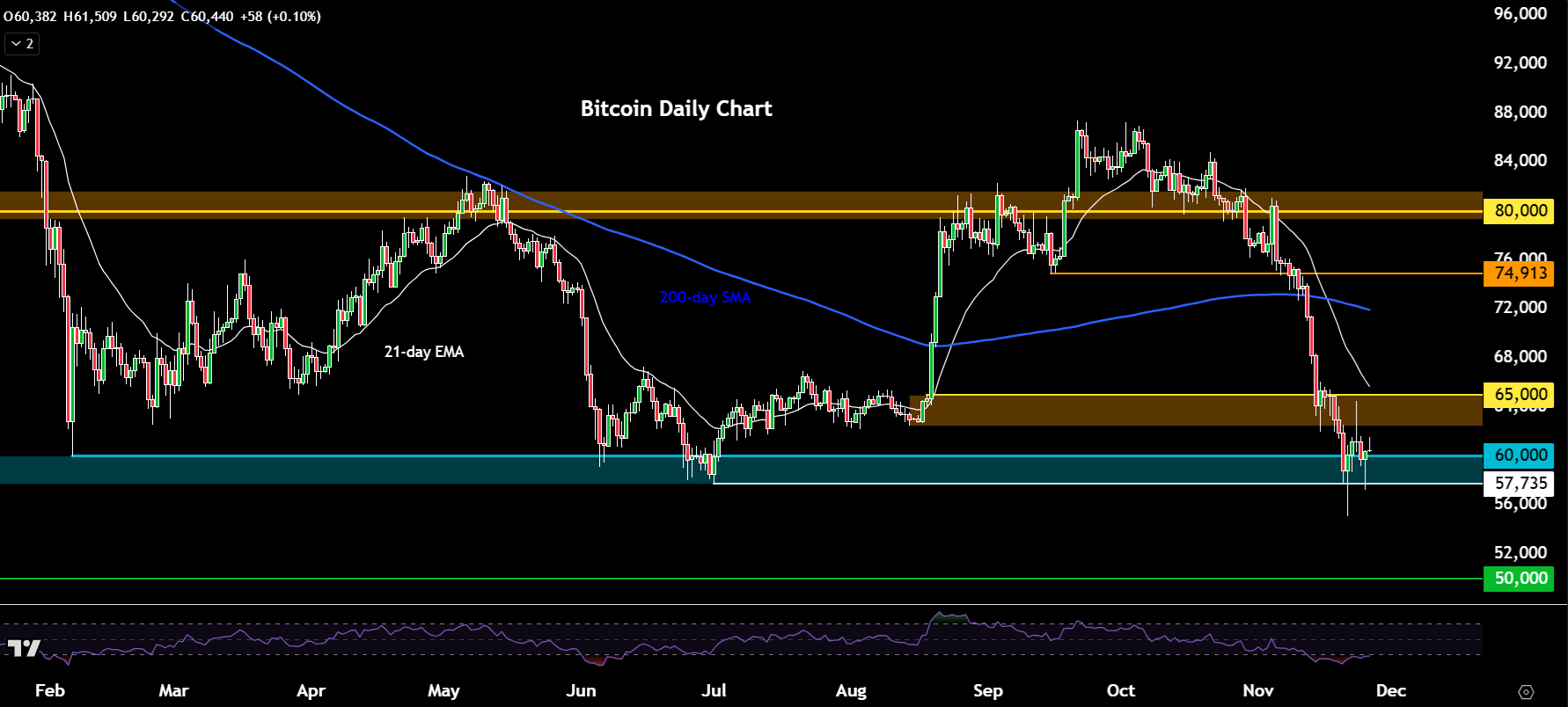
What I need to see now on BTCUSD is some upside follow-through, specifically a move above 65,000. That level was previously support and resistance, and Bitcoin was rejected after nearly testing it on Monday, but it is now pushing back up towards it. Break that and a sharp short-squeeze rally towards the 200-day average around 72,000, possibly a little higher, could be on the cards. In contrast, if Bitcoin fails to break 65,000 and then holds below 60,000, a drop to 50,000 could be the next stop in the days and weeks ahead.
Frequently Asked Questions
Will Bitcoin hold 60,000?
So far it has. Bitcoin has dipped below 60,000 but held above it on a closing basis, suggesting bearish momentum is fading around that level. A sustained move back below it could expose 50,000.
What is the line in the sand for Bitcoin?
The 65,000 level, which was previously both support and resistance. A move above it could trigger a short-squeeze rally towards the 200-day average around 72,000.
Has the Bitcoin sell-off ended?
It is too early to say. Bitcoin needs upside follow-through, specifically a break above 65,000, to suggest the worst of the selling is over and that a new bullish trend could emerge.
-- Written by Fawad Razaqzada, Market Analyst | Follow Fawad on X @Trader_F_R
Related tags:



Open an account in minutes
Experience award-winning platforms with fast and secure execution.
Economic calendar
Web Trader platform
Our sophisticated web-based platform is packed with features.
Related articles
Bitcoin forecast: BTC/USD steadies as risk appetite returns for now
Bitcoin has steadied around 60,000 after a November slide driven by ETF outflows, weaker liquidity and regulatory doubts. Fawad Razaqzada explains why 65,000 is now the line in the sand.

Gold forecast: XAU/USD steadies as the dollar rally runs out of steam
Gold has turned positive on the week after bouncing from old resistance as the dollar rally stalls. Fawad Razaqzada asks whether the daily hammer candle marks a turn or just an oversold bounce.

Iron Ore Bears Face a December Test
There's no shortage of iron ore at Chinese ports, but seasonality and price action suggest there may be better opportunities on the long side in the near term.

StoneX Financial Ltd (trading as "FOREX.com") is an execution-only service provider. This material, whether or not it states any opinions, is for general information purposes only and it does not take into account your personal circumstances or objectives. This material has been prepared using the thoughts and opinions of the author and these may change. However, FOREX.com does not plan to provide further updates to any material once published and it is not under any obligation to keep this material up to date.
This material is short term in nature and may only relate to facts and circumstances existing at a specific time or day. Nothing in this material is (or should be considered to be) financial, investment, legal, tax or other advice and no reliance should be placed on it. No opinion given in this material constitutes a recommendation by FOREX.com or the author that any particular investment, security, transaction or investment strategy is suitable for any specific person.
The material has not been prepared in accordance with legal requirements designed to promote the independence of investment research. Although FOREX.com is not specifically prevented from dealing before providing this material, FOREX.com does not seek to take advantage of the material prior to its dissemination. This material is not intended for distribution to, or use by, any person in any country or jurisdiction where such distribution or use would be contrary to local law or regulation. For further details see our full non-independent research disclaimer and quarterly summary.