
Gold came under renewed pressure in the first half of Monday’s session, alongside weakness across the major FX pairs, especially the EUR/USD. The gold weakness follows a relatively sharp two-day rally at the end of last week, which had raised hopes that the metal may finally have found a floor. For now, however, the rebound has lost some momentum, leaving the bottoming-out story far from convincing. I would still like to see confirmation from price action before turning tactically bullish on gold again, even though the longer-term fundamental case for the metal remains constructive. For now, my near-term gold forecast remains cautious as before.
Technically, gold is not yet in a convincing bullish environment with the dollar strengthening and yields remaining elevated, increasing the opportunity cost of holding a zero-yielding asset like gold. That said, it has shown some resilience despite the recent rise in bond yields and renewed strength in the US dollar. Wednesday’s US CPI report could therefore prove important in determining whether the dollar extends its rally — and whether gold can hold its recent gains, or whether it could come under renewed pressure.
Dollar and oil add fresh pressure on gold forecast
The dollar’s renewed strength is a major headwind for gold at the start of the week. Much of the move has been driven by another leg higher in oil prices, which is putting pressure on the currencies of major energy importers such as the yen, pound and euro. The euro is also being weighed down by lingering concerns over French fiscal policy.
Brent crude has climbed to $105 a barrel, testing its highest levels since mid-September. The latest move follows Iran’s rejection of a US proposal to reopen the Strait of Hormuz as insufficient, alongside an increase in attacks in the Gulf region that has disrupted supplies.
Meanwhile, hostilities between Saudi Arabia and the Houthis continue, with further attacks on Riyadh over the weekend, including one targeting a major airport. President Trump has said the US is considering joining Saudi strikes against the Houthis.
Geopolitical tensions elsewhere are also adding to the uncertainty. Ukraine’s President Volodymyr Zelensky has claimed that Russia struck a Ukrainian power plant immediately after Trump announced an energy ceasefire at the weekend.
Oil supply has also been affected by disruptions along the US Gulf Coast following Hurricane Eceas, which made landfall last week. More than 60% of regional oil production was reportedly taken offline ahead of the storm.
Gold technical analysis and key levels to watch
Gold bounced from a key technical area between $4,080 and $4,100 last week. This zone had previously acted as important support and was the launch point for the strong rally seen in early August.
Having returned to the area, gold duly found buyers last week. The question now is whether that rebound marks the beginning of a fresh bullish move or was simply a dead-cat bounce within a broader correction.
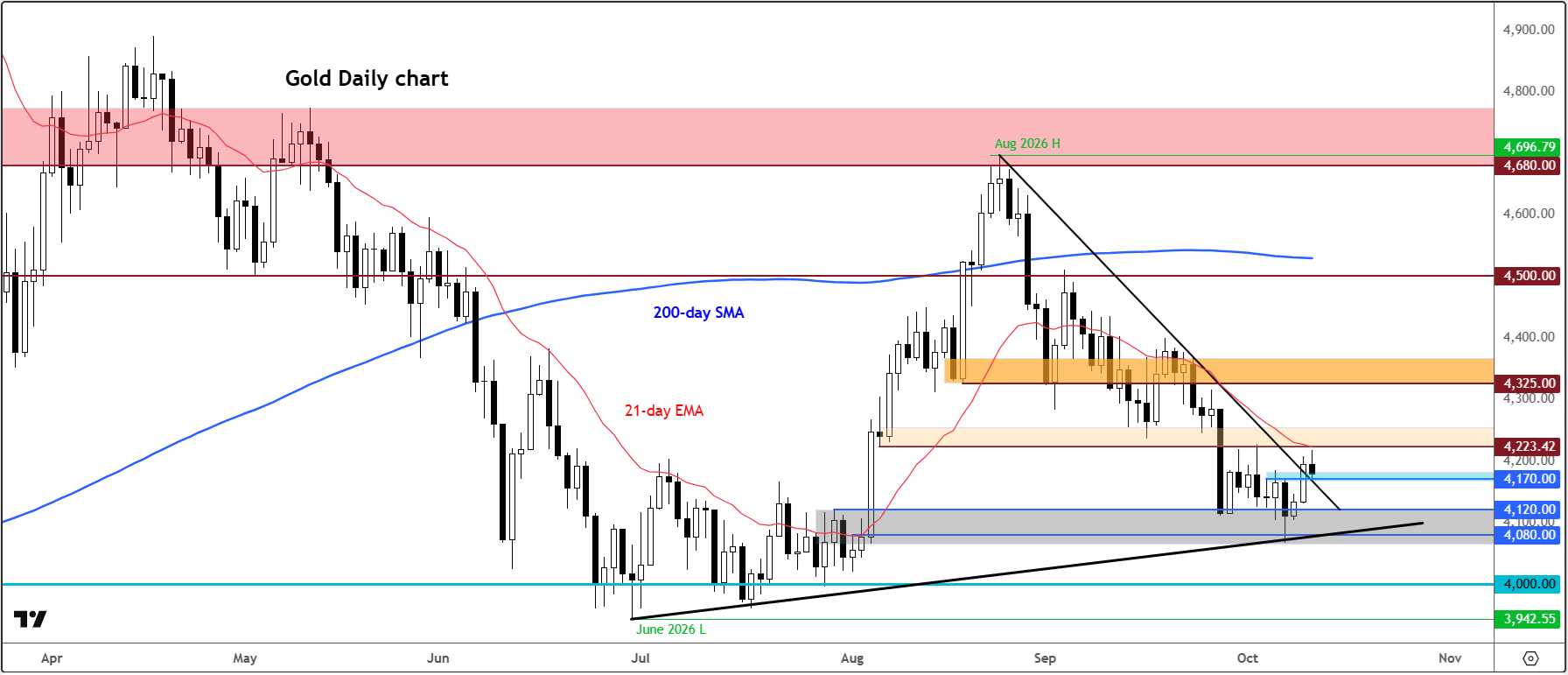
There has been one encouraging development: the gold price has broken above the short-term bearish trend line. However, the follow-through has so far been limited.
The metal remains below its 21-day exponential moving average, while resistance between $4,230 and $4,265 has held. This is the first major hurdle that needs to be cleared before I would become tactically bullish.
For now, I’m cautiously optimistic, but the dollar’s continued strength makes me reluctant to call a definitive bottom.
A break back below the $4,080–$4,100 support zone would undermine the recent recovery and open the door to further losses towards $4,000. Below that, the June low around $3,942 would come back into focus.
On the upside, a sustained break above $4,230–$4,265 would improve the technical picture considerably, potentially exposing $4,325 initially, followed by $4,400 and then $4,500.
For now, however, I would rather let price action do the talking before committing to a stronger directional view.
Gold forecast: Will the metal shrug off a stronger dollar?
Gold’s relative resilience is notable given that the dollar and bond yields have both moved higher — two factors that would normally create a difficult backdrop for the metal.
One explanation is that investors are increasingly looking beyond the immediate impact of tighter monetary policy and focusing instead on the inflation risks created by elevated oil prices. If energy costs remain high, markets may become more concerned about inflation proving sticky or even accelerating again.
That may explain why gold has held up relatively well rather than selling off more aggressively.
There are also signs of continued underlying demand. Gold-backed ETFs have continued to see inflows during the recent weakness, while central-bank buying remains an important source of support, with China continuing to accumulate gold.
In other words, the fundamental case for gold has not disappeared simply because the dollar and yields have moved higher.
US inflation and central-bank speeches in focus
The biggest near-term catalyst is likely to be US inflation data for the dollar, and by extension, gold.
September CPI is due on Wednesday, October 14, followed by PPI on Thursday. After the recent softer patch in US economic data helped take some of the sting out of the dollar and Treasury yield rally, investors will be watching closely for signs that inflation is beginning to reaccelerate.
A particularly strong CPI reading could trigger renewed volatility across markets and provide another lift for the dollar and yields, potentially putting further pressure on gold. CPI stood at 2.4% year-on-year in August.
Thursday will also bring US retail sales, jobless claims and several manufacturing surveys. Together with the inflation data, these releases should help determine the direction of the dollar for the remainder of the week, with attention then turning towards the FOMC meeting later this month.
There will also be plenty of central-bank commentary to digest. BoE Governor Andrew Bailey, ECB President Christine Lagarde and BoC Governor Tiff Macklem are due to speak on Wednesday at the IMF and World Bank annual meetings in Bangkok, followed by SNB Chairman Martin Schlegel on Thursday and Fed Chair Kevin Warsh on Friday.
For gold, the technical picture remains finely balanced. The $4,080–$4,100 area is the key line of defence, while $4,230–$4,265 remains the barrier that bulls need to overcome to turn the gold forecast bullish. Until one of those zones gives way, patience looks preferable to trying to call the next major move too early.