


S&P 500 Analysis: SPX regains confidence in Middle East de-escalation expectations
As the trading week continues to unfold, the S&P 500 has started to show a consistent recovery in short-term confidence, with the index gaining more than 2.5% during the session while attempting to sustain relatively stable buying momentum.
Share this:

As the trading week continues to unfold, the S&P 500 has started to show a consistent recovery in short-term confidence, with the index gaining more than 2.5% during the session while attempting to sustain relatively stable buying momentum. For now, short-term confidence has managed to reestablish itself, as the market has interpreted recent comments from Trump as a potential de-escalation of the conflict in the Middle East, allowing demand for equities to stabilize. If this sense of temporary security holds, buying pressure could begin to gain relevance in the coming sessions.

Hopes pinned on de-escalation
During today’s session, President Trump stated that the war against Iran “will not last much longer,” suggesting that the United States has significantly weakened the country through recent air operations. He also noted that the situation around the Strait of Hormuz could be resolved once the U.S. decides to withdraw. These remarks introduced a more optimistic tone regarding the escalation of the conflict, opening the door to potential negotiations in the short term. Even if temporary, this has helped ease market risk sentiment.
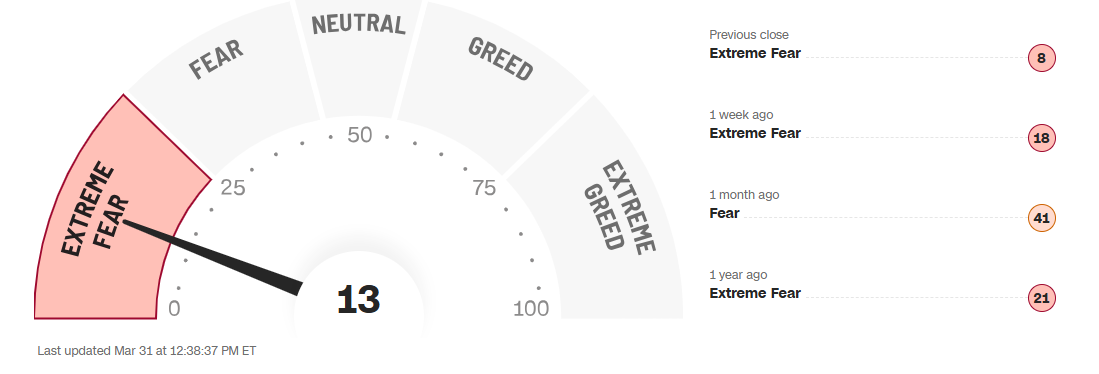
This can be seen in the CNN Fear and Greed Index, which improved from 8 points to around 13 points during the session. Although it remains in “extreme fear” territory, it shows a modest improvement in market sentiment, likely supported by recent comments from the U.S. government regarding efforts to contain the conflict in the Middle East.
Source: CNN
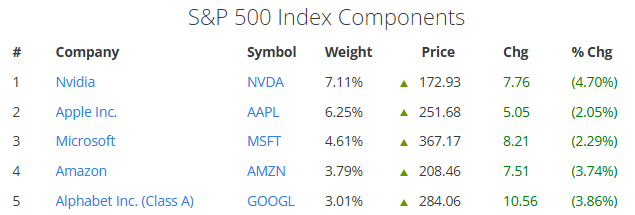
The slight rebound in confidence has allowed the main components of the SPX to post a notable short-term recovery. Nvidia is leading gains with an increase of around 4.7%, followed by Apple (2.05%), Microsoft (2.29%), Amazon (3.74%), and Google (3.86%). This reflects a temporary improvement in equity market confidence, supporting a mild bullish bias in the index.
Source: Slickcharts
In this context, SPX price action remains highly sensitive to developments in the Middle East, as this factor continues to shape overall market risk perception. As long as constructive comments persist, confidence may continue to recover in the short term, potentially translating into stronger buying pressure. However, any renewed escalation could quickly reverse recent gains and bring back a risk-off sentiment.
Long-term confidence remains fragile
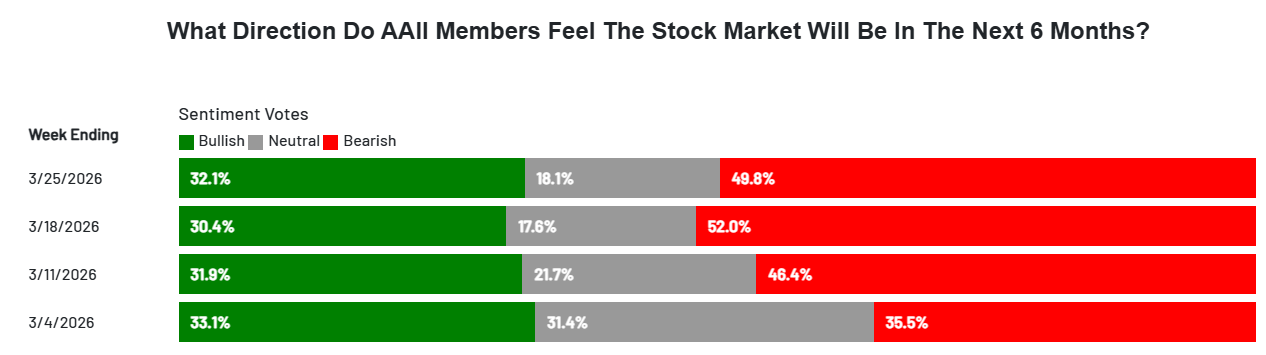
Despite the recent short-term recovery, the long-term outlook remains fragile. According to the AAII Investor Sentiment Survey, expectations for the next six months stand at 32.1% bullish, 18.1% neutral, and 49.8% bearish, suggesting that the market still does not anticipate a sustained recovery in equities.
Source: AAII
This environment could limit a structural recovery in equities, including indices like the Dow Jones, as persistent uncertainty restricts sustained demand. As long as sentiment remains skewed to the downside, the S&P 500 is likely to maintain a weaker medium-term dynamic.
S&P 500 Technical Outlook
Surce: StoneX, Tradingview
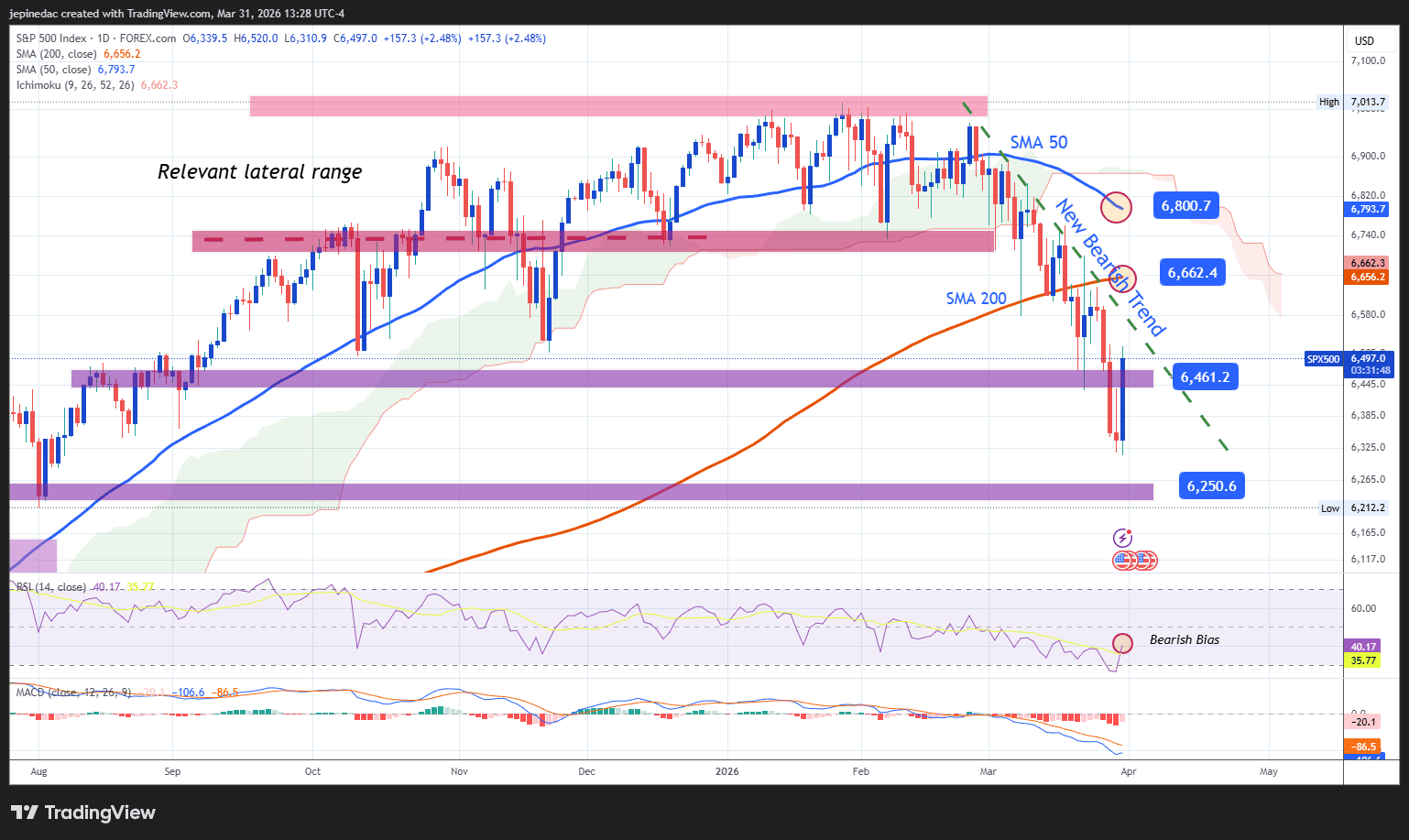
- Downtrend line remains intact: Since late February 2026, SPX price action has respected a consistent downward trendline, which continues to stand out as the most relevant technical structure. Despite the recent rebound, there has not been a strong enough move to challenge this trend, meaning the bearish structure still conditions price action in the near term.
- RSI: Despite the recent bounce, the indicator remains below the 50 neutral level, suggesting that momentum over the past 14 sessions still reflects a dominant bearish bias. Unless this level is clearly broken, downside pressure may remain relevant.
- MACD: The histogram remains below the zero line, indicating that short-term selling pressure is still significant. This reinforces the idea that the bearish bias continues to be part of SPX dynamics.
Key levels:
- 6,662 points – Key resistance: This level aligns with the 200-period simple moving average. A sustained move above it would not only invalidate the current downtrend but could also open the door for a stronger bullish bias.
- 6,461 points – Near-term barrier: A key neutral zone that has acted as a pullback area in previous months. Price action around this level could lead to a range-bound or indecisive scenario in the short term.
- 6,250 points – Key support: A level not seen since August 2025. A move toward this area could reactivate a more aggressive bearish bias and extend the current downtrend.
Written by Julian Pineda, CFA, CMT – Market Analyst
Follow him on: @julianpineda25



Open an account in minutes
Experience award-winning platforms with fast and secure execution.
Economic calendar
Web Trader platform
Our sophisticated web-based platform is packed with features.
Related articles

Nasdaq 100 forecast: Stocks rebound, but have markets found a floor?
US equities have recovered sharply after last week’s bruising sell-off, as confidence in Nvidia draws investors back into technology stocks. But a busy economic calendar, led by the November jobs report, will test whether the rebound has legs.


S&P 500, Nasdaq, Dow Forecast: Wall Street Rebound Faces Major Resistance—Bull Trap or Breakout? 11 25 2026
Wednesday’s dramatic comeback revealed stronger underlying demand, but damaged trends and lagging tech shares cloud the outlook into December.


Nasdaq 100 Analysis: Uncertainty Returns to NDX Following Tariff Announcements
Nasdaq 100 falls around 3% over two sessions after Monday's nearly 6% rally, as tariff concerns and Fed uncertainty weigh on sentiment.
StoneX Financial Ltd (trading as "FOREX.com") is an execution-only service provider. This material, whether or not it states any opinions, is for general information purposes only and it does not take into account your personal circumstances or objectives. This material has been prepared using the thoughts and opinions of the author and these may change. However, FOREX.com does not plan to provide further updates to any material once published and it is not under any obligation to keep this material up to date.
This material is short term in nature and may only relate to facts and circumstances existing at a specific time or day. Nothing in this material is (or should be considered to be) financial, investment, legal, tax or other advice and no reliance should be placed on it. No opinion given in this material constitutes a recommendation by FOREX.com or the author that any particular investment, security, transaction or investment strategy is suitable for any specific person.
The material has not been prepared in accordance with legal requirements designed to promote the independence of investment research. Although FOREX.com is not specifically prevented from dealing before providing this material, FOREX.com does not seek to take advantage of the material prior to its dissemination. This material is not intended for distribution to, or use by, any person in any country or jurisdiction where such distribution or use would be contrary to local law or regulation. For further details see our full non-independent research disclaimer and quarterly summary.