



US open: Stocks fall ahead of ISM manufacturing data
Stocks fall at the start of the new quarter as recession fears remain. Manufacturing data is due.
Share this:

US futures
Dow futures -0.4% at 30695
S&P futures -0.5% at 3775
Nasdaq futures -0.6% at 11511
In Europe
FTSE -0.25% at 7167
Dax -2% at 13034
Euro Stoxx -2.22% at 3518
A weak start to the new quarter
US stocks are pointing to a weaker start on the first day of trading in the new quarter and adding to losses from earlier in the week.
Hot inflation has fueled aggressive rate hike and recession fears hurting demand for stocks across the quarter and across the first half.
The SP&P500 fell 20% across the first half of the year in its worst start to a year since 1970 whilst the Nasdaq plunged 30% in its worst H1 performance since 2002.
The Federal Reserve is widely expected to hike interest rates by 75 basis points in its July meeting to tame inflation.
What we are starting to see is that the 10-year treasury yield is edging lower, as recession fears rise. This could help stem the selloff in equities going forwards.
Looking ahead, attention is turning to ISM manufacturing PMI, which is expected to fall to 55 in June down from 56 in May. The tick lower represents the slowing growth and deteriorating industry expectations. However, the PMI is set to remain well above 50, which separates expansion from contraction.
In corporate news:
Micron Technologies is falling after disappointing with quarterly guidance. The chip maker expects slower sales as the boom for chips could be coming to an end.
Where next for the Nasdaq?
The Nasdaq failed to retake the multi-month falling trendline resistance and rebounded lower. The fall below the 20 sma and support at 11700 keeps the bears hopeful of further downside, as does the RSI below 50. Sellers are testing support at 11490, the May low, with a break below here opening the door to 11035 the 2022 low. Buyers will look for a move over 12225, the weekly high, to create a higher high and expose the 50 sma at 12315. A move above here opens the door to 12630, the mid-June high.

FX markets – USD rises, EUR falls.
USD is rising after losses in the previous session. The USD is set to gain across the week as aggressive Fed bets have ramped up sand on safe-haven flows as fears of slower global growth pick up.
EURUSD is falling towards 1.04, despite rising inflation. Eurozone inflation rose to 8.6% YoY, a record high, although core inflation fell. Energy and food price spikes were the main contributors. Given that energy prices could continue rising and that PPPI remains elevated, EZ inflation is unlikely to fall anytime soon. The data piles pressure on the ECB to raise interest rates at a faster pace in order to tame price rises. The ECB’s July interest rate announcement could see the central bank opt for a 50-basis point rate hike. However, they would be doing so as economic growth slows considerably and risk tipping the eurozone into recession.
GBP/USD is falling again, after weaker than expected UK manufacturing PMI data. Manufacturing activity fell to 52.8 in June, down from 54.6 in May. Rising inflation dampened new orders which doesn’t bode well for the outlook.
GBP/USD -1.2% at 1.2030
EUR/USD -0.57% at 1.0574
Oil rises on tight supply
Oil prices heading high, recapturing losses from the previous session, owing to outages in Libya and shutdowns in Norway, which overshadowed recession fears hurting the demand outlook.
Oil prices are not set to end the week higher, after two straight weeks of declines.
WTI crude trades +2.4% at $108.67
Brent trades +2.3% at $110.72
Looking ahead
15:00 ISM manufacturing PMI
US futures
Dow futures -0.4% at 30695
S&P futures -0.5% at 3775
Nasdaq futures -0.6% at 11511
In Europe
FTSE -0.25% at 7167
Dax -2% at 13034
Euro Stoxx -2.22% at 3518
Learn more about trading indices
A weak start to the new quarter
US stocks are pointing to a weaker start on the first day of trading in the new quarter and adding to losses from earlier in the week.
Hot inflation has fueled aggressive rate hike and recession fears hurting demand for stocks across the quarter and across the first half.
The SP&P500 fell 20% across the first half of the year in its worst start to a year since 1970 whilst the Nasdaq plunged 30% in its worst H1 performance since 2002.
The Federal Reserve is widely expected to hike interest rates by 75 basis points in its July meeting to tame inflation.
What we are starting to see is that the 10-year treasury yield is edging lower, as recession fears rise. This could help stem the selloff in equities going forwards.
Looking ahead, attention is turning to ISM manufacturing PMI, which is expected to fall to 55 in June down from 56 in May. The tick lower represents the slowing growth and deteriorating industry expectations. However, the PMI is set to remain well above 50, which separates expansion from contraction.
In corporate news:
Micron Technologies is falling after disappointing with quarterly guidance. The chip maker expects slower sales as the boom for chips could be coming to an end.
Where next for the Nasdaq?
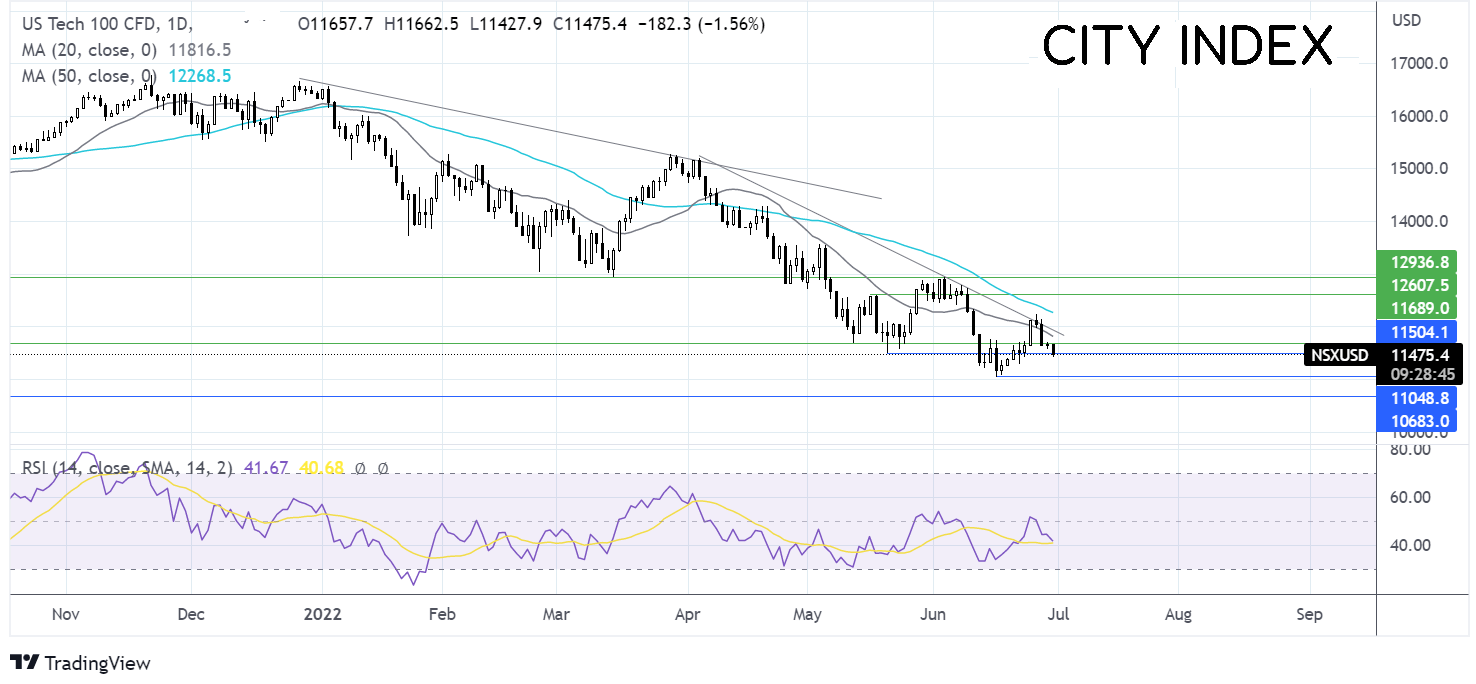
The Nasdaq failed to retake the multi-month falling trendline resistance and rebounded lower. The fall below the 20 sma and support at 11700 keeps the bears hopeful of further downside, as does the RSI below 50. Sellers are testing support at 11490, the May low, with a break below here opening the door to 11035 the 2022 low. Buyers will look for a move over 12225, the weekly high, to create a higher high and expose the 50 sma at 12315. A move above here opens the door to 12630, the mid-June high.
FX markets – USD rises, EUR falls.
USD is rising after losses in the previous session. The USD is set to gain across the week as aggressive Fed bets have ramped up sand on safe-haven flows as fears of slower global growth pick up.
EURUSD is falling towards 1.04, despite rising inflation. Eurozone inflation rose to 8.6% YoY, a record high, although core inflation fell. Energy and food price spikes were the main contributors. Given that energy prices could continue rising and that PPPI remains elevated, EZ inflation is unlikely to fall anytime soon. The data piles pressure on the ECB to raise interest rates at a faster pace in order to tame price rises. The ECB’s July interest rate announcement could see the central bank opt for a 50-basis point rate hike. However, they would be doing so as economic growth slows considerably and risk tipping the eurozone into recession.
GBP/USD is falling again, after weaker than expected UK manufacturing PMI data. Manufacturing activity fell to 52.8 in June, down from 54.6 in May. Rising inflation dampened new orders which doesn’t bode well for the outlook.
GBP/USD -1.2% at 1.2030
EUR/USD -0.57% at 1.0574
Oil rises on tight supply
Oil prices heading high, recapturing losses from the previous session, owing to outages in Libya and shutdowns in Norway, which overshadowed recession fears hurting the demand outlook.
Oil prices are not set to end the week higher, after two straight weeks of declines.
WTI crude trades +2.4% at $108.67
Brent trades +2.3% at $110.72
Learn more about trading oil here.
Looking ahead
15:00 ISM manufacturing PMI
Related tags:
Latest market news




Open an account in minutes
Experience award-winning platforms with fast and secure execution.
Economic calendar
Web Trader platform
Our sophisticated web-based platform is packed with features.
Related articles
USD/JPY, AUD/JPY: Central Bank Divergence Creates Two-Way Risk
USD/JPY eyes a breakout above 160, while AUD/JPY faces further losses as Fed, RBA and BoJ interest rate expectations diverge.

S&P, Nasdaq Slide as NVDA, AI Worries Continue to Build
It was a busy weekend in the headlines as a campaign to bring back Jensen Huang atop NVDA gained steam, even with accusations of possible treason and a circular funding model that has started to raise questions.

Gold and silver forecast: Precious metals extend drop but seasonality hopes keeps bullish case alive
It has been a risk off session so far today with stocks, gold and especially silver (-4%) all taking a drop. Gold has fallen to a fresh 2026 low and its now more than $100 below the psychologically important $4,000 mark. A firmer US dollar, rising US rate expectations and fading safe-haven demand have combined to undermine the metal, despite continued central bank buying. This year has so far been a bad one for gold.

StoneX Financial Ltd (trading as "FOREX.com") is an execution-only service provider. This material, whether or not it states any opinions, is for general information purposes only and it does not take into account your personal circumstances or objectives. This material has been prepared using the thoughts and opinions of the author and these may change. However, FOREX.com does not plan to provide further updates to any material once published and it is not under any obligation to keep this material up to date.
This material is short term in nature and may only relate to facts and circumstances existing at a specific time or day. Nothing in this material is (or should be considered to be) financial, investment, legal, tax or other advice and no reliance should be placed on it. No opinion given in this material constitutes a recommendation by FOREX.com or the author that any particular investment, security, transaction or investment strategy is suitable for any specific person.
The material has not been prepared in accordance with legal requirements designed to promote the independence of investment research. Although FOREX.com is not specifically prevented from dealing before providing this material, FOREX.com does not seek to take advantage of the material prior to its dissemination. This material is not intended for distribution to, or use by, any person in any country or jurisdiction where such distribution or use would be contrary to local law or regulation. For further details see our full non-independent research disclaimer and quarterly summary.