
With the close of April, the overall behavior of the cryptocurrency market has been defined by a phase of indecision and weakness, influenced by the recent wave of central bank interest rate decisions across global markets.
This environment has not only confirmed a trend toward keeping interest rates at elevated levels, but has also reduced expectations of near-term rate cuts, limiting the conditions needed for a consistent recovery in crypto market demand. In this context, this catalyst has become increasingly relevant, as it may continue to drive a scenario of weakness and indecision in major cryptocurrencies in the coming sessions.

Central bank week
This week saw key monetary policy decisions from institutions such as the European Central Bank, the Federal Reserve, and others. The main takeaway has been a general stance of rate stability, with no significant changes expected in the short term.
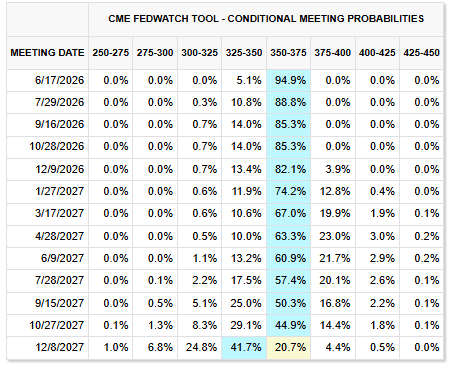
In the case of the Federal Reserve, CME Group probabilities indicate that for the next decision in June, there is a roughly 94.9% probability that rates will remain unchanged at the current 3.75% level. Moreover, there is over an 80% probability that this stable-rate environment will persist through December 2026.
This reflects a clear stance from the central bank toward maintaining a restrictive monetary policy for longer, with no immediate signals of rate cuts.
Source: CMEGROUP
Expectations of higher rates for a prolonged period have begun to have a direct impact on risk appetite in the cryptocurrency market. A high-rate environment keeps borrowing costs elevated and reduces available liquidity, limiting capital flows into higher-risk assets such as cryptocurrencies.
Additionally, rate stability has supported a recovery in the bond market, particularly in the United States, where 10-year Treasury yields have returned to levels near 4.4%. This increases the attractiveness of these assets relative to crypto, reducing the incentive for investors to maintain positions in cryptocurrencies in the short term.
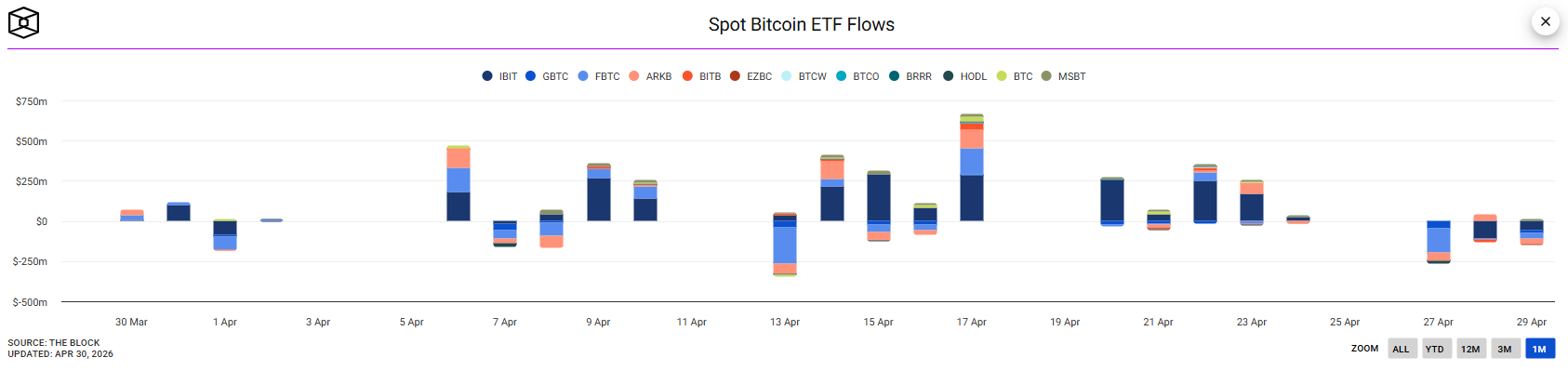
In fact, this lack of demand is already being reflected in key market metrics. In the case of Bitcoin ETFs, net outflows have been recorded during the first sessions of the week. As of April 29, outflows reached $148 million, indicating a liquidation of positions and a decline in market confidence.
Source: Theblock
Taking all of this into account, a higher-for-longer rate environment limits liquidity inflows into the crypto market. This is further reinforced by the relative attractiveness of alternative markets such as bonds, which continues to reduce investor interest in cryptocurrencies in the short term.
This dynamic is aligned with the recent decline in demand activity, and it is likely to remain a key factor sustaining a phase of weakness and indecision in the market in the coming sessions.
Bitcoin relative to other markets
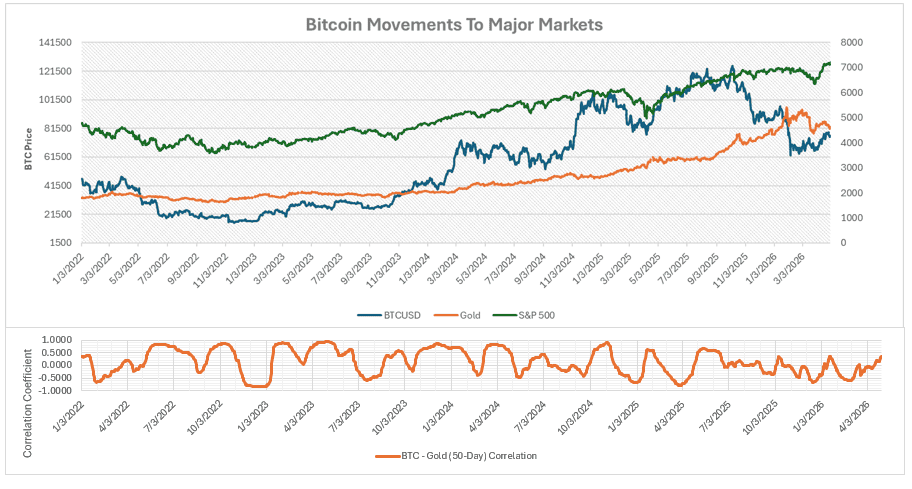
One of the most relevant developments in the short term has been the increase in correlation between Bitcoin and gold. Currently, the coefficient has moved above the 0.35 level, showing a positive relationship between both assets over the past 50 sessions. It is important to note that correlation levels may change over time.
Source: Data – TVC, StoneX, Tradingview
This relationship is particularly interesting, as gold has recently entered a phase of neutrality, failing to clearly position itself as either a risk asset or a safe haven. This has weakened its demand, and Bitcoin appears to be mirroring a similar dynamic.
In this context, the cryptocurrency market is not being perceived as an attractive risk asset compared to traditional markets, but neither is it acting as a reliable safe haven. This results in a decline in interest among market participants.
This behavior suggests that, much like gold, Bitcoin may be facing a lack of fundamental catalysts needed to drive a sustained recovery in market confidence over the medium term.
Overall, this dynamic reflects a decline in risk appetite within the crypto market, where demand has failed to hold up against major macroeconomic events such as central bank decisions. This reinforces the idea that weakness and indecision may continue to dominate in the short term.
Confidence shows no signs of recovery
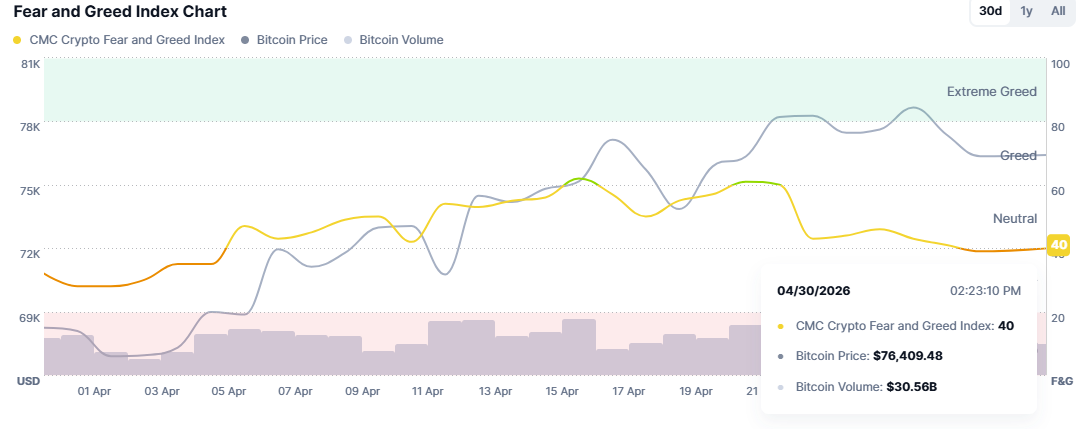
Crypto market sentiment indicators continue to show weakness. The Fear and Greed Index remains around the 40 level, with no significant changes, once again approaching the “fear” zone.
Source: Coinmarketcap
This behavior indicates that market confidence has not been able to consolidate, limiting the conditions needed for a stronger recovery in demand.
If this trend continues, the cryptocurrency market is likely to remain in a phase of weakness and indecision in the short term.
Written by Julian Pineda, CFA, CMT – Market Analyst
Follow him on: @julianpineda25