
US futures
Dow futures 0.43% at 43,563
S&P futures 0.23% at 6155
Nasdaq futures 0.18% at 22494
In Europe
FTSE 0.35% at 8775
DAX 0.95% at 23857
- US stocks rise, holding gains after PCE data
- Core PCE rose to 2.7% YoY
- Nike jumps 10% after earnings
- Oil is set to drop 12% across the week as the risk premium evaporates
Core PCE doesn’t deter from dovish Fed bets
U.S. stocks are set to open higher, holding onto gains despite a slight increase in inflation, as the markets react to the signing of the U.S.-China trade framework.
Core PCE, the Federal Reserve's preferred gauge for inflation, rose 0.2% MoM, up from 0.1%. On an annual basis, core PCE ticked higher to 2.7% up from 2.6% Expectations had been for core PCE to remain unchanged. Meanwhile, personal spending unexpectedly fell -0.1% after rising 0.2% in April.
The data suggest that price pressures remain muted; however, consumer spending fell due to high levels of uncertainty surrounding Trump's economic policies, which are weighing on the outlook for growth.
The decline in consumer spending coincides with a decline in consumer sentiment resulting from Trump's unpredictable trade policies. Weakness in consumer spending risks spilling over into job growth. Meanwhile, inflation remains muted, although some economists expect it to pick up in the next few months as businesses increasingly pass on higher costs to households.
Federal Reserve chair Jerome Powell told lawmakers this week expects inflation to pick up in June, July, and August as tariffs are increasingly reflected in prices. That said, if he also believed that if inflation didn't tick higher, the Fed could continue cutting rates, in a more dovish stance than previously.
The market is now pricing in 65 basis points worth of cuts this year, with a 93% chance of a cut in September.
Separately, the US and China have agreed on the details of a trade framework, which has now been signed formalising a deal on rare earth shipments, with the US set to lower export curbs. This has added to the improved market mood.
Corporate news
Nike is rising over 10% after Nike posted Q4 results that beat forecasts, and analysts expect profit sales declines to moderate in the future. It's taken its biggest hit from turnaround efforts, costing roughly $1 billion. HSBC upgraded Nike following the results.
Pony AI shares rose 2% after The New York Times reported that Uber is in talks to help fund an acquisition of Pony AI's US subsidiary.
Nasdaq 100 forecast – technical analysis.
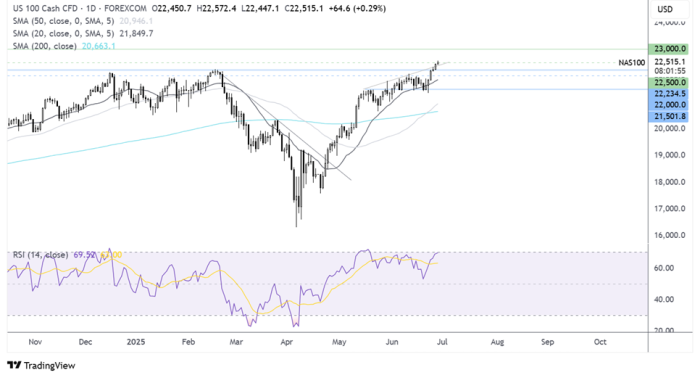
The Nasdaq 100 has recovered from Monday’s low of 23,350, rising above 22,245 and the rising trendline resistance to a fresh record high of 22,570. The RSI supports further gains as long as it remains out of overbought territory. The bulls will look to rise above 22500 towards 23000. On the downside, support can be seen at 22,000, and a break below 21,500 is needed to create a lower low.
FX markets – USD fall, EUR/USD rises
The USD is extending its decline and is on track to fall 1.5% this week. The USD dollar index has plunged to its lowest levels since 2022 as traders ramp up expectations for a Fed rate cut. The shift comes after Fed Chair Powell’s testimony before Congress, which was considered more dovish.
The EUR/USD is rising towards 1.1750, benefiting from a weaker USD despite weaker eurozone data. Eurozone economic sentiment unexpectedly fell to 94 in June, led by deteriorating industry confidence and with retail also contributing.
GBP/USD is rising, as it continues to benefit from USD weakness despite signs of the UK fundamental picture weakening. This week, BoE Governor Andrew Bailey warned of signs of a slowing UK labour market as employers respond to higher national insurance contributions. Bailey appears to be softening his stance towards rate cuts. The next rate cut is expected in August.
Oil steadies after steep ceasefire-inspired losses
Oil prices are edging higher for a third straight day but are on track for their steepest weekly decline in two years, as the ceasefire in the Middle East has seen the risk premium fall away.
During the 12-day war between Israel and Iran, oil prices soared on fears of an impact on supply. However, the announcement of a ceasefire at the start of this week resulted in a 12% decline in oil prices. Attention will be on the July 6 OPEC meeting where another output hike is expected of 411k barrels per day.
Oil was being supported by multiple inventory reports that showed a strong draw in fuel inventories, highlighting solid demand.