


This was one of those boring rate decisions where markets were confident that no actual moves would be announced today. Instead, the focus is on the nuance, like who would vote to cut rates or what Powell might say during the presser. But even that second component is going to swing less weight as it’s highly expected that Powell will soon give way to his successor, someone of President Trump’s choosing who will likely be dovish. And for Powell, he seemed to go out of his way to sidestep any drama during the Q&A, saying multiple times, “I have nothing for you.”
This puts both more intense focus on the NFP report for later in the week and also incoming inflation data, as Powell and the Fed’s statement noted elevated inflation as a factor of consideration.
But – for traders looking to impart strategy in macro markets there’s perhaps a bigger issue at play right now and it’s something that could drive significant volatility in markets around the world. This isn’t mean to fear-monger, nor is it designed to create fear. But the reality is global equity gains have been driven by increasing leverage over the past four years and a large component of that could soon come under pressure.
Perhaps the more important item from today was something that happened earlier in the session with the comment from US Treasury Secretary Scott Bessent, saying that the US was not intervening in USD/JPY. That led to a near-immediate pop of strength in USD/JPY and other Yen-pairs such as GBP/JPY and EUR/JPY.
USD/JPY Hourly Price Chart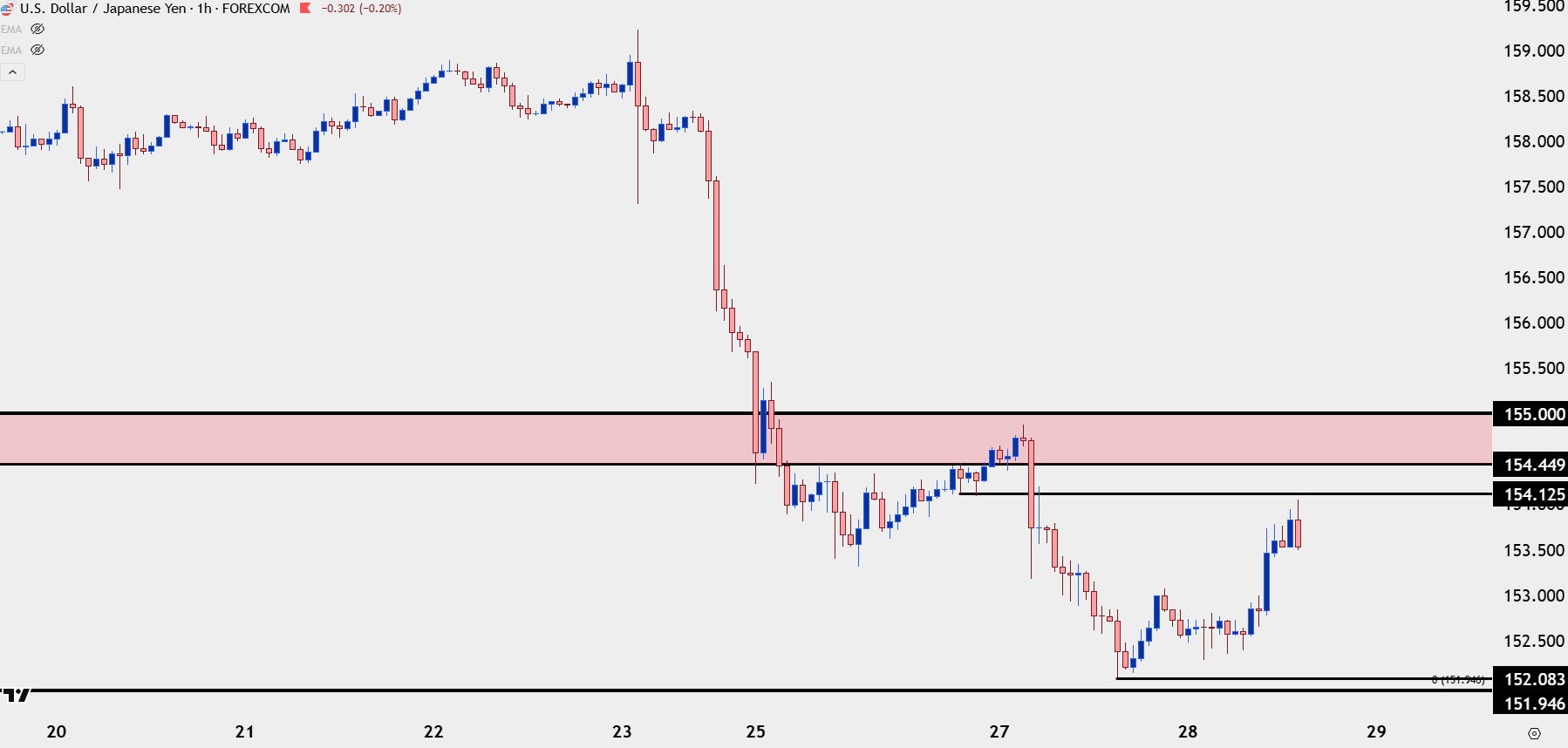
Chart prepared by James Stanley; data derived from Tradingview
Currency Balance v/s De-Leveraging Risk
The carry trade that drove so clearly from 2022 and even into this year was a major driver of global leverage. Hedge funds and market participants could get loans in Japan at low rates and then invest elsewhere where rates are higher, or, even in Japan with the Nikkei shooting higher; but the challenge at that point is the exposure in the Japanese Yen. So, one way to hedge that risk was with a short-Yen trade and this could push demand on the long side of USD/JPY or EUR/JPY or GBP/JPY.
That freshly borrowed capital could then drive into other markets around the globe, such as the AI trade that continued at a blistering pace through much of last year.
If USD/JPY starts falling quickly, there’s little motivation to keep those hedges alive and that can quickly lead to a spiraling scenario in the USD/JPY pair. And at some point, that can soon draw away from the trends that were pushed by that leverage in the first place. This explains why US equities were rocked after the July 11th 2024 US CPI print, the same morning of a BoJ intervention designed to get USD/JPY below the 160.00 handle.
At this point, the rollover for the USD/JPY pair remains tilted to the long side, with shorts having to pay while longs can earn a credit. So the incentivization element remains with the broader trend. But that doesn’t mean that prices have to go up as this is still a very crowded trade, and if we do get evidence that the US may be closer to rate cuts via the NFP report or incoming inflation data, the math can soon push longs to cut bait and that could create even more pressure in USD/JPY.
For now, the look is on how market participants respond to the 154.45-155.00 area that, so far, has held lower-high resistance.
Logically speaking getting closer to 160.00 will see bullish demand wane and that’s been somewhat of the line-in-the-sand for the Japanese Ministry of Finance thus far.
But, at this point, I continue to favor GBP/JPY and perhaps even EUR/JPY for JPY-weakness scenarios returning. I explained that in-depth in yesterday’s webinar and I remain of that mind today.
GBP/JPY Daily Chart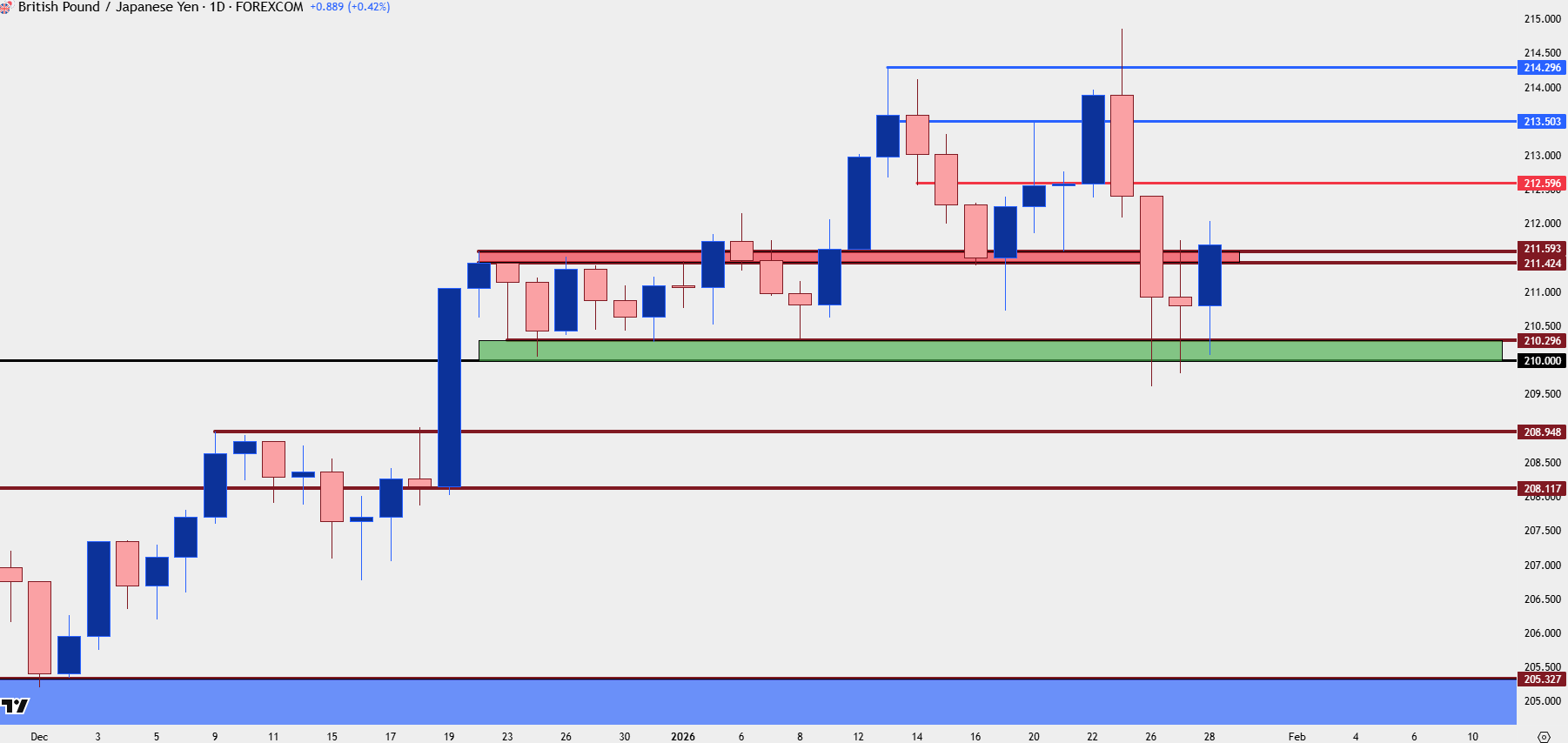
Chart prepared by James Stanley; data derived from Tradingview
--- written by James Stanley, Senior Market Analyst, Global Macro