



3 Stock Market Lessons from 2008 as Congress Debates Another Crisis Bill
What actionable trading takeaways can we draw from 2008 for the current week?
Share this:

As my colleague Joe Perry noted in his Week Ahead report on Friday, traders this week should “expect cases of coronavirus to increase and government interventions to continue. We’re in the early innings of a long ballgame.”
With markets entering the next phase in the war against the virus, the key factor to watch this week will be the progress of a “big bazooka” fiscal policy bill out of the US. Over the weekend, the much-ballyhooed $1T+ package, failed to pass a procedural vote in the Senate, which is operating at reduced capacity as one US Senator, Rand Paul, has tested positive for coronavirus, causing several Senators who were in close contact with him to self-quarantine. In any event, Senate Democrats and Republicans are scheduled to reconvene midday today to try to hash out their differences, with another vote expected around 1pm ET.
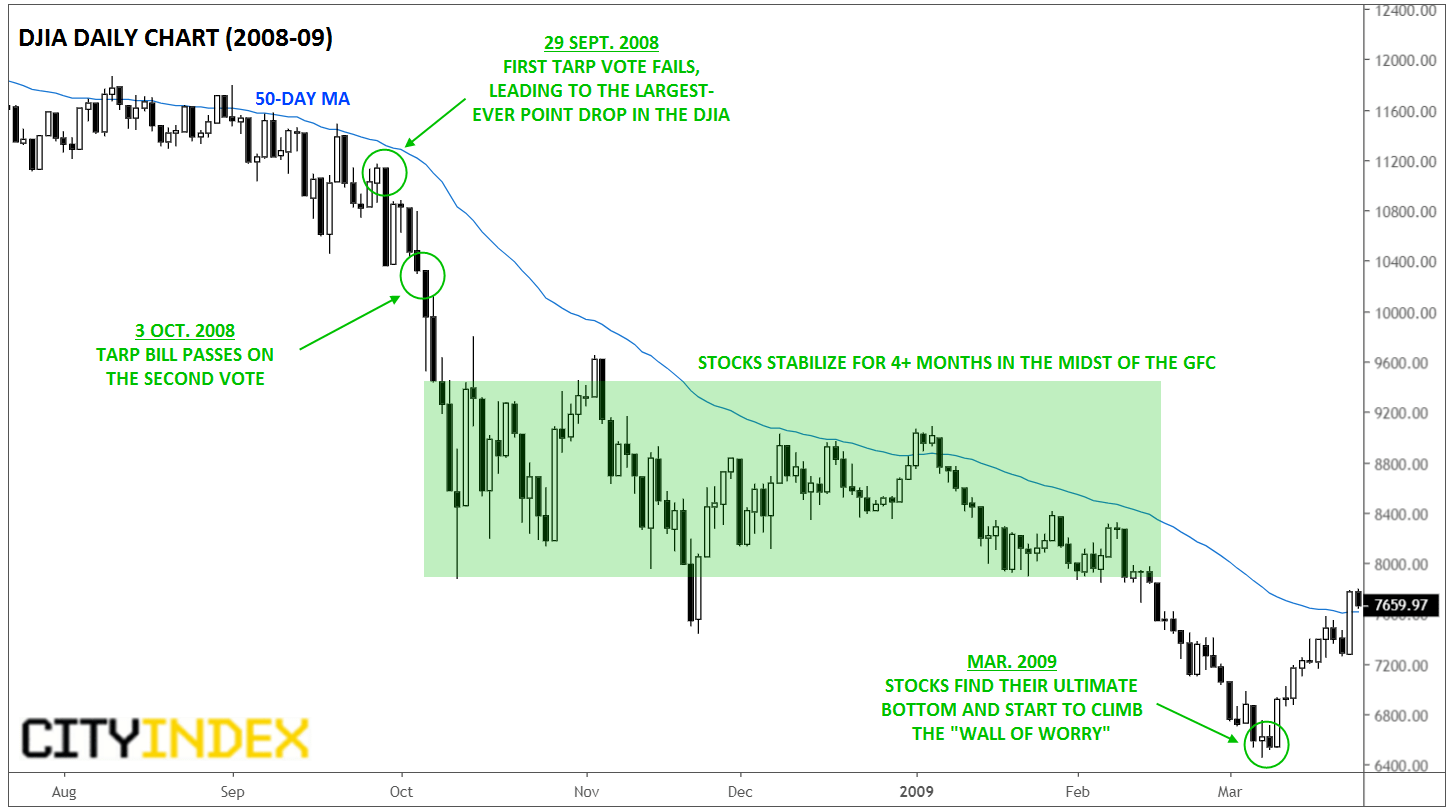
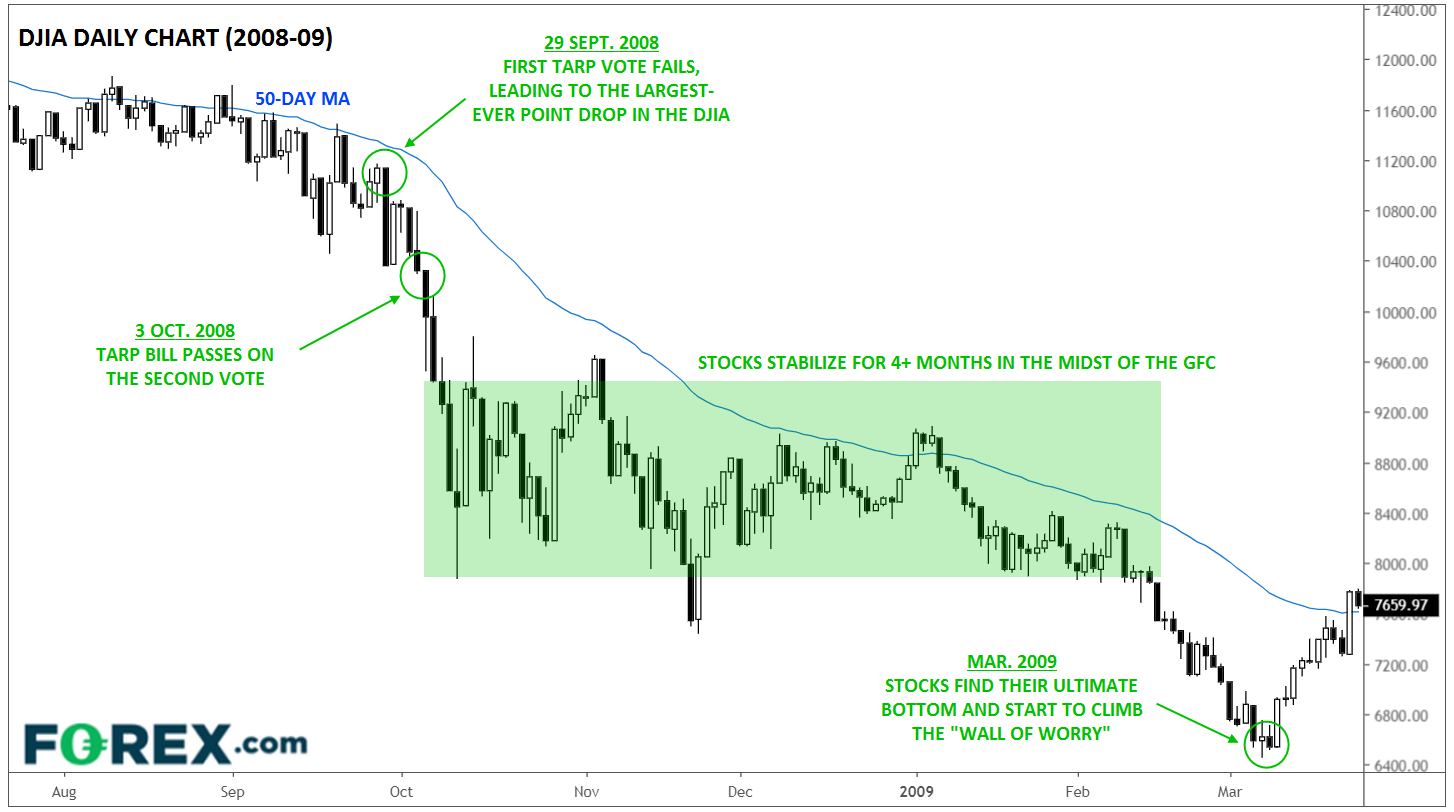
The whole saga is reminiscent of the initial vote on the last major US government fiscal crisis response, the Troubled Asset Repurchase Program (TARP) in late September 2008. Spurred on by early rumblings of the anti-deficit “Tea Party” movement, the first vote on the much-needed bill failed in the House of Representatives on September 29, leading to a 777-point drop in the Dow Jones Industrial Average (DJIA), at its time, the largest ever point drop. Perhaps spooked by the precipitous drop in stocks, the House subsequently passed the bill handily a couple days later on October 3.
Source: TradingView, GAIN Capital
What actionable trading takeaways can we draw from 2008 for the current week?
1. Many of the same politicians that initially voted against TARP remain in their posts to this day, so hopefully they recall their lessons from that fateful period. We hope it won’t take another failed vote and deep market swoon to get the notoriously divided Congress to reach an agreement for the good of the American people (and stock markets!). With full credit to Winston Churchill, at a minimum, “You can always count on the Americans to do the right thing… after they have tried everything else.”
2. Even the passage of the much-needed fiscal stimulus bill in 2008 did not prevent the stock market from falling further, though it did at least help stocks stabilize for a period shortly thereafter, followed by one last foray to new lows in Q1 2009.
3. As we’ve noted before, the stock market WILL bottom before infection and economic data starts to improve, just as it bottomed in early 2009 before housing market and broader activity figures turned higher. Markets always “climb a wall of worry” coming out of panicked periods, with (often years of) skepticism toward the initial bullish move.
Related tags:
Latest market news




The complete CFD trading experience
Award-winning platforms, competitive spreads, low commissions and dedicated support.
We live and breathe the markets and are dedicated to helping traders realise their ambitions as we continue to set the industry bar.
Economic calendar
Web Trader platform
Our sophisticated web-based platform is packed with features.
Related articles
US Midterm Fallout: What Does the “Blue Tsunami” Mean for the S&P 500?
Democrats made sweeping gains in the US midterm elections, winning control of both the House and Senate - what does it mean for the S&P 500 and the AI trade?

S&P 500 forecast: Democrats’ midterm victory rattled markets before dip buyers stepped in
Markets had a wild overnight session, with futures initially plunging before staging a sharp reversal and turning decisively higher. Global equity markets also bounced back, alongside gold and silver, while the US dollar has weakened. Oil prices fell on hopes of a deal between the US and Iran, providing another boost to market sentiment. The key question is why have markets rebounded so strongly and, more importantly, whether the recovery can last, given the prior assumption that a blue sweep would have been net negative for stocks?


Silver, Nasdaq Outlook: Democratic Win Supports Risk-Asset Rebounds
A Democratic win in the U.S. midterm elections is supporting rebounds in risk assets, including precious metals, currency pairs, cryptocurrencies and U.S. indices. This reaction appears to align with changing sentiment around the war and its inflationary impact.

StoneX Europe Ltd may make third party material available on this website which may contain information included but not limited to the conditions of financial markets. The material is for information purposes only and does not contain, and should not be construed as containing, investment advice and/or investment recommendation and/or an investment research and/or an offer of or solicitation for any transactions in financial instruments; any decision to enter into a specific transaction shall be made by the client following an assessment by him/her of their situation.
StoneX Europe Ltd makes no representation or warranty and assumes no liability as to the accuracy or completeness of the information provided, nor any loss arising from any investment based on a recommendation, forecast or other information supplied. You should always seek independent advice as to your suitability to speculate in any related markets and your ability to assume the associated risks, if you are at all unsure. We are not under any obligation to update any such material. Any opinion made may be personal to the author and may not reflect the opinion of StoneX Europe Ltd.