



AUD/USD Forecast: Risk Appetite Rules, But NAB May Yet Move the Aussie
The Aussie barely reacted to Gulf headlines and remains tethered to the Fed and risk appetite, but today's NAB survey may prove the domestic story matters after all.
Share this:

- April NAB business survey flags emerging activity risks
- Markets still price one more RBA hike in 2026
- Fed and risk appetite drive AUD/USD more broadly
- Gulf headlines fail to shift sentiment
- 100DMA keeps AUD/USD bulls contained
The Survey That Still Matters
AUD/USD might be the Fed and risk appetite show right now, but I honestly think today's NAB business survey for May has the potential to deliver some meaningful market impact. The risks around the internal activity measures look skewed heavily to the downside in my opinion, potentially providing the catalyst for a move in the Aussie.
If there's ever going to be a soft survey that carries a reliable message on true activity on the ground, this one is it.
The Case for Weaker Conditions
There were some notable features of the prior survey that, along with a softening in other hard domestic data recently, have fuelled my concern about activity. Just look at the forward orders measure, which went from +6 in February to -5 in April; hardly what you'd expect if demand was holding up.

Source: NAB
Purchase costs were also going up faster than output or retail prices also points to margin compression, suggesting there were already signs businesses were having to take a hit in order to support demand.
Combined with the easing in capacity utilisation, it makes me think we could see the business conditions measure flip negative, perhaps significantly, in the May survey, mirroring the trend in confidence beforehand.
The federal budget has been negatively received by the electorate and the housing market is also softening rapidly, increasing the risk of a pullback in household spending. Taken together, the downside risks to activity look to be building.
Is RBA Pricing Too Aggressive?
That's important given swaps markets still have roughly one more RBA hike priced by year-end. Even if the May survey continues to point to elevated price pressures, another deterioration in the activity gauges would add to the case for the RBA to pause its hiking cycle, especially given the elevated downside risks to the employment side of its mandate.
It would also raise the possibility that markets are underestimating the extent of the slowdown already underway in the domestic economy.
Fed, Fear and the Aussie
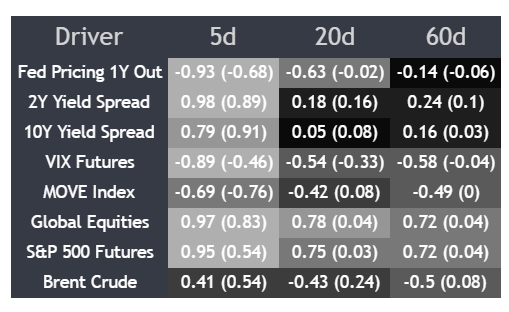
While today's survey may have the capacity to move AUD/USD in the near-term, more broadly, the Aussie very much remains the Fed and risk appetite show, as demonstrated by the strength of the correlation coefficient scores in the matrix below.
Source: TradingView
The broader message is that risk appetite remains the dominant driver, with AUD/USD maintaining exceptionally strong relationships with global equities and S&P 500 futures over both the five-day and 20-day windows.
However, last week's stronger-than-expected US payrolls report appears to have reignited the rates outlook side of the equation, with the five-day correlations with Fed pricing one year out and US yield spreads strengthening sharply compared with a week earlier. That leaves Wednesday's US CPI report looming as the next major test for both narratives.

Source: TradingView (Australia AEST)
Markets will also be keeping an eye on the potential SpaceX IPO, which is reportedly being targeted for Friday, although a final date has yet to be confirmed. Given the enormous investor interest surrounding the listing and the scale of capital likely to be involved, it has the potential to become an important driver of liquidity conditions broader risk sentiment.
Beyond the scheduled event calendar, developments in the Gulf also warrant attention. However, it's notable just how little reaction there was in the Aussie on Monday to both escalation and de-escalation headlines that crossed during the session.
You get the sense that many traders have already figured out they have no edge trying to anticipate headlines if and when they arrive, meaning many are either ignoring the conflict altogether or using it purely for trade entry and exit points. Nobody appears willing to price in significant left or right tail risks until, and if, there's actual confirmation.
Technical Damage Done

Source: TradingView
Last Friday's US payrolls report delivered some serious technical damage to AUD/USD, seeing the pair break a series of important downside levels, including the 50-day moving average, support at .7100, the 100-day moving average and the uptrend from the lows hit in late March, coinciding with a period of strong risk appetite across markets. The fact the Aussie has broken that trend provides a cautionary message for other less liquid, riskier asset classes.
What's notable from the price action on Monday is just how unconvincing the Aussie's recovery was despite a late revival in risk appetite, with the pair comprehensively rejected at the 100DMA before eventually delivering a gravestone doji on the daily. That leaves the 100DMA and former March uptrend as the key overhead zone to watch today, suggesting bears are currently selling into strength.
On the downside, .6964 was a former breakout level that deserves attention, along with the psychologically important .7000 big figure. A break beneath the former would have bears eyeing a retest of the late March swing low at .6835, where the 200DMA is now also found. Should AUD/USD manage to push back above the resistance zone overhead during the session, .7100, the 50DMA and .7200 are the levels to watch.
The message from the oscillators favours short setups over longs in the near-term, with RSI (14) trending lower beneath 50 but not yet oversold, while MACD has flipped negative and is now diverging further away from the signal line.
Latest market news




The complete CFD trading experience
Award-winning platforms, competitive spreads, low commissions and dedicated support.
We live and breathe the markets and are dedicated to helping traders realise their ambitions as we continue to set the industry bar.
Economic calendar
Web Trader platform
Our sophisticated web-based platform is packed with features.
Related articles
EUR/USD Q4 2026 Outlook: Euro at a Crossroads as Fed, ECB Tighten 9 25 2026
EUR/USD enters Q4 at a pivotal inflection point as competing Fed-ECB policy paths and persistent inflation risks collide with major technical support.
USD/JPY Q4 2026 Outlook: Hawkish Fed Pricing Clashes With Intervention Risk
The year-end tug-of-war is clear: hawkish Fed pricing supports USD/JPY, while intervention risk limits the upside.

Japanese Yen Forecast: USD/JPY 4% Rally Challenges Post-Intervention Downtrend 9 24 2026
USD/JPY momentum has shifted sharply higher, putting a major resistance confluence in focus as U.S. and Japanese event risk builds.
StoneX Europe Ltd may make third party material available on this website which may contain information included but not limited to the conditions of financial markets. The material is for information purposes only and does not contain, and should not be construed as containing, investment advice and/or investment recommendation and/or an investment research and/or an offer of or solicitation for any transactions in financial instruments; any decision to enter into a specific transaction shall be made by the client following an assessment by him/her of their situation.
StoneX Europe Ltd makes no representation or warranty and assumes no liability as to the accuracy or completeness of the information provided, nor any loss arising from any investment based on a recommendation, forecast or other information supplied. You should always seek independent advice as to your suitability to speculate in any related markets and your ability to assume the associated risks, if you are at all unsure. We are not under any obligation to update any such material. Any opinion made may be personal to the author and may not reflect the opinion of StoneX Europe Ltd.