



Australian growth rebounded in Q4
Hopes that growth in Australia would rebound in Q1 were easily met, with GDP rising 3.4% q/q compared to 3.0% expected.
Share this:

The Australian economy grew 3.4% q/q in seasonally adjusted terms in q4, according to the ABS (Australian Bureau of Statistics), beating expectations of 3%. The economy grew by 4.2% y/y to beat expectations of 3.7%. Ultimately it was its strongest quarter in five and matches the post=pandemic rebound in 2021. It also more than recoups the -1.9% contraction in Q3 which took a knock due to self-imposed lockdowns triggered from the rise of Delta.

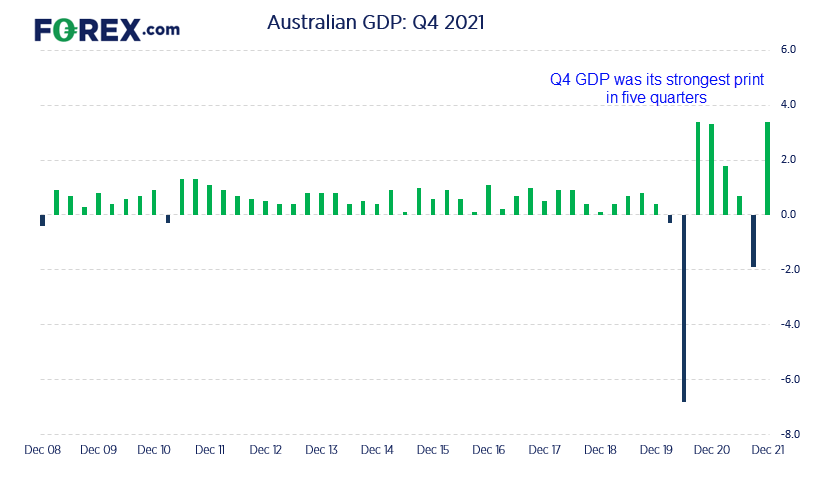
NSW and VIC drive the rebound
Household spending rose 6.3% in Q4 which is the first time it has exceeded pre-pandemic levels. Going out remained a key feature with spending on hotels and café’s rose 24.3% and recreation and culture spending up 17.1%. As expected, the laggards of Q3 (NSW and VIC) were the main drivers behind Q4 consumption as lockdowns are now a thing of the past for most.
How are things shaping up for Q1 GDP?
As decent as these developments are, growth data is extremely lagging and economists are pouring over leading indicators to get a grapple on Q1’s potential. So far this year we have seen retail sales rise 1.8% and AIG’ manufacturing PMI expand by 53.2, up from 48.4. Markit Economics PMI has also seen services and manufacturing PMI’s rise to 56.4 and 55.9 respectively and NAB’s business confidence post an optimistic 3 – up from -12 in December. Overall data for Q1 looks promising, although something to also factor in are extreme weather conditions which will almost certainly weaken data for QLD, with floods now cropping up across the key state of NSW.
AUD currently on track for a 5th consecutive bullish week


The Australian dollar is trying to tally up its fifth consecutive bullish week, which is quite impressive considering traders remains heavily net-short the futures markets. Rising commodity prices, such as key export markets including iron ore, coal, iron ore prices have certainly helped support the Aussie and effectively brush aside its status as a risk-asset despite war in Ukraine. Yet the potential for supply disruptions are also feeding back into established trends on said commodities, helping to place a floor of support for the Aussie. But it should be noted that the 200 and 50-week eMA’s reside around 0.7300 and the YTD high on AUD.USD - so we may find this level initially caps as resistance before any breakout occurs.
AUD fell on rising trading activity

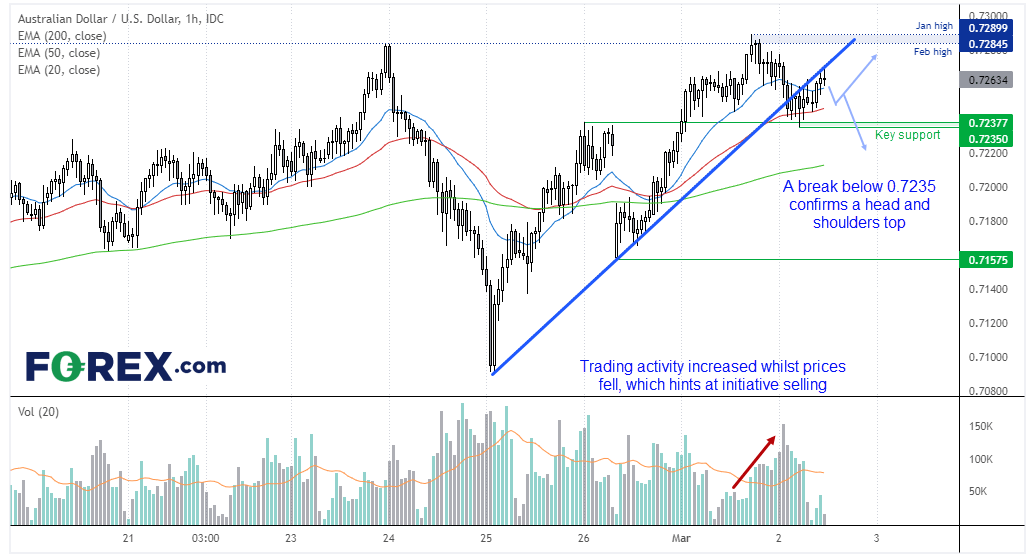
We can see on the hourly chart that the Aussie is testing the inside of a broken trendline, although the 50-bar eMA is currently supporting trend. But the Fed remains on track to raise rates this month despite the Ukraine crisis, which leaves the potential for the US dollar to recoup some losses and weigh on the Aussie over the near-term.
Should a higher low form above 0.7235 support then the reward to risk ratio becomes more appealing for longs towards the Jan and Feb highs. However, if we see a break below 0.7235 then it leaves the potential for another leg lower, as part of a head and shoulders top formation.
How to trade with City Index
You can easily trade with City Index by using these four easy steps:
- Open an account, or log in if you’re already a customer
• Open an account in the UK
• Open an account in Australia
• Open an account in Singapore
- Search for the company you want to trade in our award-winning platform
- Choose your position and size, and your stop and limit levels
- Place the trade
Related tags:
Latest market news




The complete CFD trading experience
Award-winning platforms, competitive spreads, low commissions and dedicated support.
We live and breathe the markets and are dedicated to helping traders realise their ambitions as we continue to set the industry bar.
Economic calendar
Web Trader platform
Our sophisticated web-based platform is packed with features.
Related articles
Gold Q4 2026 outlook: Resilience in the face of rallying dollar and yields
As we headed towards the latter stages of Q3 and into Q4, the Fed had just hiked rates in a hawkish FOMC meeting, while the likes of the ECB and BoJ had also tightened their respective policies. Oil prices remained elevated amid the prolonged US-Iran conflict. Meanwhile, bond yields were breaking out, and the dollar was higher across the board. Yet, remarkably, gold was still holding in the positive territory for the third quarter, even if it had weakened somewhat in September.
EUR/USD Q4 2026 Outlook: Euro at a Crossroads as Fed, ECB Tighten 9 25 2026
EUR/USD enters Q4 at a pivotal inflection point as competing Fed-ECB policy paths and persistent inflation risks collide with major technical support.

USD/JPY Q4 2026 Outlook: Hawkish Fed Pricing Clashes With Intervention Risk
The year-end tug-of-war is clear: hawkish Fed pricing supports USD/JPY, while intervention risk limits the upside.

StoneX Europe Ltd may make third party material available on this website which may contain information included but not limited to the conditions of financial markets. The material is for information purposes only and does not contain, and should not be construed as containing, investment advice and/or investment recommendation and/or an investment research and/or an offer of or solicitation for any transactions in financial instruments; any decision to enter into a specific transaction shall be made by the client following an assessment by him/her of their situation.
StoneX Europe Ltd makes no representation or warranty and assumes no liability as to the accuracy or completeness of the information provided, nor any loss arising from any investment based on a recommendation, forecast or other information supplied. You should always seek independent advice as to your suitability to speculate in any related markets and your ability to assume the associated risks, if you are at all unsure. We are not under any obligation to update any such material. Any opinion made may be personal to the author and may not reflect the opinion of StoneX Europe Ltd.