






Biden Has Officially Won Whats Next for Traders
We can look at the moves we’ve seen since election night as a harbinger of the short-term trends to expect in the coming days and weeks
Share this:

After one of the most contentious and acrimonious campaigns in history, the end is finally upon us.
While states like Georgia, Pennsylvania, Arizona, and Nevada are still putting the finishing touches on their vote counts (and President Trump is still threatening litigation over the ballots and recounts in several states), former Vice President Joe Biden has officially been declared the winner of the 2020 US Presidential Election by the AP, NBC, CBS, ABC, Fox News, and CNN.
Meanwhile, control of the Senate still hangs in the balance, with the Republicans likely to land on 50 Senators while the two Georgia races head to a special election on 5 January 2021 (note that we’re assuming a couple unofficial results will go for Republicans, in-line with historical precedent). Assuming Biden takes the White House, Vice President Kamala Harris would cast the deciding vote in the event of a tie, so Democrats would need to win both of these races in the traditionally Republican state to “control” the Senate by the narrowest of margins. While it’s certainly possible Dems could win both, the market appears to be pricing in a split government (Democratic President, Republican Senate, Democratic House of Representatives) for at least the next two years.
What can we expect next from markets moving forward? As we’ve noted repeatedly, traders are a forward-looking bunch, so we can look at the moves we’ve seen since election night as a harbinger of the short-term trends to expect in the coming days and weeks:
Forex: Pauper Dollar?
When it comes to the FX market, “King Dollar” has been more “Pauper Dollar” this week. The greenback is by far the week’s weakest major currency, falling by more than 1% against all of its major rivals, and by over 3% against the resurgent Australian dollar. The buck is also probing its lowest level in nearly six years against the Swiss franc:
Source: TradingView, GAIN Capital
The cleanest narrative for this move is that, with COVID cases growing exponentially across the US and a split government likely, a massive $2-3T+ stimulus package is looking increasingly unlikely. If that view proves correct, the nascent US recovery could stall as we move through the winter, making other currencies with more responsive fiscal authorities and a better control of the virus more attractive.
Equities: More of the Same
Uninhibited, capitalism tends toward dominant oligopolies and monopolies. That’s exactly what we’ve seen over the past couple of years when a Republican President and Democratic-controlled House of Representatives were unable to unite against the technology behemoths that continue to gobble up market share. With another rough couple of months expected for “main street” brick-and-mortar businesses slowed by COVID-19, the FAAMG stocks may continue to gobble up market share and put their smaller rivals out of business.
This scenario would be bullish for tech-heavy, large-cap indices like the Nasdaq 100, especially at the expense of their smaller capitalization rivals like the Russell 2000, a trend that has been unstoppable over the last couple years already:
Source: TradingView, GAIN Capital
Commodities: Fed to Keep its Foot on the Accelerator?
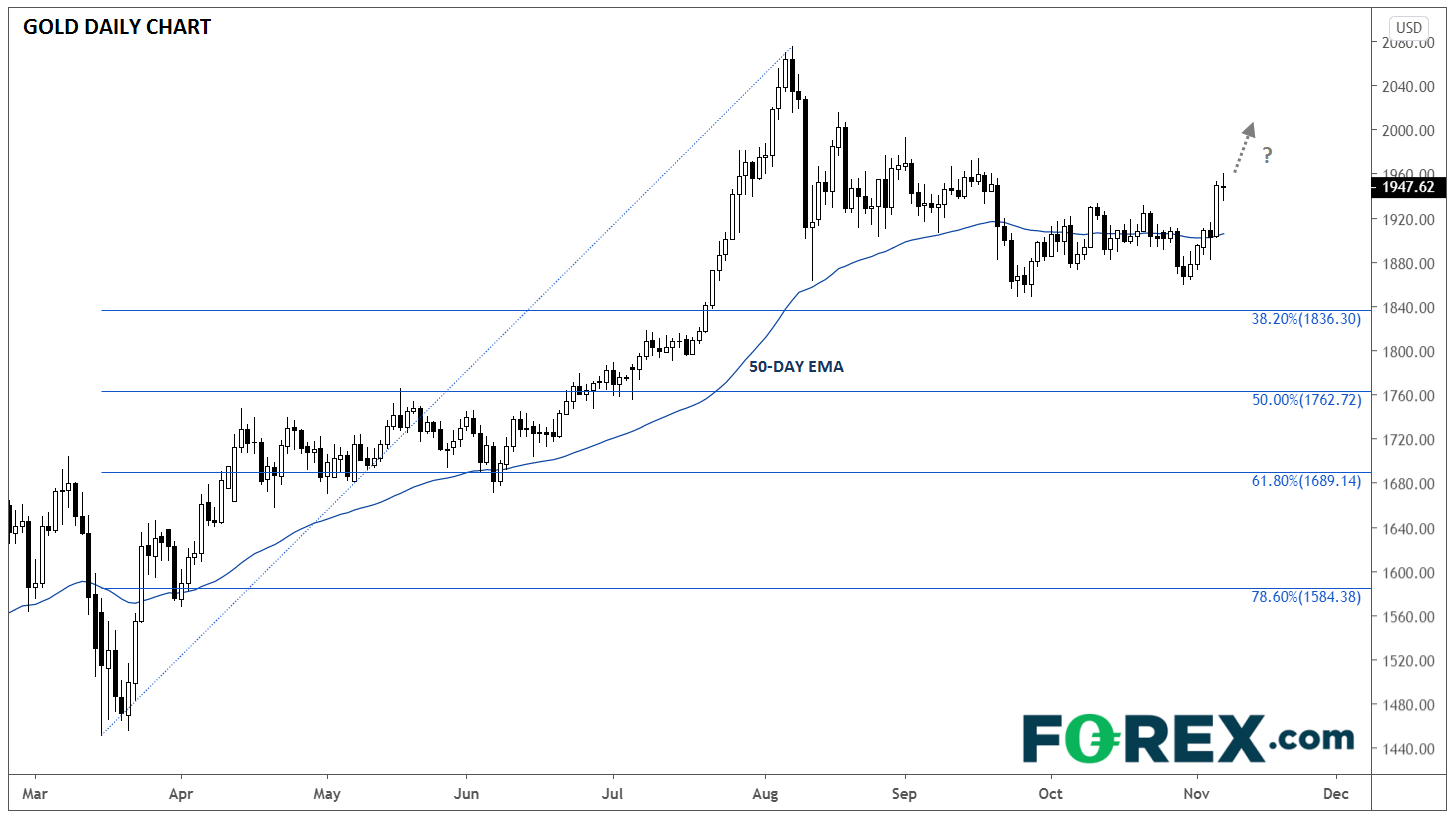
Finally, tying together the comments above, the Federal Reserve will likely have to leave the monetary spigots wide open to account for an expected lack of action from US fiscal authorities. With asset purchases and near-zero percent interest rates likely to remain in place for years to come, commodities like gold and oil that are priced in the US dollar may see a tailwind under the expected US political regime. As we can see below, gold has already caught a bid this week and could soon make a run back toward the psychologically-significant $2000 level next.
Source: TradingView, GAIN Capital
Of course, there are many factors beyond just US politics influencing all of these global markets, so traders should continue to monitor the virus data, market trends, global geopolitical developments, and the prospects for fiscal/monetary policy in other countries as well. In fact, we’re looking forward returning to a more “normal” environment that isn’t so focused on US politics in the days and weeks to come!
After one of the most contentious and acrimonious campaigns in history, the end is finally upon us.
While states like Georgia, Pennsylvania, Arizona, and Nevada are still putting the finishing touches on their vote counts (and President Trump is still threatening litigation over the ballots and recounts in several states), former Vice President Joe Biden has officially been declared the winner of the 2020 US Presidential Election by the AP, NBC, CBS, ABC, Fox News, and CNN.
Meanwhile, control of the Senate still hangs in the balance, with the Republicans likely to land on 50 Senators while the two Georgia races head to a special election on 5 January 2021 (note that we’re assuming a couple unofficial results will go for Republicans, in-line with historical precedent). Assuming Biden takes the White House, Vice President Kamala Harris would cast the deciding vote in the event of a tie, so Democrats would need to win both of these races in the traditionally Republican state to “control” the Senate by the narrowest of margins. While it’s certainly possible Dems could win both, the market appears to be pricing in a split government (Democratic President, Republican Senate, Democratic House of Representatives) for at least the next two years.
What can we expect next from markets moving forward? As we’ve noted repeatedly, traders are a forward-looking bunch, so we can look at the moves we’ve seen since election night as a harbinger of the short-term trends to expect in the coming days and weeks:
Forex: Pauper Dollar?
When it comes to the FX market, “King Dollar” has been more “Pauper Dollar” this week. The greenback is by far the week’s weakest major currency, falling by more than 1% against all of its major rivals, and by over 3% against the resurgent Australian dollar. The buck is also probing its lowest level in nearly six years against the Swiss franc:
Source: TradingView, GAIN Capital
The cleanest narrative for this move is that, with COVID cases growing exponentially across the US and a split government likely, a massive $2-3T+ stimulus package is looking increasingly unlikely. If that view proves correct, the nascent US recovery could stall as we move through the winter, making other currencies with more responsive fiscal authorities and a better control of the virus more attractive.
Equities: More of the Same
Uninhibited, capitalism tends toward dominant oligopolies and monopolies. That’s exactly what we’ve seen over the past couple of years when a Republican President and Democratic-controlled House of Representatives were unable to unite against the technology behemoths that continue to gobble up market share. With another rough couple of months expected for “main street” brick-and-mortar businesses slowed by COVID-19, the FAAMG stocks may continue to gobble up market share and put their smaller rivals out of business.
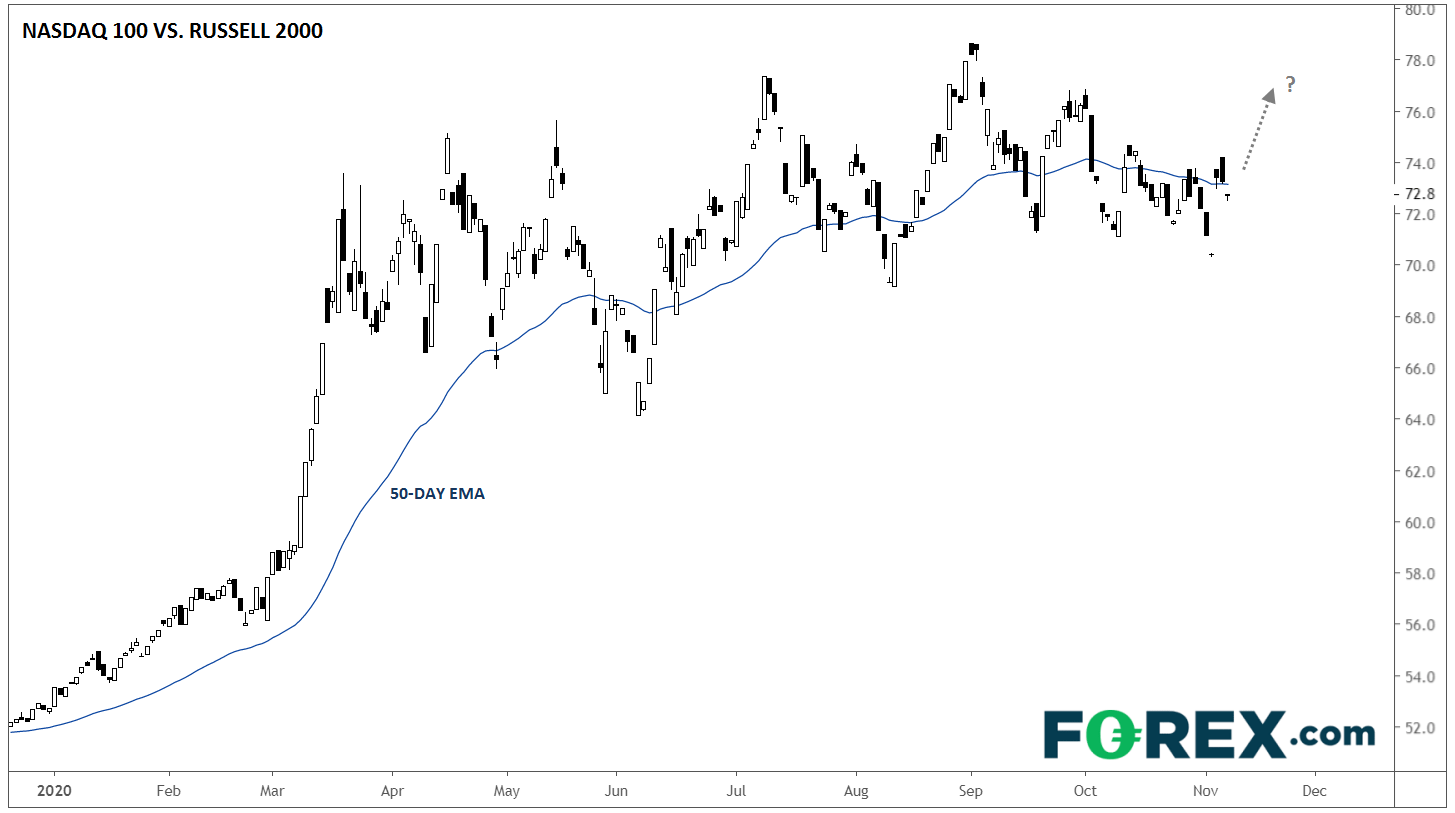
This scenario would be bullish for tech-heavy, large-cap indices like the Nasdaq 100, especially at the expense of their smaller capitalization rivals like the Russell 2000, a trend that has been unstoppable over the last couple years already:
Source: TradingView, GAIN Capital
Commodities: Fed to Keep its Foot on the Accelerator?
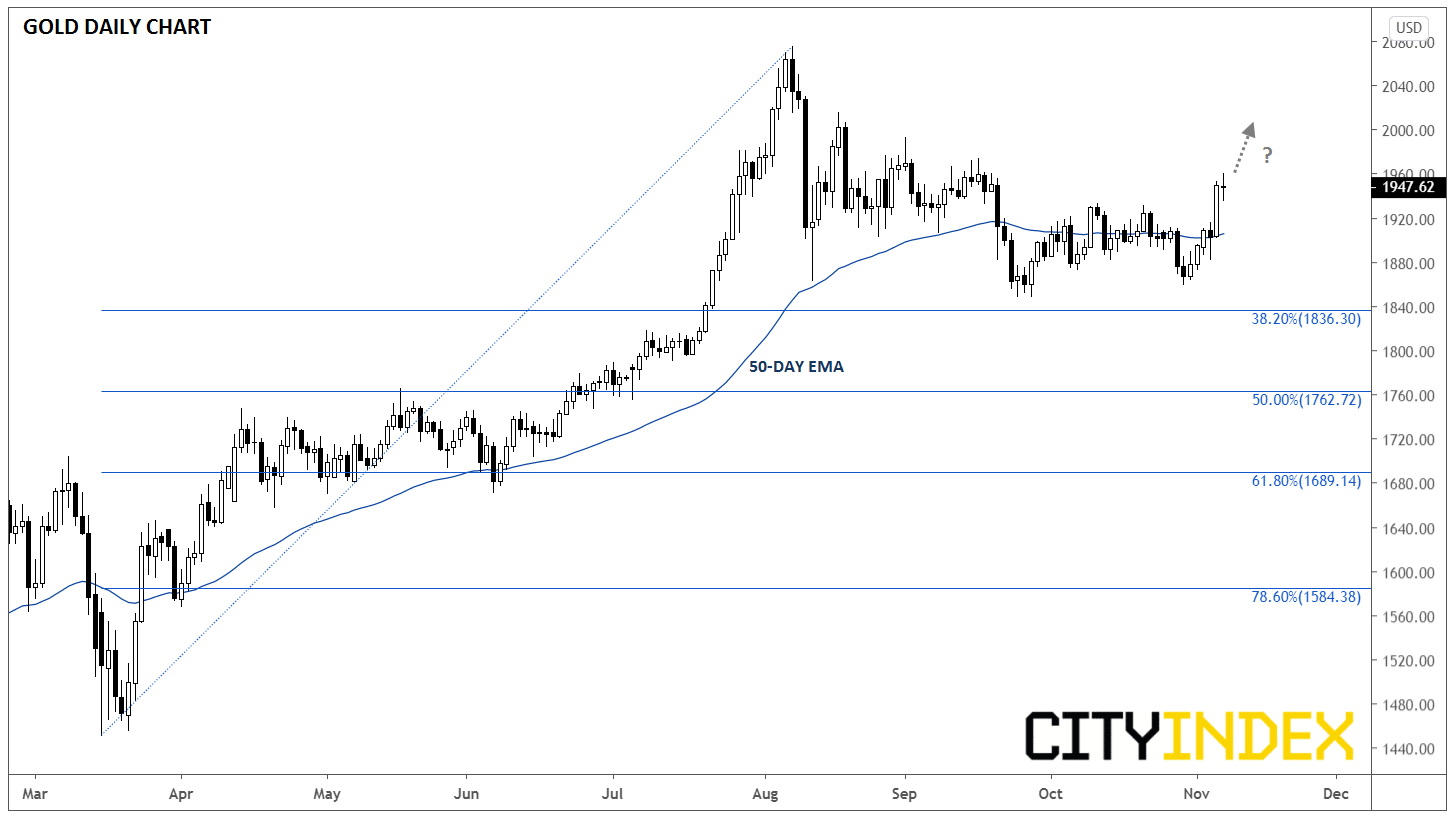
Finally, tying together the comments above, the Federal Reserve will likely have to leave the monetary spigots wide open to account for an expected lack of action from US fiscal authorities. With asset purchases and near-zero percent interest rates likely to remain in place for years to come, commodities like gold and oil that are priced in the US dollar may see a tailwind under the expected US political regime. As we can see below, gold has already caught a bid this week and could soon make a run back toward the psychologically-significant $2000 level next.
Source: TradingView, GAIN Capital
Of course, there are many factors beyond just US politics influencing all of these global markets, so traders should continue to monitor the virus data, market trends, global geopolitical developments, and the prospects for fiscal/monetary policy in other countries as well. In fact, we’re looking forward returning to a more “normal” environment that isn’t so focused on US politics in the days and weeks to come!



The complete CFD trading experience
Award-winning platforms, competitive spreads, low commissions and dedicated support.
We live and breathe the markets and are dedicated to helping traders realise their ambitions as we continue to set the industry bar.
Economic calendar
Web Trader platform
Our sophisticated web-based platform is packed with features.
Related articles

EUR/USD Q4 2026 Outlook: Euro at a Crossroads as Fed, ECB Tighten 9 25 2026
EUR/USD enters Q4 at a pivotal inflection point as competing Fed-ECB policy paths and persistent inflation risks collide with major technical support.


USD/JPY Q4 2026 Outlook: Hawkish Fed Pricing Clashes With Intervention Risk
The year-end tug-of-war is clear: hawkish Fed pricing supports USD/JPY, while intervention risk limits the upside.


Japanese Yen Forecast: USD/JPY 4% Rally Challenges Post-Intervention Downtrend 9 24 2026
USD/JPY momentum has shifted sharply higher, putting a major resistance confluence in focus as U.S. and Japanese event risk builds.
StoneX Europe Ltd may make third party material available on this website which may contain information included but not limited to the conditions of financial markets. The material is for information purposes only and does not contain, and should not be construed as containing, investment advice and/or investment recommendation and/or an investment research and/or an offer of or solicitation for any transactions in financial instruments; any decision to enter into a specific transaction shall be made by the client following an assessment by him/her of their situation.
StoneX Europe Ltd makes no representation or warranty and assumes no liability as to the accuracy or completeness of the information provided, nor any loss arising from any investment based on a recommendation, forecast or other information supplied. You should always seek independent advice as to your suitability to speculate in any related markets and your ability to assume the associated risks, if you are at all unsure. We are not under any obligation to update any such material. Any opinion made may be personal to the author and may not reflect the opinion of StoneX Europe Ltd.