




FOMC meeting preview USDJPY in focus as Powell holds fire
When it comes to the FX market, the Fed will always have its biggest influence on the US dollar...
Share this:

More than a year on from the first (reported) COVID-19 case in the US, the world’s largest economy remains on thin ice. Despite optimism around multiple highly-effective vaccines, initial unemployment claims have ticked up in recent weeks, and countless businesses are struggling to hold on amidst government-mandated shutdowns until the economy can start to “return to normal” in the second half of the year.
Against this backdrop, the Federal Reserve’s decision is clear: Continue to offer maximum stimulus, with large ongoing asset purchases and interest rates at 0%. Previous hints of tapering asset purchases (“quantitative easing”) have been walked back in recent days, with officials opting indicating that they’d like to see “substantial further progress” toward the central bank’s dual mandate, 2% average inflation and maximum employment.
In terms of changes for this year, it is notable that Christopher Waller, who was sworn in by the Board of Governors last month, will vote in his first FOMC meeting this year. Between Waller and the normal yearly rotation between regional Fed Presidents, the 2021 voters are on track to have a slightly more dovish tilt this year, though it’s unlikely that the central bank would be tightening policy meaningfully this year regardless.
Following the December release of the Fed’s Summary of Economic Projections (SEP), the policymaking body will not be releasing updated economic forecasts until March. This means that traders will key in on Fed Chairman Jerome Powell’s press conference more than usual, with the Chairman likely to voice support for expanded fiscal stimulus and emphasize the downside risks to the near-term economic outlook, even if he remains cautiously optimistic over the longer-term prospects.
Market to watch: USD/JPY
When it comes to the FX market, the Fed will always have its biggest influence on the US dollar. Though no meaningful changes are expected to monetary policy for months, the central bank’s economic outlook for the year, along with any details on how Powell and company intend to eventually wind down the current unprecedented stimulus, could lead to short-term volatility in the US dollar.
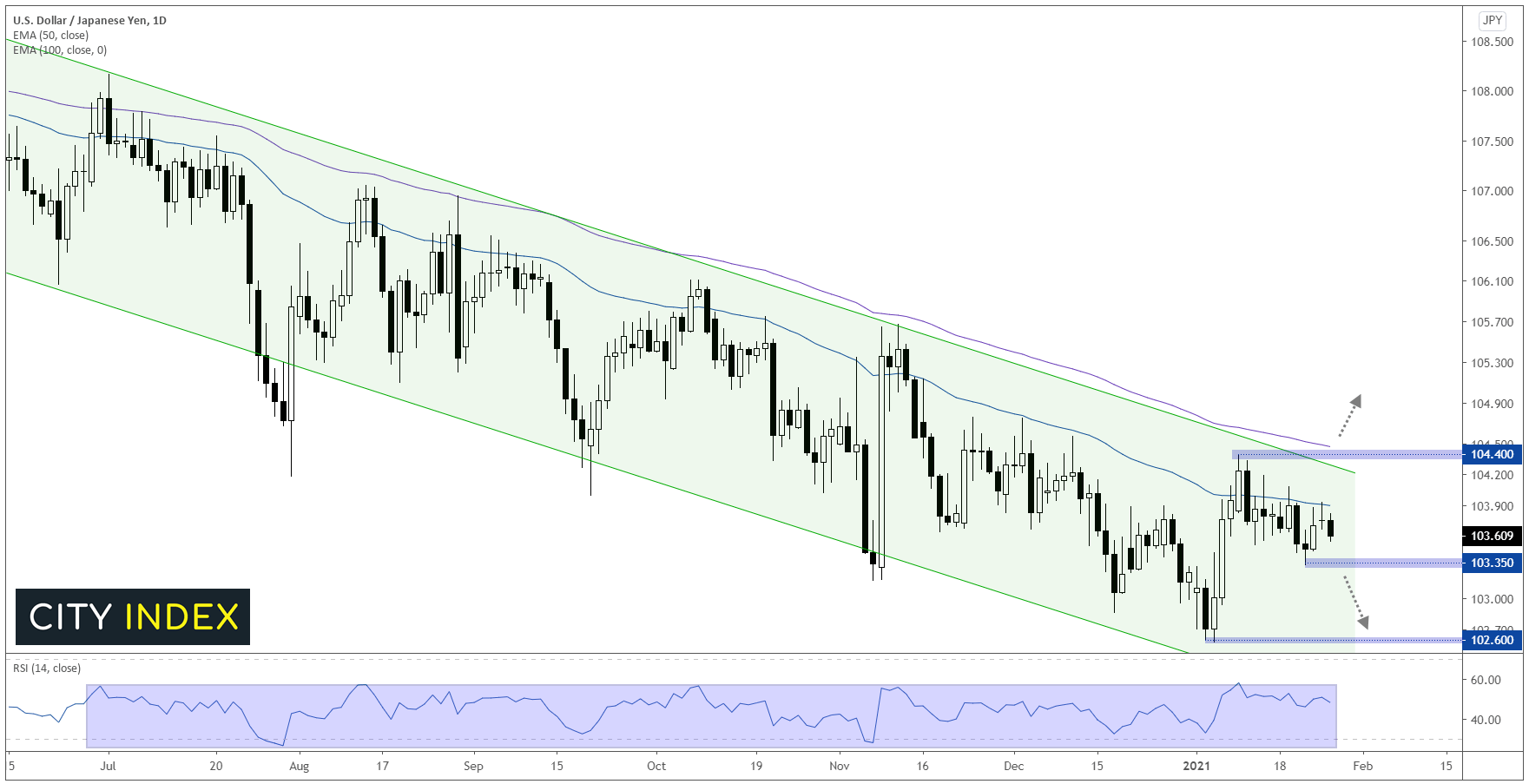
Looking at the USD/JPY pairing, rates remain in a clear bearish channel dating back to Q2 2020. More recently, the pair has spent the last two weeks consolidating in the upper-103.00s after the early January spike. With the bearish channel intact and longer-term moving averages capping prices of late, the path of least resistance for USD/JPY remains to the downside. A break of last week’s low near 103.35 could clear the way for the unit to retest its post-pandemic low around 102.60 heading into February:
Source: TradingView, GAIN Capital
Meanwhile, a bullish breakout above 104.40 would be needed to erase the bearish bias; such a move would be seen as stronger if the pair’s 14-day RSI is able to break above the 60 level which has capped every rally for the last eight months.
Learn more about forex trading opportunities.
More than a year on from the first (reported) COVID-19 case in the US, the world’s largest economy remains on thin ice. Despite optimism around multiple highly-effective vaccines, initial unemployment claims have ticked up in recent weeks, and countless businesses are struggling to hold on amidst government-mandated shutdowns until the economy can start to “return to normal” in the second half of the year.
Against this backdrop, the Federal Reserve’s decision is clear: Continue to offer maximum stimulus, with large ongoing asset purchases and interest rates at 0%. Previous hints of tapering asset purchases (“quantitative easing”) have been walked back in recent days, with officials opting indicating that they’d like to see “substantial further progress” toward the central bank’s dual mandate, 2% average inflation and maximum employment.
In terms of changes for this year, it is notable that Christopher Waller, who was sworn in by the Board of Governors last month, will vote in his first FOMC meeting this year. Between Waller and the normal yearly rotation between regional Fed Presidents, the 2021 voters are on track to have a slightly more dovish tilt this year, though it’s unlikely that the central bank would be tightening policy meaningfully this year regardless.
Following the December release of the Fed’s Summary of Economic Projections (SEP), the policymaking body will not be releasing updated economic forecasts until March. This means that traders will key in on Fed Chairman Jerome Powell’s press conference more than usual, with the Chairman likely to voice support for expanded fiscal stimulus and emphasize the downside risks to the near-term economic outlook, even if he remains cautiously optimistic over the longer-term prospects.
Market to watch: USD/JPY
When it comes to the FX market, the Fed will always have its biggest influence on the US dollar. Though no meaningful changes are expected to monetary policy for months, the central bank’s economic outlook for the year, along with any details on how Powell and company intend to eventually wind down the current unprecedented stimulus, could lead to short-term volatility in the US dollar.
Looking at the USD/JPY pairing, rates remain in a clear bearish channel dating back to Q2 2020. More recently, the pair has spent the last two weeks consolidating in the upper-103.00s after the early January spike. With the bearish channel intact and longer-term moving averages capping prices of late, the path of least resistance for USD/JPY remains to the downside. A break of last week’s low near 103.35 could clear the way for the unit to retest its post-pandemic low around 102.60 heading into February:
Source: TradingView, GAIN Capital
Meanwhile, a bullish breakout above 104.40 would be needed to erase the bearish bias; such a move would be seen as stronger if the pair’s 14-day RSI is able to break above the 60 level which has capped every rally for the last eight months.
Learn more about forex trading opportunities.
Latest market news




The complete CFD trading experience
Award-winning platforms, competitive spreads, low commissions and dedicated support.
We live and breathe the markets and are dedicated to helping traders realise their ambitions as we continue to set the industry bar.
Economic calendar
Web Trader platform
Our sophisticated web-based platform is packed with features.
Related articles

Gold Analysis: Rising Yields and Dollar Strength Weigh on XAU/USD
The trading week continues, and for now gold remains under notable pressure in the short term. This can be seen in the performance of XAU/USD over the last three trading sessions, where the metal has declined by more than 2.00%, bringing a bearish bias back into focus after it had lost momentum in recent weeks.


NZD/USD: US yield advantage keeps pressure on the Kiwi
NZD/USD has become unusually sensitive to relative front-end rates, with the US two-year yield advantage now near historically extreme levels.

USD/MXN Analysis: Can the Peso Recover Against a More Aggressive Fed?
Although the Mexican peso is attempting to regain some ground during today's session, price action throughout the week shows a gain of more than 1.00% in USD/MXN, highlighting buying momentum that continues to favor the U.S. dollar.
StoneX Europe Ltd may make third party material available on this website which may contain information included but not limited to the conditions of financial markets. The material is for information purposes only and does not contain, and should not be construed as containing, investment advice and/or investment recommendation and/or an investment research and/or an offer of or solicitation for any transactions in financial instruments; any decision to enter into a specific transaction shall be made by the client following an assessment by him/her of their situation.
StoneX Europe Ltd makes no representation or warranty and assumes no liability as to the accuracy or completeness of the information provided, nor any loss arising from any investment based on a recommendation, forecast or other information supplied. You should always seek independent advice as to your suitability to speculate in any related markets and your ability to assume the associated risks, if you are at all unsure. We are not under any obligation to update any such material. Any opinion made may be personal to the author and may not reflect the opinion of StoneX Europe Ltd.