




FOMC meeting preview Will inflation spook the Fed
The most important data point to watch will be the central bank’s expectations for interest rates in 2022 and 2023...
Share this:

Traders are still digesting the surprising outcome of Thursday’s ECB meeting, wherein the central bank announced that it would start purchasing bonds at a “significantly higher pace” over the next quarter in an attempt to get ahead of rising yields and (potential) increasing price pressures in the coming months.
Beyond its immediate implications for European assets, this decision underscores different approaches to THE biggest question vexing global central bankers this year: Is the coordinated rise in bond yields across the globe signaling excessive inflation in the coming quarters?
While the ECB appears to think the answer to that question may be “yes,” recent comments from Federal Reserve policymakers suggest that they’re still skeptical of a sustained uptick in inflation. With the US central bank scheduled for their semi-quarterly monetary policy meeting on Wednesday March 17, traders will be eager to see if the Fed’s resolve remains steadfast. To that end, a couple of solid to outright strong long-term Treasury bond auctions this week could convince the central bank to hold off on any additional stimulus at this month’s meeting.
Fed meeting: Key things to watch
This month’s meeting will be accompanied by the quarterly update to the central bank’s economic projections, and given the recent shifts in yields and market-based measures of inflation expectations, the most important data point to watch will be the central bank’s expectations for interest rates in 2022 and 2023 (the infamous “dot plot”).
In their December projections, only one Fed policymaker expected interest rates to rise off the current, essentially 0% interest rate level by 2022. If several more policymakers indicate an expected rate hike as soon as next year, or if the median member starts to expect a hike in 2023, it would show that US central bankers may not be as united and sanguine on price pressures as they’ve appeared to date.
In addition to interest rate expectations, the market will also scrutinize the central banks economic projections. Given the just-passed fiscal stimulus bill and rapid progress of vaccinations in the country, the Fed’s December forecasts for 4.2% economic growth and a 5.0% unemployment rate at the end of the year look overly pessimistic; they are likely to be revised higher, though it will be interesting to see if those revisions also “pull forward” previously-expected economic improvements from 2022 and 2023.
Finally, any changes to the official monetary policy statement, as well as the general tone of Fed Governor Jerome Powell’s press conference, could provide insight on the Fed’s plans moving forward. Expect media members to grill Powell on the definition of “substantial progress” toward the central bank’s employment and price stability goals in an attempt to glean insight into when bond purchases could cease and interest rates could rise.
Given its previous premature attempts to tighten policy, the central bank may be most likely to remain in “lower for longer” / “wait and see” for this meeting, with any evidence of rising inflation characterized as transitory for now.
Fed meeting: USD impact
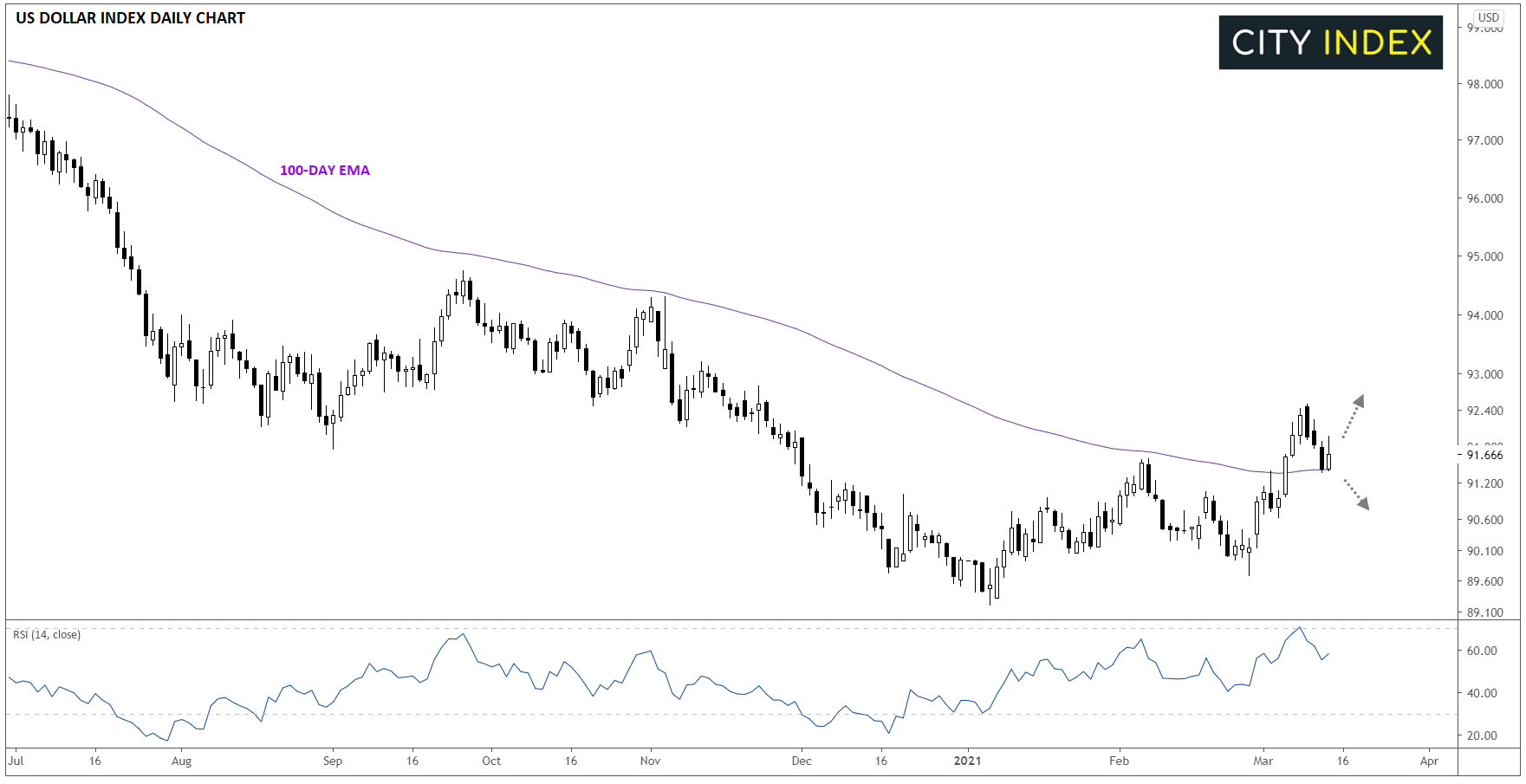
As for the world’s reserve currency, the US dollar has caught a bid so far this month, albeit off a relatively low level. If the Fed makes no changes to policy and expresses no immediate concerns about inflation, it would serve as a proverbial “green light” for traders to push bond yields, and by extension the US dollar, higher. Meanwhile, any explicit concerns about inflation or hints at stepping up bond purchases like we saw from the ECB could hit the greenback and drive the dollar index lower.
Source: StoneX
Learn more about forex trading opportunities.
Traders are still digesting the surprising outcome of Thursday’s ECB meeting, wherein the central bank announced that it would start purchasing bonds at a “significantly higher pace” over the next quarter in an attempt to get ahead of rising yields and (potential) increasing price pressures in the coming months.
Beyond its immediate implications for European assets, this decision underscores different approaches to THE biggest question vexing global central bankers this year: Is the coordinated rise in bond yields across the globe signaling excessive inflation in the coming quarters?
While the ECB appears to think the answer to that question may be “yes,” recent comments from Federal Reserve policymakers suggest that they’re still skeptical of a sustained uptick in inflation. With the US central bank scheduled for their semi-quarterly monetary policy meeting on Wednesday March 17, traders will be eager to see if the Fed’s resolve remains steadfast. To that end, a couple of solid to outright strong long-term Treasury bond auctions this week could convince the central bank to hold off on any additional stimulus at this month’s meeting.
Fed meeting: Key things to watch
This month’s meeting will be accompanied by the quarterly update to the central bank’s economic projections, and given the recent shifts in yields and market-based measures of inflation expectations, the most important data point to watch will be the central bank’s expectations for interest rates in 2022 and 2023 (the infamous “dot plot”).
In their December projections, only one Fed policymaker expected interest rates to rise off the current, essentially 0% interest rate level by 2022. If several more policymakers indicate an expected rate hike as soon as next year, or if the median member starts to expect a hike in 2023, it would show that US central bankers may not be as united and sanguine on price pressures as they’ve appeared to date.
In addition to interest rate expectations, the market will also scrutinize the central banks economic projections. Given the just-passed fiscal stimulus bill and rapid progress of vaccinations in the country, the Fed’s December forecasts for 4.2% economic growth and a 5.0% unemployment rate at the end of the year look overly pessimistic; they are likely to be revised higher, though it will be interesting to see if those revisions also “pull forward” previously-expected economic improvements from 2022 and 2023.
Finally, any changes to the official monetary policy statement, as well as the general tone of Fed Governor Jerome Powell’s press conference, could provide insight on the Fed’s plans moving forward. Expect media members to grill Powell on the definition of “substantial progress” toward the central bank’s employment and price stability goals in an attempt to glean insight into when bond purchases could cease and interest rates could rise.
Given its previous premature attempts to tighten policy, the central bank may be most likely to remain in “lower for longer” / “wait and see” for this meeting, with any evidence of rising inflation characterized as transitory for now.
Fed meeting: USD impact
As for the world’s reserve currency, the US dollar has caught a bid so far this month, albeit off a relatively low level. If the Fed makes no changes to policy and expresses no immediate concerns about inflation, it would serve as a proverbial “green light” for traders to push bond yields, and by extension the US dollar, higher. Meanwhile, any explicit concerns about inflation or hints at stepping up bond purchases like we saw from the ECB could hit the greenback and drive the dollar index lower.
Source: StoneX
Learn more about forex trading opportunities.
Latest market news




The complete CFD trading experience
Award-winning platforms, competitive spreads, low commissions and dedicated support.
We live and breathe the markets and are dedicated to helping traders realise their ambitions as we continue to set the industry bar.
Economic calendar
Web Trader platform
Our sophisticated web-based platform is packed with features.
Related articles
USD/JPY Q4 2026 Outlook: Hawkish Fed Pricing Clashes With Intervention Risk
The year-end tug-of-war is clear: hawkish Fed pricing supports USD/JPY, while intervention risk limits the upside.
USD/CAD and USD/MXN Q4 2026 Outlook: Will the U.S. Dollar Dominate North America Again?
The final stretch of 2026 is approaching, and North America's major currencies have begun to show a shift in the strength dynamics seen earlier in the year. New expectations of a more aggressive monetary policy stance, particularly in the United States, could be significantly reshaping the outlook for the region. At the same time, this backdrop, combined with potential trade tensions across North America, may become one of the most important drivers of currency performance in the months ahead.


Gold Analysis: Rising Yields and Dollar Strength Weigh on XAU/USD
The trading week continues, and for now gold remains under notable pressure in the short term. This can be seen in the performance of XAU/USD over the last three trading sessions, where the metal has declined by more than 2.00%, bringing a bearish bias back into focus after it had lost momentum in recent weeks.
StoneX Europe Ltd may make third party material available on this website which may contain information included but not limited to the conditions of financial markets. The material is for information purposes only and does not contain, and should not be construed as containing, investment advice and/or investment recommendation and/or an investment research and/or an offer of or solicitation for any transactions in financial instruments; any decision to enter into a specific transaction shall be made by the client following an assessment by him/her of their situation.
StoneX Europe Ltd makes no representation or warranty and assumes no liability as to the accuracy or completeness of the information provided, nor any loss arising from any investment based on a recommendation, forecast or other information supplied. You should always seek independent advice as to your suitability to speculate in any related markets and your ability to assume the associated risks, if you are at all unsure. We are not under any obligation to update any such material. Any opinion made may be personal to the author and may not reflect the opinion of StoneX Europe Ltd.