




Key 2020 US Election Dates and Markets to Watch
See a schedule of key dates to watch around the 2020 US election and the potential markets to watch throughout the election!
Share this:

** Update (9 October 2020): Following President Trump's COVID-19 diagnosis, the second debate has been postponed/cancelled. We will update this article as we hear more about whether there will be any additional Presidential debates before the election. **
When is the US election?
All 50 states and Washington DC will head to the polls on Tuesday, 3 November 2020. Citizens will be voting across six different timezones, with final results historically being announced around 11:00pm-12:00am EST (4:00am-5:00am GMT on Wednesday 4 November 2020). However, the share of mail-in votes is likely to exceed the historical average of 20-25% of all ballots given the ongoing COVID-19 pandemic, so there is a risk that the result is not made official until later in the week (or even later in the month!).
What are the key dates to watch before the election?
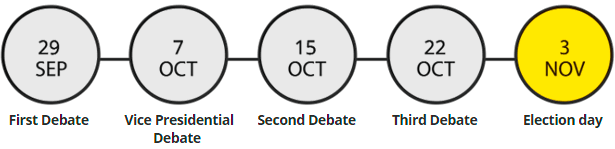
Ahead of the election, there are several key debates that may have a big impact on the polls:
- 29 September: First presidential debate at Case Western Reserve University and Cleveland Clinic in Cleveland, Ohio.
- 7 October: Vice presidential debate at the University of Utah in Salt Lake City, Utah.
- 15 October: Second presidential debate at the Adrienne Arsht Center for the Performing Arts in Miami, Florida.
- 22 October: Third presidential debate at Belmont University in Nashville, Tennessee.
What are the key dates to watch after the election?
Unlike in previous years, the result may not be clear on Election night – instead, we may be looking at more of an election week or election month before the result is confirmed. Accordingly, the procedural dates after election night may be relevant:
- 14 December: Members of the Electoral College will cast their official ballots for president. Under the U.S. system, the winner of each state's popular vote earns that state's electoral votes, which are apportioned by population. The candidate who receives a majority of the 538 electoral votes available, or 270, wins the presidency.
- 6 January 2021: Congress will meet at 1:00pm in Washington to count the electoral votes and declare a winner.
- 20 January 2021: Inauguration Day. The winner and his running mate will be sworn in as president and vice president at the U.S. Capitol in Washington.
What will that mean for markets?
In a year full of unprecedented events, the 2020 presidential election will undoubtedly be another event that looks different than in the past. Traders expecting a clear winner by midnight EST will likely be in for disappointment; according to a recent Axios/Ipsos poll, only about a third (36%) of US adults expect a winner to be announced on election night, with an addition quarter (24%) expecting a formal result within the next day or two. Fully 25% of survey respondents expect the outcome to be unclear for more than a week after election day!
Nonetheless, traders will still try to handicap which candidate is most likely to win based on the outcome of “election night.” While the US stock market will remain closed overnight, index futures, international stocks, commodities markets, and the foreign exchange market will all be open to present trading opportunities.
Be sure to tune in for our full election week coverage, including our constantly-updating live blog on election night for instant analysis of how the results are impacting the markets you’re trading!
** Update (9 October 2020): Following President Trump's COVID-19 diagnosis, the second debate has been postponed/cancelled. We will update this article as we hear more about whether there will be any additional Presidential debates before the election. **
When is the US election?
All 50 states and Washington DC will head to the polls on Tuesday, 3 November 2020. Citizens will be voting across six different timezones, with final results historically being announced around 11:00pm-12:00am EST (4:00am-5:00am GMT on Wednesday 4 November 2020). However, the share of mail-in votes is likely to exceed the historical average of 20-25% of all ballots given the ongoing COVID-19 pandemic, so there is a risk that the result is not made official until later in the week (or even later in the month!).
What are the key dates to watch before the election?
Ahead of the election, there are several key debates that may have a big impact on the polls:
- 29 September: First presidential debate at Case Western Reserve University and Cleveland Clinic in Cleveland, Ohio.
- 7 October: Vice presidential debate at the University of Utah in Salt Lake City, Utah.
- 15 October: Second presidential debate at the Adrienne Arsht Center for the Performing Arts in Miami, Florida.
- 22 October: Third presidential debate at Belmont University in Nashville, Tennessee.
What are the key dates to watch after the election?
Unlike in previous years, the result may not be clear on Election night – instead, we may be looking at more of an election week or election month before the result is confirmed. Accordingly, the procedural dates after election night may be relevant:
- 14 December: Members of the Electoral College will cast their official ballots for president. Under the U.S. system, the winner of each state's popular vote earns that state's electoral votes, which are apportioned by population. The candidate who receives a majority of the 538 electoral votes available, or 270, wins the presidency.
- 6 January 2021: Congress will meet at 1:00pm in Washington to count the electoral votes and declare a winner.
- 20 January 2021: Inauguration Day. The winner and his running mate will be sworn in as president and vice president at the U.S. Capitol in Washington.
What will that mean for markets?
In a year full of unprecedented events, the 2020 presidential election will undoubtedly be another event that looks different than in the past. Traders expecting a clear winner by midnight EST will likely be in for disappointment; according to a recent Axios/Ipsos poll, only about a third (36%) of US adults expect a winner to be announced on election night, with an addition quarter (24%) expecting a formal result within the next day or two. Fully 25% of survey respondents expect the outcome to be unclear for more than a week after election day!
Nonetheless, traders will still try to handicap which candidate is most likely to win based on the outcome of “election night.” While the US stock market will remain closed overnight, index futures, international stocks, commodities markets, and the foreign exchange market will all be open to present trading opportunities.
Be sure to tune in for our full election week coverage, including our constantly-updating live blog on election night for instant analysis of how the results are impacting the markets you’re trading!
Latest market news




The complete CFD trading experience
Award-winning platforms, competitive spreads, low commissions and dedicated support.
We live and breathe the markets and are dedicated to helping traders realise their ambitions as we continue to set the industry bar.
Economic calendar
Web Trader platform
Our sophisticated web-based platform is packed with features.
Related articles

Crude Oil Weekly Outlook: WTI Holds Above $97 as US–Iran Proposals Misalign, Supply Risks Persist
Crude Oil Weekly Outlook: US–Iran proposals remain misaligned, choking what could become the largest supply shock in history in terms of inventories and flows. This continues to support WTI and Brent in bullish territory, holding above $93 and $100, respectively.


Crude Oil Traders Face Whipsaw Risk as Iran Talks Shift Sentiment
Razan Hilal, Market Analyst at FOREX.com, analyzes crude oil price volatility as U.S.-Iran negotiations drive rapid sentiment shifts and technical reversals. Prices dropped sharply on optimism around a potential deal, only to rebound as uncertainty over the Strait of Hormuz and ongoing disruptions resurfaced. She outlines the key levels traders are watching and what could confirm either a deeper selloff or a renewed bullish trend.

FOMC Meeting Preview: Powell Poised to Pass the Grenade to Warsh?
Traders and economists expect the Fed to hold interest rates in the 3.50-3.75% range, but the biggest question is whether FOMC Chairman Jerome Powell will stay on the Federal Reserve’s board.
StoneX Europe Ltd may make third party material available on this website which may contain information included but not limited to the conditions of financial markets. The material is for information purposes only and does not contain, and should not be construed as containing, investment advice and/or investment recommendation and/or an investment research and/or an offer of or solicitation for any transactions in financial instruments; any decision to enter into a specific transaction shall be made by the client following an assessment by him/her of their situation.
StoneX Europe Ltd makes no representation or warranty and assumes no liability as to the accuracy or completeness of the information provided, nor any loss arising from any investment based on a recommendation, forecast or other information supplied. You should always seek independent advice as to your suitability to speculate in any related markets and your ability to assume the associated risks, if you are at all unsure. We are not under any obligation to update any such material. Any opinion made may be personal to the author and may not reflect the opinion of StoneX Europe Ltd.