



Nasdaq 100 forecast: Stocks continue rebound despite rising oil and elevated bond yields
US equities extended their gains after the open with the major indices managing a modest recovery yesterday. At the time of writing, the Nasdaq 100 was up 1% and leading the pack. Despite the gains, it is difficult to read too much into the move. The underlying backdrop remains challenging. Many of the existing risks that have unsettled markets recently are still firmly in place.
Share this:

US equities extended their gains after the open with the major indices managing a modest recovery yesterday. At the time of writing, the Nasdaq 100 was up 1% and leading the pack. Despite the gains, it is difficult to read too much into the move. The underlying backdrop remains challenging. Many of the existing risks that have unsettled markets recently are still firmly in place. From the fresh escalation between US and Iran, forcing WTI above $90 a barrel and raising the prospect of another inflationary shock, to ongoing bond market turbulence and the potential reverse yen-funded carry trade. All or any of these risks are enough to trigger another bout of selling across risk assets. But for now, it looks like Waller’s dovish remarks and the sharp drop in USD/JPY are helping to keep the bulls interested. Still, the risks to our Nasdaq 100 forecast remain tilted to the downside.
Equities face a tougher macro backdrop
Risk appetite has apparently improved again having deteriorated sharply earlier this week. Oil and US Treasury yields have been the main culprits behind the recent stock market volatility, as investors respond to the worsening geopolitical backdrop and a hawkish Fed.
The concern for equity markets is that several pressures are now working in the same direction. Higher crude prices threaten to push inflation higher, with investors also forced to reassess the Fed’s policy outlook.
Meanwhile, relatively soft economic data have done little to prevent markets from adopting a more hawkish view of US rates.
There is another potential source of volatility in the currency market. The stronger yen is raising concerns that yen-funded carry trades could begin to unwind, potentially adding another layer of forced selling across risk assets. So far, this hasn’t been evidence in equities but it is nonetheless something to keep an eye on.
Higher yields are becoming harder for markets to ignore
But the biggest risk I reckon is the continued upward move in bond yields. This is particularly important for equities. Fed Chair Kevin Warsh’s hawkish Jackson Hole speech has brought the possibility of a September rate hike firmly back into focus, despite subsequent economic data failing to provide much support for a more aggressive policy stance.
That shift in expectations has been reflected across global bond markets, with yields moving higher along the curve.
The US 10-year Treasury yield climbed to a fresh 19-month high, while the 30-year yield has also moved above recent peaks, before easing lower in the last couple of days. It is perhaps this small pullback in yields that have caused equities to rebound. But the trend is clearly bullish for yields and dips could prove to be short lived. Put another way, the recovery for stocks could be short lived.
Meanwhile in Japan, the simultaneous recovery in both the yen and yields suggests investors may also be taking the prospect of tighter Bank of Japan policy more seriously. A potential 50-basis-point rate increase at the upcoming meeting, particularly if accompanied by guidance pointing to further hikes, could reignite concerns about an unwinding of yen-funded carry trades.
Higher yields increase the opportunity cost of owning stocks, while expensive, long-duration areas of the market — particularly technology — are typically among the most sensitive to changes in discount rates.
That leaves the Nasdaq 100 forecast particularly exposed if the bond sell-off continues.
Can the economic data shift the Fed narrative?
Well, the Fed’s Waller has spoken today and among other things said that he’s open to leaving rates unchanged at the FOMC’s upcoming meeting should the latest CPI data point to cooling inflation. He added that he’s seen some signs of disinflation in recent data. But that’s quite a different view from the Fed’s Chair, who clearly has more influence.
So, the key question now is whether incoming US data can challenge the increasingly hawkish rate outlook before the September 16 FOMC meeting.
Investors still have one more payroll report, due on Friday, followed by the August CPI release next week, as well as a number of secondary economic indicators.
In theory, weaker data could push back against expectations of a September hike. In practice, however, the Fed Chair’s hawkish tone at Jackson Hole may make it harder for incoming numbers to materially change the narrative.
Technical Nasdaq 100 forecast and key levels to watch
Consolidation is the name of the game for the Nasdaq 100. The tech-heavy index has recently slipped back below its 21-day exponential moving average and remains below the pivotal 29,430 level, while price action continues to develop within what appears to be a falling-wedge formation.
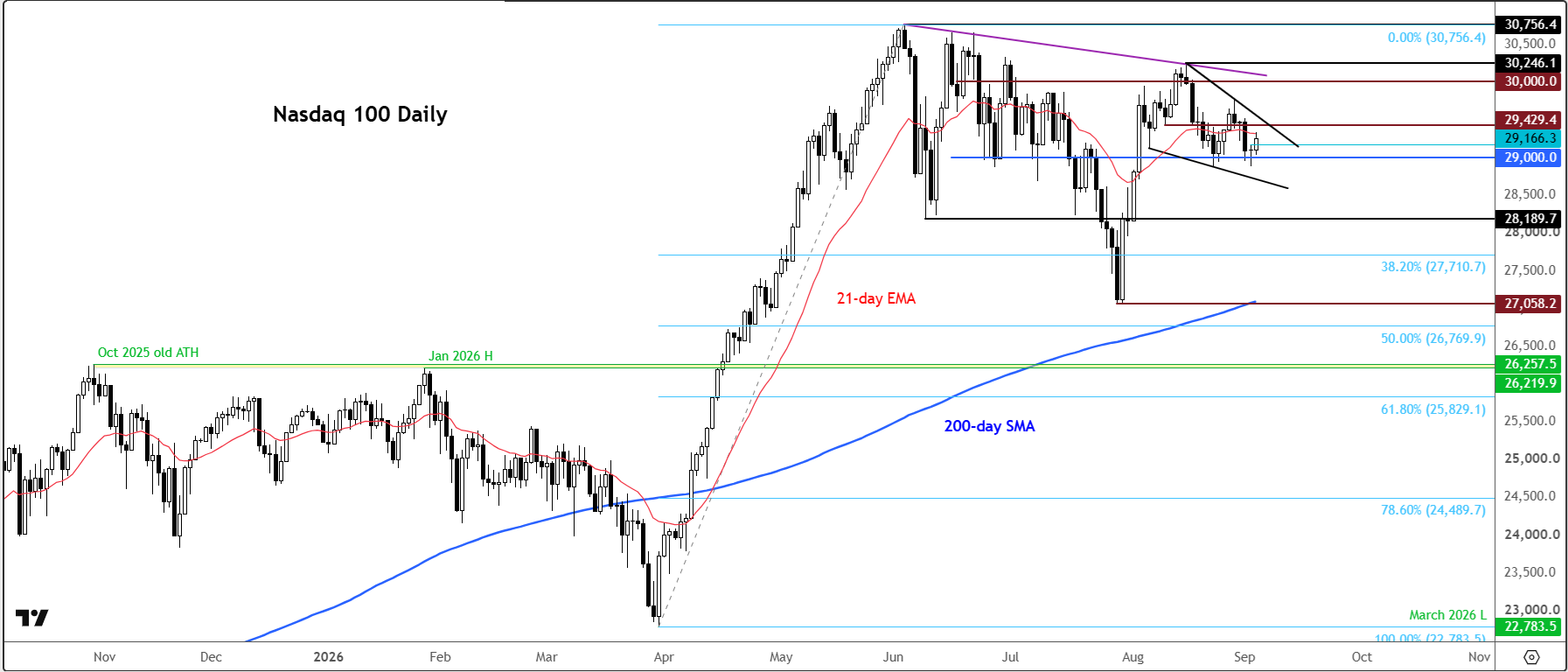
The longer-term trend is therefore not decisively bearish, but the recent price action is hardly bullish. In the current environment, trading from level to level may make more sense than positioning for a large directional swing.
If selling pressure resumes from here, the first area to watch is the lower support trend of the wedge around 28,700. A break below that would bring 28,190 into focus, followed by the psychologically important 28,000 level.
Watch oil prices and bonds
For now, the clearest signals are likely to come from the oil and bond markets.
Further gains in either could put additional pressure on equities, but a sustained rise in crude would be particularly uncomfortable. It would reinforce inflation concerns at precisely the wrong time and increase the risk of tighter monetary policy not only in the US but across developed markets more broadly.

Related tags:



The complete CFD trading experience
Award-winning platforms, competitive spreads, low commissions and dedicated support.
We live and breathe the markets and are dedicated to helping traders realise their ambitions as we continue to set the industry bar.
Economic calendar
Web Trader platform
Our sophisticated web-based platform is packed with features.
Related articles

Gold Outlook: XAU/USD hit hard as US yields, dollar resume ascent
A stronger dollar, surging front-end yields and renewed geopolitical tension have combined to push gold back towards key technical support.

EUR/USD weekly outlook: Oil, inflation and NFP in focus
After coming under significant pressure in recent weeks, the EUR/USD came off its lows to finish the week on a positive note on Friday, albeit with only a mild rebound. That was not enough to prevent the exchange rate falling for the third consecutive week, as the US dollar and bond yields rallied across the board.

Gold Q4 2026 outlook: Resilience in the face of rallying dollar and yields
As we headed towards the latter stages of Q3 and into Q4, the Fed had just hiked rates in a hawkish FOMC meeting, while the likes of the ECB and BoJ had also tightened their respective policies. Oil prices remained elevated amid the prolonged US-Iran conflict. Meanwhile, bond yields were breaking out, and the dollar was higher across the board. Yet, remarkably, gold was still holding in the positive territory for the third quarter, even if it had weakened somewhat in September.
StoneX Europe Ltd may make third party material available on this website which may contain information included but not limited to the conditions of financial markets. The material is for information purposes only and does not contain, and should not be construed as containing, investment advice and/or investment recommendation and/or an investment research and/or an offer of or solicitation for any transactions in financial instruments; any decision to enter into a specific transaction shall be made by the client following an assessment by him/her of their situation.
StoneX Europe Ltd makes no representation or warranty and assumes no liability as to the accuracy or completeness of the information provided, nor any loss arising from any investment based on a recommendation, forecast or other information supplied. You should always seek independent advice as to your suitability to speculate in any related markets and your ability to assume the associated risks, if you are at all unsure. We are not under any obligation to update any such material. Any opinion made may be personal to the author and may not reflect the opinion of StoneX Europe Ltd.