


Nasdaq Eyes Breakout as Yields, Dollar and Volatility Ease
Nasdaq is already benefiting from softer yields, DXY and VXN. A payrolls outcome that extends those trends would add weight to the bullish breakout case.
Share this:

- US financial conditions have eased in recent days
- Nasdaq has responded, rebounding into a resistance zone
- Persistent easing has historically delivered stronger forward returns
- Friday’s payrolls report may determine whether the bullish move extends
We’ve seen a short-term easing in US financial conditions which has coincided with a rebound in the Nasdaq, leaving the index sitting just beneath a key technical resistance zone heading into Friday’s August payrolls report.
Financial Conditions Turn in Nasdaq’s Favour
Source: TradingView, LSEG, FOREX.com
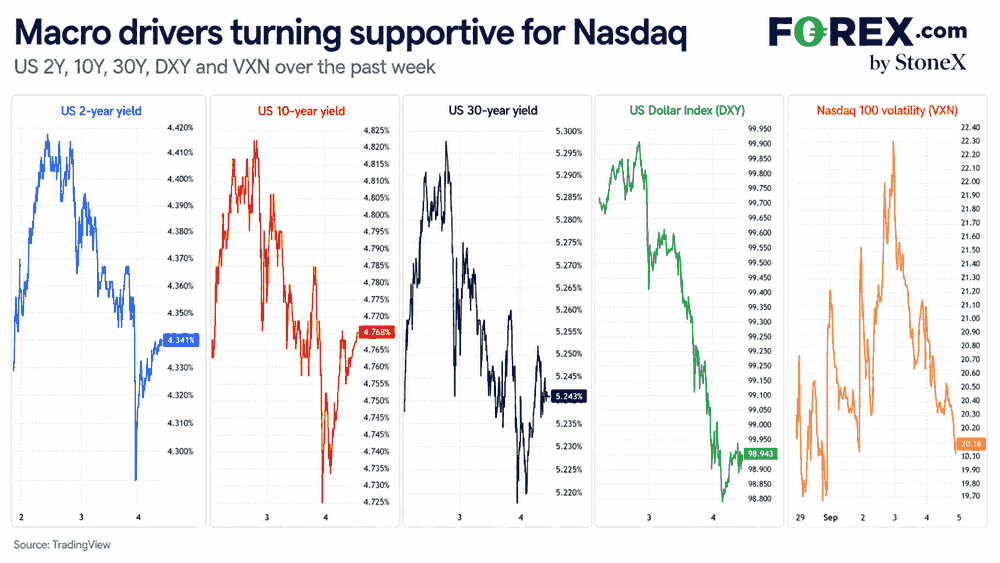
Over the past week, Treasury yields have pulled back across the curve, the US dollar has weakened and VXN, the Nasdaq equivalent of the S&P 500 volatility index, or VIX, has also reversed from levels seen earlier in the week.
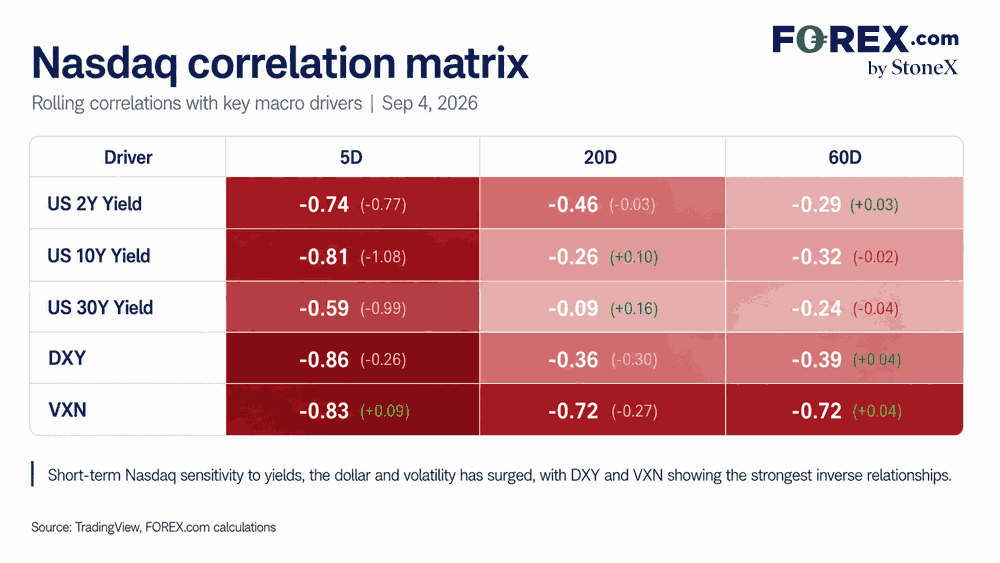
The tailwinds this has created for Nasdaq are evident in the correlation matrix below, showing the strength of the inverse relationship with yields, DXY and VXN, particularly over shorter timeframes.
Source: TradingView, FOREX.com
Put simply, as they have fallen, Nasdaq has often done the opposite.
While that has provided a short-term tailwind, backtesting suggests the persistence of easing financial conditions typically matters more than the initial shift itself.
Persistence Matters More Than the Initial Move
Source: TradingView, LSEG, FOREX.com
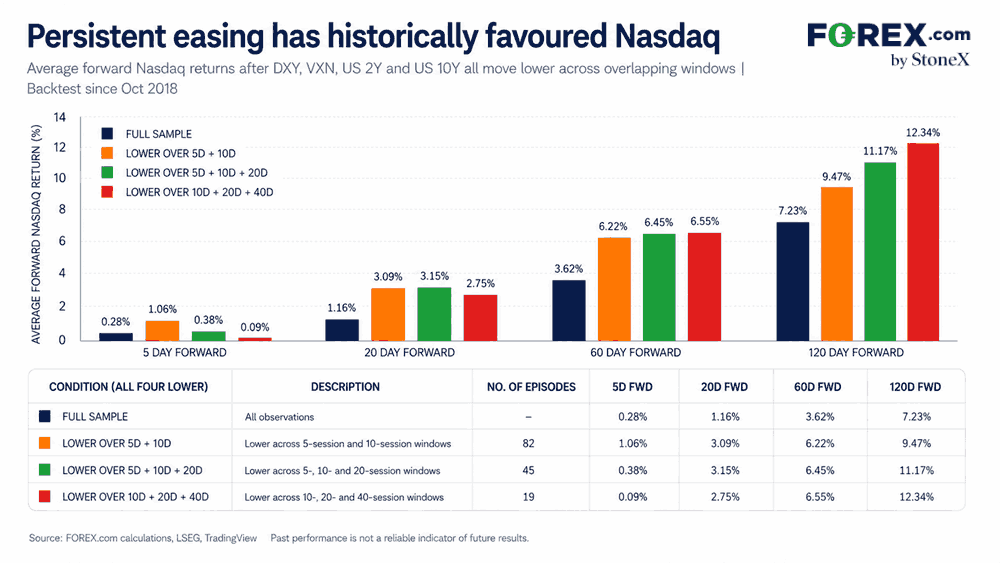
Looking at periods since late 2018 when DXY, VXN and the US 2 and 10-year yields were all falling together, Nasdaq’s forward returns improved as easing became more persistent, outperforming the broader sample over the same forward periods.
When all four were lower across five and 10-session windows, Nasdaq averaged gains of around 3.1% over the following 20 sessions, 6.2% over 60 sessions and 9.5% over 120 sessions, compared with full-sample averages of roughly 1.2%, 3.6% and 7.2%.
When the easing persisted across 10, 20 and 40-session windows, the average 60 and 120 session gains increased to around 6.6% and 12.3% respectively, again comfortably above the broader historical averages.
While strong earnings growth tied to the AI buildout has clearly been a major force behind Nasdaq’s gains, the backtesting suggests financial conditions matter too. When yields, the dollar and volatility ease together and stay lower, the index has historically performed better, pointing to macro conditions as another important driver of overall performance.
Payrolls Could Extend the Easing
That puts greater emphasis on Friday’s US non-farm payroll report, given it carries the potential to vastly impact financial conditions depending on the outcome.
August has historically been a weak month for payrolls relative to forecast, while the recent labour market has also been marked by an extraordinary run of declines in labour force participation. That has helped cap the unemployment rate even as hiring has weakened sharply, in part due to changes in labour supply and immigration.
If we were to see a pop in the participation rate without a commensurate lift in employment in the household survey, it would create upside risk for the unemployment rate regardless of how payrolls prints in the establishment survey. That would likely weigh on Treasury yields and DXY, while also putting downward pressure on VXN.
That would create the kind of backdrop that has recently worked in Nasdaq’s favour and, if the easing persists, the backtesting suggests the support could extend well beyond the immediate reaction.
Of course, the opposite may apply if we get a blowout jobs report. A stronger payrolls outcome, or a result that keeps the unemployment rate contained, could push yields and DXY higher again, tightening financial conditions and potentially limiting upside for the index.
Nasdaq Jammed Beneath Resistance
Source: TradingView
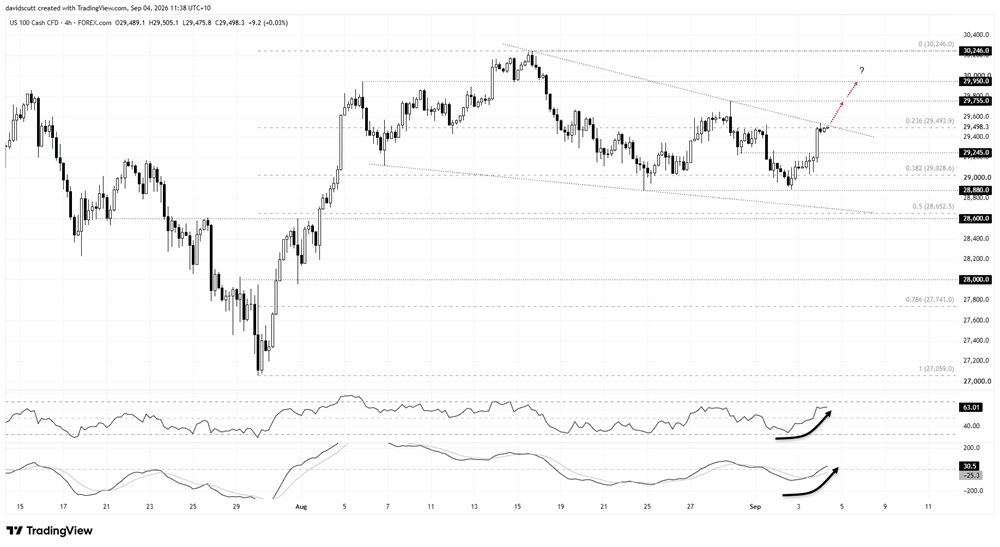
That backdrop creates an interesting setup for the Nasdaq heading into the payrolls report, with the index now jammed against a confluence of resistance comprising the downtrend running from the highs set in the middle of August, along with the 23.6% Fibonacci retracement of the July to August bull move.
With RSI (14) pushing higher away from the neutral 50 level and MACD flipping positive, having already crossed the signal line, the message is that upside momentum is building, favouring long setups over shorts.
If we see a sustained break above the confluence of the 23.6% Fib and downtrend resistance around 29,500, it would allow for a setup where longs could be established with a tight stop beneath the confluence zone for protection, targeting a potential retest of the highs hit in August. Levels of note along the way that could act as potential targets, depending on desired risk-reward, include 29,755, the high set on August 28, 29,950, which has acted as support and resistance at various points this year, along with the August peak of 30,246.
Of course, if the index cannot break above the resistance zone, there is also the option to initiate shorts beneath it with a tight stop above for protection, targeting either 29,245 or the 38.2% Fibonacci retracement of the July to August bull move initially.
Latest market news




The complete CFD trading experience
Award-winning platforms, competitive spreads, low commissions and dedicated support.
We live and breathe the markets and are dedicated to helping traders realise their ambitions as we continue to set the industry bar.
Economic calendar
Web Trader platform
Our sophisticated web-based platform is packed with features.
Related articles
Gold Outlook: XAU/USD hit hard as US yields, dollar resume ascent
A stronger dollar, surging front-end yields and renewed geopolitical tension have combined to push gold back towards key technical support.
S&P 500, Nasdaq, Dow Forecast: Wall Street Split Widens Into Month-End 9 26 2026
Nasdaq strength contrasts with mounting Dow pressure as rising Treasury yields raise the stakes for stocks heading into the monthly close.

EUR/USD weekly outlook: Oil, inflation and NFP in focus
After coming under significant pressure in recent weeks, the EUR/USD came off its lows to finish the week on a positive note on Friday, albeit with only a mild rebound. That was not enough to prevent the exchange rate falling for the third consecutive week, as the US dollar and bond yields rallied across the board.

StoneX Europe Ltd may make third party material available on this website which may contain information included but not limited to the conditions of financial markets. The material is for information purposes only and does not contain, and should not be construed as containing, investment advice and/or investment recommendation and/or an investment research and/or an offer of or solicitation for any transactions in financial instruments; any decision to enter into a specific transaction shall be made by the client following an assessment by him/her of their situation.
StoneX Europe Ltd makes no representation or warranty and assumes no liability as to the accuracy or completeness of the information provided, nor any loss arising from any investment based on a recommendation, forecast or other information supplied. You should always seek independent advice as to your suitability to speculate in any related markets and your ability to assume the associated risks, if you are at all unsure. We are not under any obligation to update any such material. Any opinion made may be personal to the author and may not reflect the opinion of StoneX Europe Ltd.