



Two trades to watch: EUR/GBP, Gold
EUR/GBP falls after inflation hits 6.2%, Spring statement next. Gold looks to Fed Chair Powell.
Share this:
EUR/GBP falls after UK inflation, Chancellor's spring statement next
UK CPI rose to 6.2% YoY in February, up from 5.5% in January and ahead of the 6% forecast driven by energy, food, and fuel costs even before the fallout from the Russian war hits the data.
30-year high inflation will pile pressure on the BoE to keep raising interest rates, which are already at 0.75% of the pre-pandemic level.
However, fears are growing that further rate hikes could hurt economic growth.
The Chancellor’s Spring Statement is due later, where the Chancellor will set out his spending plans.
The euro failed to find strength in recent ECB policy makers’ comments, who don’t consider stagflation to be a concern for the eurozone.
Eurozone consumer confidence data is due later and is expected to fall to -12.3 in March from -8.8.
Where next for EUR/GBP?
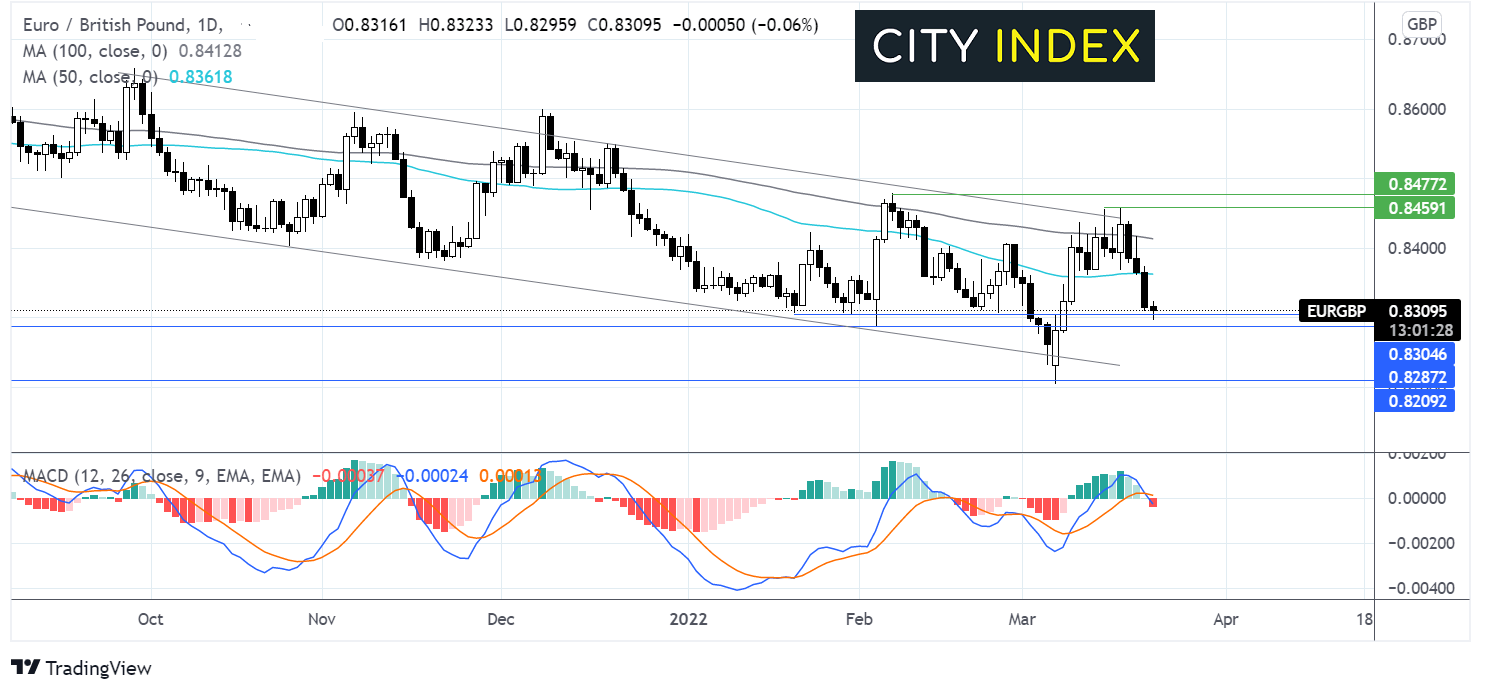
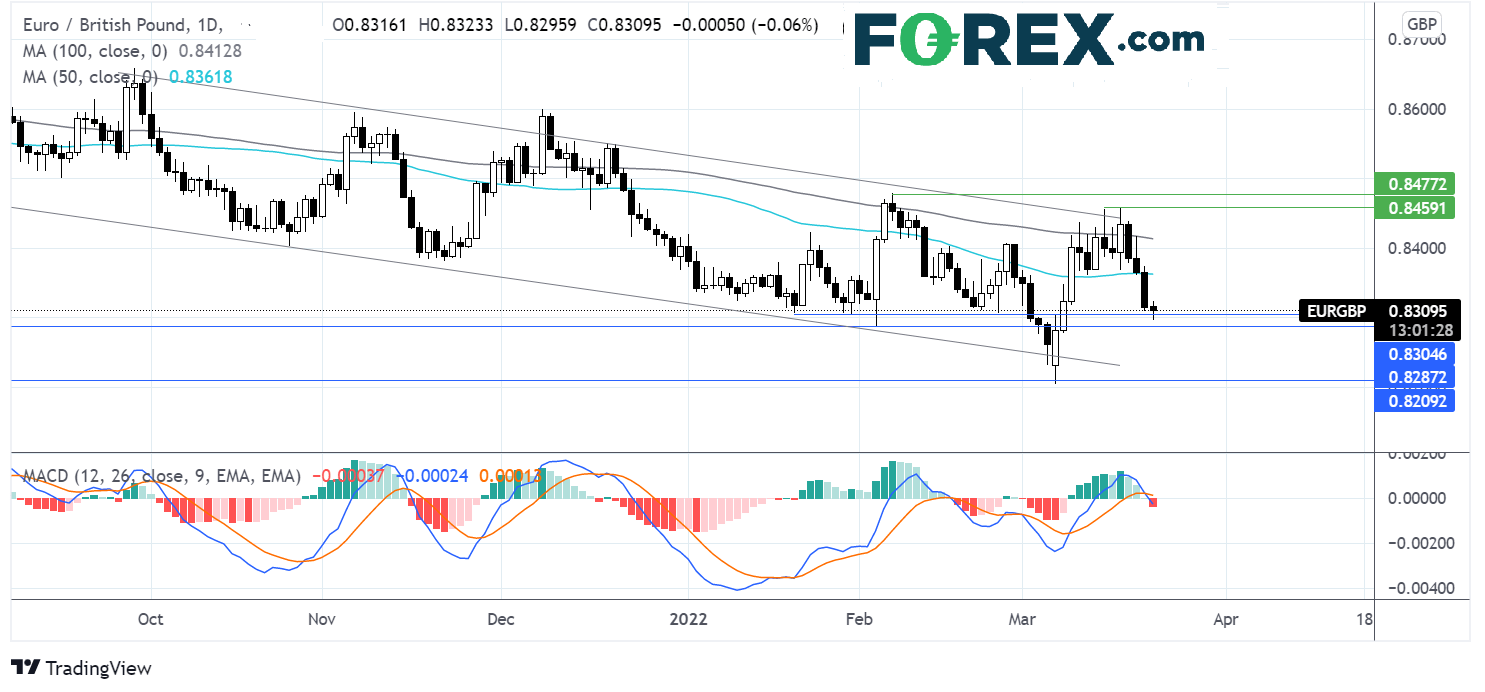
EUR/GBP is extending its rebound lower from 0.8450, falling below the 100 & 50 sma, which, combined with the bearish crossover on the MACD, gives sellers hope of further downside.
Sellers will need to break below 0.83 to attack 0.8290, the February 3 low, and head towards 0.8230, the March 4 low.
Any meaningful recovery would need to break above the 50 SMA at 0.8350 to expose the 100 sma at 0.8410.
Gold looks to Fed Chair Powell.
Gold prices remain under pressure on Wednesday as US treasury yields remain elevated on hawkish Fed expectations.
The Russia Ukraine war is failing to inspire gold bugs that are more focused on the more aggressive path of monetary tightening expected from the Fed.
Yesterday Fed Mester said that he expected rate hikes of 2.5% across the year and front loading.
Attention will now shift back to Fed Chair Powell, who is due to speak this afternoon. Earlier in the week, he signaled that the Fed was prepared to hike rates by 50 basis points at any meeting if required. The market is pricing in a 70% probability of a 50-basis point rate hike in May. This is bad news for non-yielding, dollar-denominated Gold.
Where next for Gold prices?
Since March, gold has been trending lower, forming a series of lower lows and lower highs. After falling to a low 1895 on March 16, the price has pushed higher.
Currently, the price trades caught between the 50 & 200 sma. Sellers will look for a move below the 200 SMA at 1910, opening the door to 1895, the March 16 low.
Buyers will be looking for a move over 1936 the 50 sma to attack 1950 the March 17 high.


How to trade with City Index
Follow these easy steps to start trading with City Index today:
- Open a City Index account, or log-in if you’re already a customer.
- Search for the market you want to trade in our award-winning platform.
- Choose your position and size, and your stop and limit levels
- Place the trade.
Related tags:
Latest market news




The complete CFD trading experience
Award-winning platforms, competitive spreads, low commissions and dedicated support.
We live and breathe the markets and are dedicated to helping traders realise their ambitions as we continue to set the industry bar.
Economic calendar
Web Trader platform
Our sophisticated web-based platform is packed with features.
Related articles
Gold Q4 2026 outlook: Resilience in the face of rallying dollar and yields
As we headed towards the latter stages of Q3 and into Q4, the Fed had just hiked rates in a hawkish FOMC meeting, while the likes of the ECB and BoJ had also tightened their respective policies. Oil prices remained elevated amid the prolonged US-Iran conflict. Meanwhile, bond yields were breaking out, and the dollar was higher across the board. Yet, remarkably, gold was still holding in the positive territory for the third quarter, even if it had weakened somewhat in September.
EUR/USD Q4 2026 Outlook: Euro at a Crossroads as Fed, ECB Tighten 9 25 2026
EUR/USD enters Q4 at a pivotal inflection point as competing Fed-ECB policy paths and persistent inflation risks collide with major technical support.

USD/JPY Q4 2026 Outlook: Hawkish Fed Pricing Clashes With Intervention Risk
The year-end tug-of-war is clear: hawkish Fed pricing supports USD/JPY, while intervention risk limits the upside.

StoneX Europe Ltd may make third party material available on this website which may contain information included but not limited to the conditions of financial markets. The material is for information purposes only and does not contain, and should not be construed as containing, investment advice and/or investment recommendation and/or an investment research and/or an offer of or solicitation for any transactions in financial instruments; any decision to enter into a specific transaction shall be made by the client following an assessment by him/her of their situation.
StoneX Europe Ltd makes no representation or warranty and assumes no liability as to the accuracy or completeness of the information provided, nor any loss arising from any investment based on a recommendation, forecast or other information supplied. You should always seek independent advice as to your suitability to speculate in any related markets and your ability to assume the associated risks, if you are at all unsure. We are not under any obligation to update any such material. Any opinion made may be personal to the author and may not reflect the opinion of StoneX Europe Ltd.