


USD/JPY Analysis: Dollar Dominance Pressures the Yen
It has been a difficult week for the yen, mainly because the USD/JPY pair has gained more than 1.00% over the last two sessions, reflecting noticeable weakness in the Japanese currency against the US dollar. The yen’s weakness is driven by its lack of accumulated appeal, even amid current geopolitical tensions.
Share this:

It has been a difficult week for the yen, mainly because the USD/JPY pair has gained more than 1.00% over the last two sessions, reflecting noticeable weakness in the Japanese currency against the US dollar.
The yen’s weakness is driven by its lack of accumulated appeal, even amid current geopolitical tensions. At the same time, the US dollar has shown consistent strength against its main rivals. If market preference continues to tilt toward dollar demand, buying pressure on USD/JPY could gain further momentum in the coming sessions.


Is nothing stopping the US dollar?
The escalation of geopolitical tensions in the Middle East, marked by recurring attacks and the absence of short-term agreements that could lead to de-escalation, has had a clear impact on markets: increased exposure and hedging in US dollars.
Historically, the yen has acted as a safe-haven currency during periods of heightened risk perception. However, the current environment appears different. Most defensive flows have shifted toward the dollar, leaving the yen in a secondary role, mainly due to the relative performance of the fixed-income markets in both countries.
Although both Japanese and US 10-year government bond yields have moved higher, the rate differential remains decisive. While US bond yields exceed 4.1%, Japanese bond yields remain only slightly above 2.00%. This differential continues to position dollar-denominated assets as more attractive in the short term.
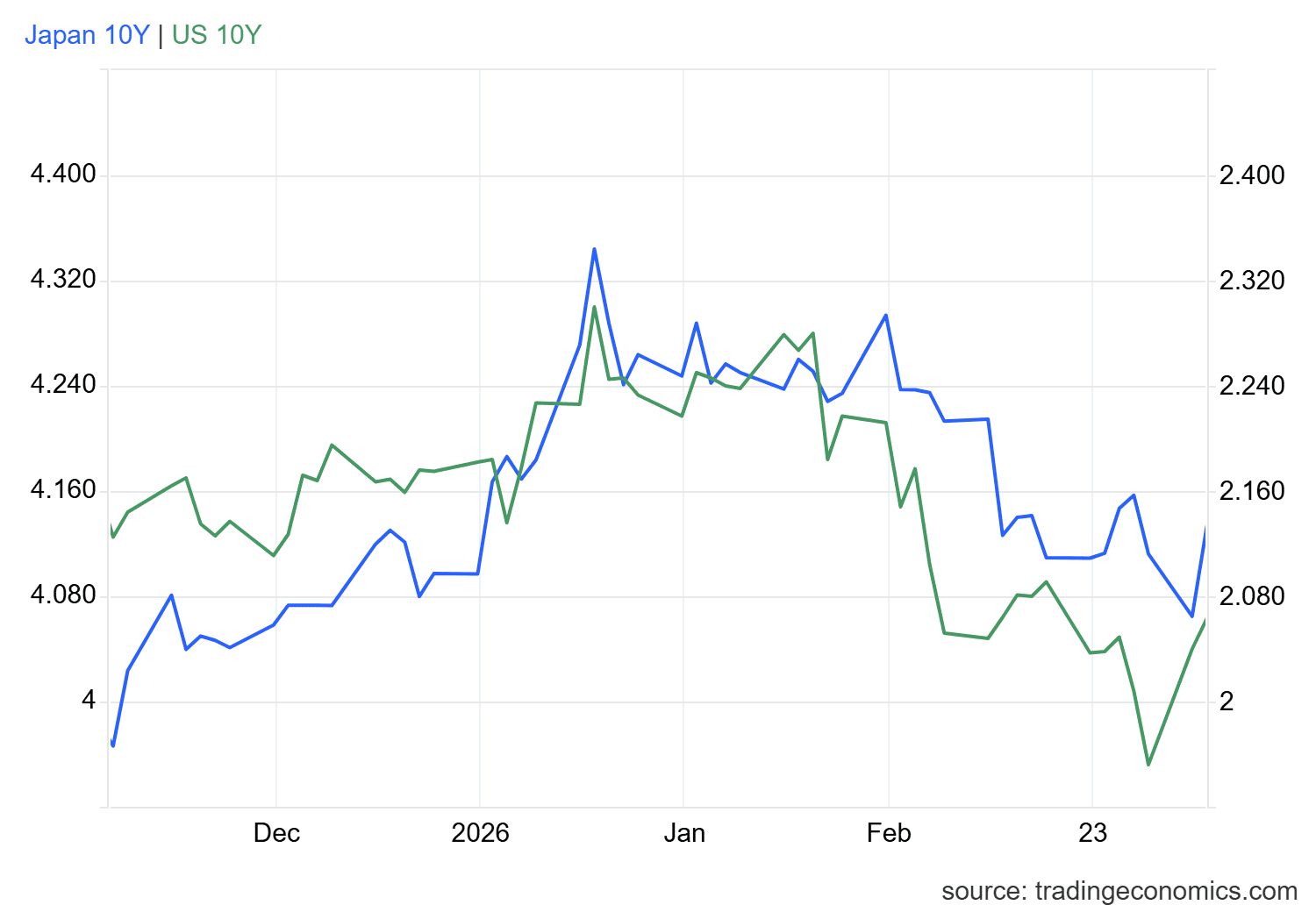
Source: TradingEconomics
This dynamic is also reflected in the DXY index, which measures the dollar’s strength against its main peers. The index is now trading above 99 points, a level not seen since mid-January, highlighting consistent demand for US dollars. This strength is supported both by rising Treasury yields and by the dollar’s relative attractiveness compared to markets such as Japan.
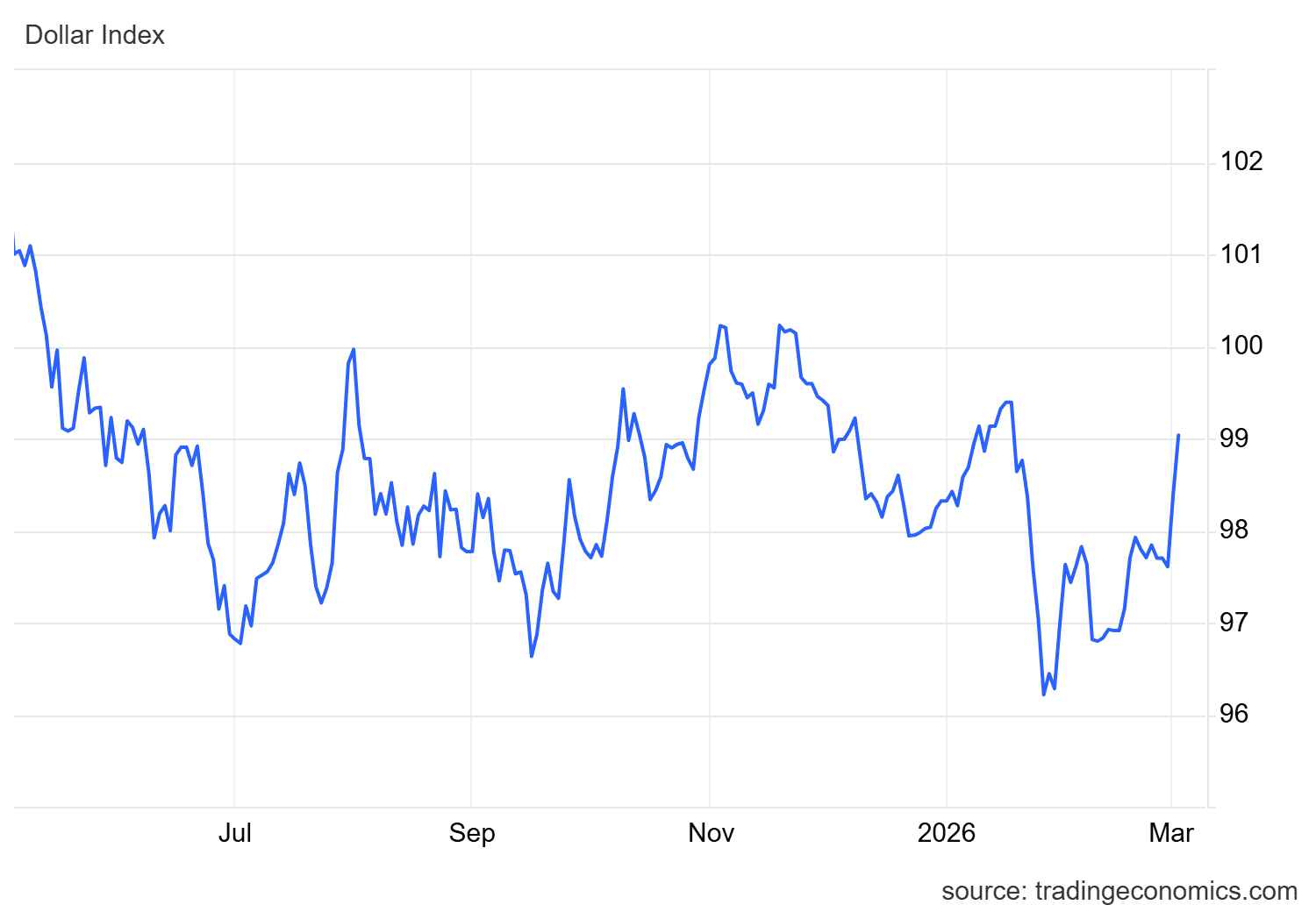
Source: TradingEconomics
In this context, the combination of geopolitical tensions and a clearly favorable rate differential for the United States continues to direct capital flows toward the dollar. As long as the risk environment remains elevated and US bond yields maintain an attractive premium over Japanese yields, the yen may continue to lose safe-haven relevance. If sustained, this dynamic could reinforce buying pressure in USD/JPY and consolidate a more consistent bullish bias in the short term.
Technical outlook for USD/JPY
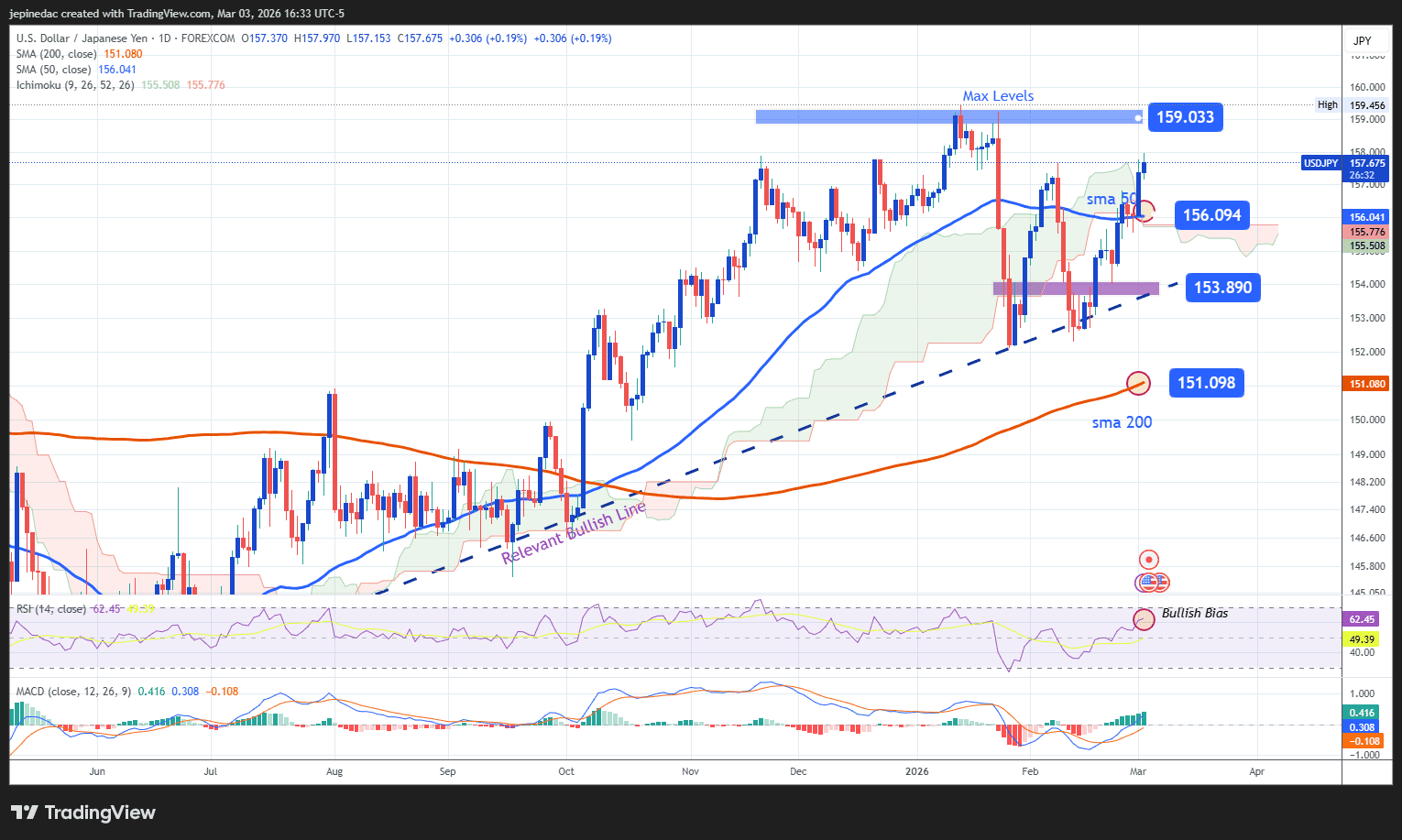
Source: StoneX, Tradingview
- The uptrend remains relevant: For several months, USD/JPY has maintained a consistent buying bias, forming a broad upward trendline. So far, no correction has been deep enough to threaten this technical structure, meaning the uptrend remains the dominant pattern. In recent sessions, buying pressure has regained traction. If this dynamic continues, the current bullish trend could extend further in the coming sessions.
- RSI: The RSI remains above the neutral 50 level, indicating that average buying momentum over the last 14 sessions continues to dominate. If the indicator continues advancing, it could reinforce more evident buying pressure in USD/JPY.
- MACD: The MACD histogram remains above the zero line, reflecting that short-term moving averages maintain bullish dominance. If this dynamic persists, the buying bias could remain relevant for USD/JPY price action in the coming sessions.
Key levels:
- 159.033 – Key resistance: Area corresponding to the 2026 highs and the main bullish barrier to monitor. Sustained moves above this level could consolidate a dominant buying bias and open the door to a more aggressive bullish trendline formation in the coming sessions.
- 156.094 – Near-term barrier: Level aligned with the 50-period moving average, acting as a recent neutrality zone. As long as price fails to move decisively away from this area, a short-term consolidation scenario could persist.
- 153.890 – Main support: Level aligned with recent lows. Moves below this zone could threaten the current bullish structure and open the door to a more relevant selling bias in the coming sessions.
Written by Julian Pineda, CFA, CMT – Market Analyst
Follow him on: @julianpineda25



The complete CFD trading experience
Award-winning platforms, competitive spreads, low commissions and dedicated support.
We live and breathe the markets and are dedicated to helping traders realise their ambitions as we continue to set the industry bar.
Economic calendar
Web Trader platform
Our sophisticated web-based platform is packed with features.
Related articles

EUR/USD Q4 2026 Outlook: Euro at a Crossroads as Fed, ECB Tighten 9 25 2026
EUR/USD enters Q4 at a pivotal inflection point as competing Fed-ECB policy paths and persistent inflation risks collide with major technical support.


USD/JPY Q4 2026 Outlook: Hawkish Fed Pricing Clashes With Intervention Risk
The year-end tug-of-war is clear: hawkish Fed pricing supports USD/JPY, while intervention risk limits the upside.


Japanese Yen Forecast: USD/JPY 4% Rally Challenges Post-Intervention Downtrend 9 24 2026
USD/JPY momentum has shifted sharply higher, putting a major resistance confluence in focus as U.S. and Japanese event risk builds.
StoneX Europe Ltd may make third party material available on this website which may contain information included but not limited to the conditions of financial markets. The material is for information purposes only and does not contain, and should not be construed as containing, investment advice and/or investment recommendation and/or an investment research and/or an offer of or solicitation for any transactions in financial instruments; any decision to enter into a specific transaction shall be made by the client following an assessment by him/her of their situation.
StoneX Europe Ltd makes no representation or warranty and assumes no liability as to the accuracy or completeness of the information provided, nor any loss arising from any investment based on a recommendation, forecast or other information supplied. You should always seek independent advice as to your suitability to speculate in any related markets and your ability to assume the associated risks, if you are at all unsure. We are not under any obligation to update any such material. Any opinion made may be personal to the author and may not reflect the opinion of StoneX Europe Ltd.