




What in the world is wrong with gold
Despite being in an environment tailor-made for gold to thrive, the yellow metal continues to lag. Why?
Share this:

Imagine you went back in time six months and told an investor the following:
- Central banks would continue to buy up assets and expand the money supply
- Governments would continue to run record fiscal deficits
- The US dollar would fall
- Inflation expectations would rise
- Rioters would storm the US Capitol
I don’t know about you, but that sounds like an environment tailor-made for gold prices to surge into record territory to me. Instead, the yellow metal has been one of the most disappointing assets on the planet over the last two quarters, with prices down nearly -20% from their August peak and -8% year-to-date. Even January’s political turmoil wasn’t enough to boost gold: the “ultimate safe haven” asset fell 2% on the day that rioters stormed the Capitol and ultimately finished that week down 6% from pre-raid levels.
So why is gold so weak?
As with any question about a market movement, there are multiple answers.
First, it’s worth noting that gold has a reputation for being an uncorrelated investment, and falling while nearly every other speculative asset is surging into record territory is certainly confirmation of that. Many long-term gold holders are most interested in the yellow metal’s diversification benefits when their other investments are falling, an environment that we haven’t seen much of late. In other words, in order to take their victory laps while everyone else is losing, gold bugs by definition must occasionally lose money while every other investment is rising.
One other possible explanation is that cryptoassets like Bitcoin actually are gaining market share for the global “store of value” demand. After all, famous investors like Stanley Druckenmiller and Paul Tudor Jones both believe the idea has merit, and Bitcoin did surge 9% on the day of the Capitol riots. That said, despite its technological merits, Bitcoin will never be able to approach gold’s unfathomably long history of being a reliable store of value, so gold bugs would argue that this may be a more short-lived phenomenon.
The final explanation for gold’s recent underperformance could be that it’s just noise. As any experienced trader will tell you, markets don’t always move perfectly as they’re “supposed to.” It’s always possible that the market’s collective understanding of gold as a hedge against fiat currency debasement is no longer relevant, but more often, traders will ignore a seemingly relevant development before coming around to respect it again all at once.
Gold technical analysis
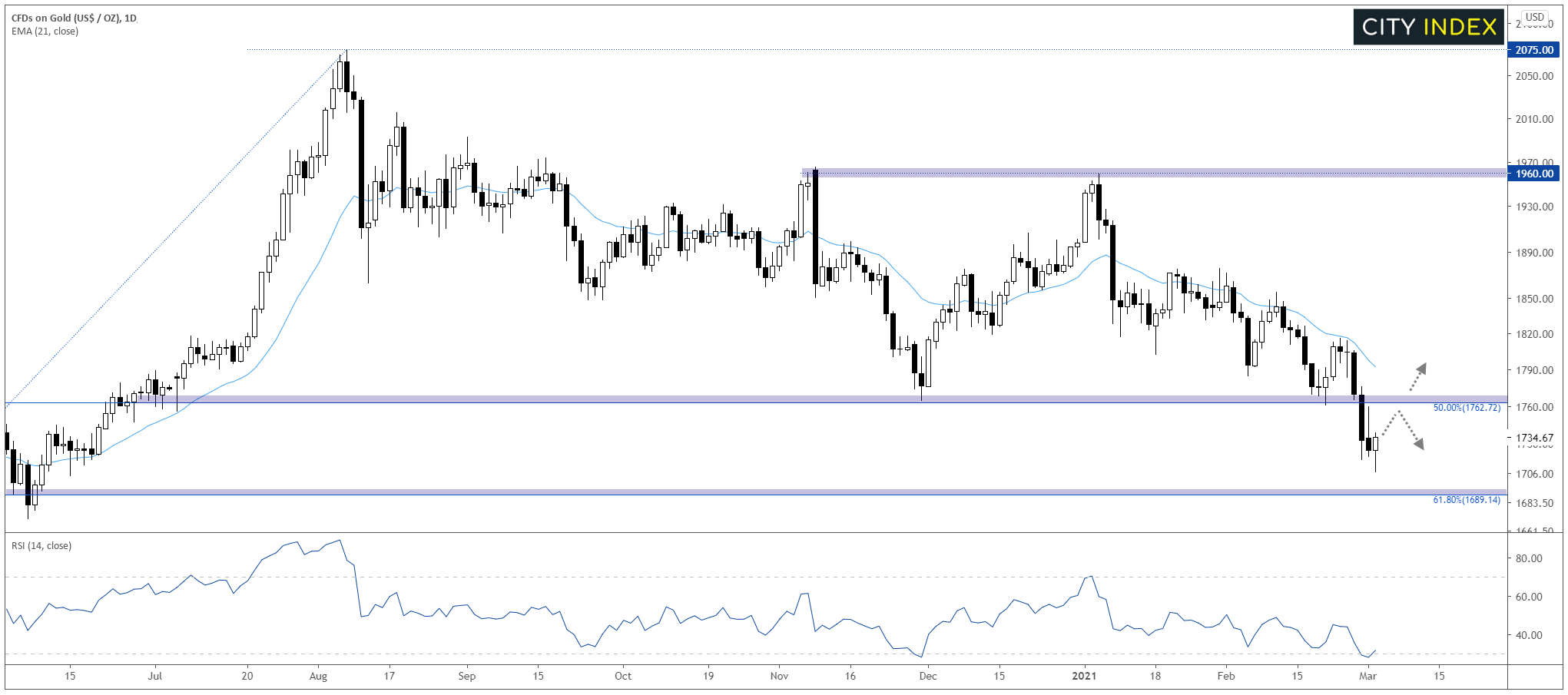
Just this morning, gold prices peeked below $1710 for the first time since June, though they have staged a decent bounce off the lows as we go to press:
Source: TradingView, StoneX
Moving forward, previous-support-turned-resistance at the 50% Fibonacci retracement of the March-August 2020 rally near $1765 could cap short-term rallies. Traders would need to see a break above that level to flip the near-term bias back in favor of the bulls. Meanwhile with traders selling any short-term rallies of late, the next downside level to watch will be the 61.8% retracement of that same rally near $1690, corresponding with some of the lows we saw through Q2 2020.
Learn more about gold and silver trading opportunities.
Imagine you went back in time six months and told an investor the following:
- Central banks would continue to buy up assets and expand the money supply
- Governments would continue to run record fiscal deficits
- The US dollar would fall
- Inflation expectations would rise
- Rioters would storm the US Capitol
I don’t know about you, but that sounds like an environment tailor-made for gold prices to surge into record territory to me. Instead, the yellow metal has been one of the most disappointing assets on the planet over the last two quarters, with prices down nearly -20% from their August peak and -8% year-to-date. Even January’s political turmoil wasn’t enough to boost gold: the “ultimate safe haven” asset fell 2% on the day that rioters stormed the Capitol and ultimately finished that week down 6% from pre-raid levels.
So why is gold so weak?
As with any question about a market movement, there are multiple answers.
First, it’s worth noting that gold has a reputation for being an uncorrelated investment, and falling while nearly every other speculative asset is surging into record territory is certainly confirmation of that. Many long-term gold holders are most interested in the yellow metal’s diversification benefits when their other investments are falling, an environment that we haven’t seen much of late. In other words, in order to take their victory laps while everyone else is losing, gold bugs by definition must occasionally lose money while every other investment is rising.
One other possible explanation is that cryptoassets like Bitcoin actually are gaining market share for the global “store of value” demand. After all, famous investors like Stanley Druckenmiller and Paul Tudor Jones both believe the idea has merit, and Bitcoin did surge 9% on the day of the Capitol riots. That said, despite its technological merits, Bitcoin will never be able to approach gold’s unfathomably long history of being a reliable store of value, so gold bugs would argue that this may be a more short-lived phenomenon.
The final explanation for gold’s recent underperformance could be that it’s just noise. As any experienced trader will tell you, markets don’t always move perfectly as they’re “supposed to.” It’s always possible that the market’s collective understanding of gold as a hedge against fiat currency debasement is no longer relevant, but more often, traders will ignore a seemingly relevant development before coming around to respect it again all at once.
Gold technical analysis
Just this morning, gold prices peeked below $1710 for the first time since June, though they have staged a decent bounce off the lows as we go to press:
Source: TradingView, StoneX
Moving forward, previous-support-turned-resistance at the 50% Fibonacci retracement of the March-August 2020 rally near $1765 could cap short-term rallies. Traders would need to see a break above that level to flip the near-term bias back in favor of the bulls. Meanwhile with traders selling any short-term rallies of late, the next downside level to watch will be the 61.8% retracement of that same rally near $1690, corresponding with some of the lows we saw through Q2 2020.
Learn more about gold and silver trading opportunities.
Related tags:
Latest market news




The complete CFD trading experience
Award-winning platforms, competitive spreads, low commissions and dedicated support.
We live and breathe the markets and are dedicated to helping traders realise their ambitions as we continue to set the industry bar.
Economic calendar
Web Trader platform
Our sophisticated web-based platform is packed with features.
Related articles
Gold Q4 2026 outlook: Resilience in the face of rallying dollar and yields
As we headed towards the latter stages of Q3 and into Q4, the Fed had just hiked rates in a hawkish FOMC meeting, while the likes of the ECB and BoJ had also tightened their respective policies. Oil prices remained elevated amid the prolonged US-Iran conflict. Meanwhile, bond yields were breaking out, and the dollar was higher across the board. Yet, remarkably, gold was still holding in the positive territory for the third quarter, even if it had weakened somewhat in September.
EUR/USD Q4 2026 Outlook: Euro at a Crossroads as Fed, ECB Tighten 9 25 2026
EUR/USD enters Q4 at a pivotal inflection point as competing Fed-ECB policy paths and persistent inflation risks collide with major technical support.

USD/JPY Q4 2026 Outlook: Hawkish Fed Pricing Clashes With Intervention Risk
The year-end tug-of-war is clear: hawkish Fed pricing supports USD/JPY, while intervention risk limits the upside.

StoneX Europe Ltd may make third party material available on this website which may contain information included but not limited to the conditions of financial markets. The material is for information purposes only and does not contain, and should not be construed as containing, investment advice and/or investment recommendation and/or an investment research and/or an offer of or solicitation for any transactions in financial instruments; any decision to enter into a specific transaction shall be made by the client following an assessment by him/her of their situation.
StoneX Europe Ltd makes no representation or warranty and assumes no liability as to the accuracy or completeness of the information provided, nor any loss arising from any investment based on a recommendation, forecast or other information supplied. You should always seek independent advice as to your suitability to speculate in any related markets and your ability to assume the associated risks, if you are at all unsure. We are not under any obligation to update any such material. Any opinion made may be personal to the author and may not reflect the opinion of StoneX Europe Ltd.