




WTI Crude Extends Selloff as OPEC+ Supply Surge Meets Recession Fears
WTI crude opened the week on the back foot after OPEC+ raised output for a second month, stoking fears of oversupply amid softening demand and fragile trade dynamics. While geopolitical tensions are rising, the technicals still point lower.
Share this:

- WTI opens below $56 after another OPEC+ output hike
- June production boost matches May’s surprise increase
- Geopolitical risks rising but not yet impacting price
- Support eyed at $55.12, with $54 and $49.33 below
Summary
WTI opened the week sharply lower as OPEC+ delivered another surprise output hike, extending bearish momentum that’s been building since March. With global supply rising and macro risks mounting, downside levels are back in play, even as Middle East tensions threaten to stir volatility if they escalate further.
OPEC+ Boosts Crude Production Again
Crude oil futures have opened at the weakest level since early 2021, extending April’s heavy losses after OPEC+ announced a second straight month of accelerated production increases. U.S. crude fell more than 4% while Brent dropped nearly 4%, with both hitting their lowest levels since early April.
Eight core members of the group, led by Saudi Arabia, agreed to lift output by 411,000 barrels per day in June, matching the surprise hike delivered in May. The combined increases now exceed 800,000 bpd, marking a significant step towards unwinding the 2.2 million bpd in voluntary cuts pledged since 2022.
The aggressive supply boost is fuelling concerns of a growing surplus just as demand worries re-emerge, driven by soft economic signals and renewed trade frictions between the United States and its major trading partners.
Geopolitical Tensions Create Reversal Risk
However, while price action remains firmly focused on supply, tensions in the Middle East are simmering. Israel has vowed to retaliate after a missile fired by Yemen’s Houthi rebels landed near its main international airport over the weekend. Tehran, in turn, has warned it will strike back if either the U.S. or Israel initiates an attack.
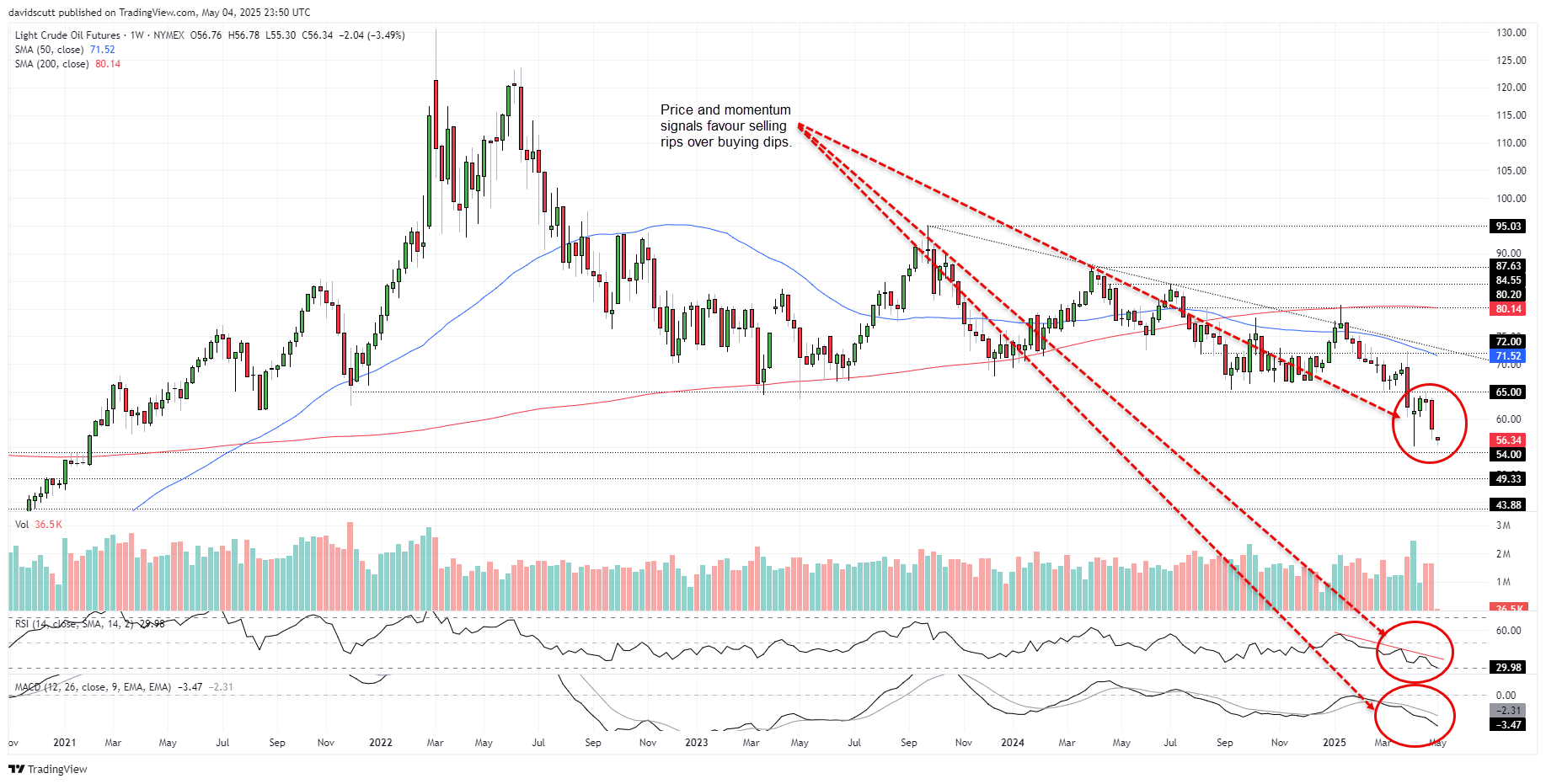
For now, the geopolitical backdrop has failed to counter the bearish tone driven by OPEC+’s rapid unwind of earlier cuts, as shown in the weekly chart below of WTI crude futures.
WTI Remains Sell-On-Rallies Play
Source: TradingView
Having broken and closed below support at $65 in late March, and with momentum indicators such as RSI (14) and MACD delivering increasingly bearish signals, WTI remains a clear sell-on-rallies play for now. That view is reinforced by the evening star pattern completed over the past three weeks, warning of potential downside ahead.
$55.12 is the first level of note for shorts, coinciding with where futures bounced aggressively in early April and again today. If it were to be taken out, support at $54, $49.33 and even $43.88 may come into play. Anything beyond those levels would likely require a major negative economic shock to eventuate, placing emphasis on trade negotiations between the United States and China in the week ahead. On the topside, resistance may be encountered just above $60 and again at $65.
-- Written by David Scutt
Follow David on Twitter @scutty
How to trade with City Index
You can trade with City Index by following these four easy steps:
- Open an account, or log in if you’re already a customer
• Open an account in the UK
• Open an account in Australia
• Open an account in Singapore
- Search for the market you want to trade in our award-winning platform
- Choose your position and size, and your stop and limit levels
- Place the trade
Related tags:
Latest market news



The complete CFD trading experience
Award-winning platforms, competitive spreads, low commissions and dedicated support.
We live and breathe the markets and are dedicated to helping traders realise their ambitions as we continue to set the industry bar.
Economic calendar
Web Trader platform
Our sophisticated web-based platform is packed with features.
Related articles

S&P 500 Forecast: SPX rises after cooler-than-expected inflation data
U.S. stocks are rising and Treasury yields are falling after data showed that inflation increased at a cooler pace than expected, while U.S. consumer spending rose again in August.


The RBA Hiked Rates and the Australian Dollar Still Fell
AUD/USD fell after the RBA rate hike because the central bank's hawkish stance was already priced in while the U.S. dollar stayed firm.


EUR/USD forecast: Eurozone stagflation risks mount as dollar holds firm ahead of data
The dollar was bouncing back at the time of writing, after it had eased overnight on the back of some weaker-than-expected economic data yesterday which had prompted markets to scale back expectations of an October Fed rate hike. However, with more significant US data due today and Friday, and with oil prices continuing to remain elevated, the dollar’s broader direction remains bullish.
StoneX Europe Ltd may make third party material available on this website which may contain information included but not limited to the conditions of financial markets. The material is for information purposes only and does not contain, and should not be construed as containing, investment advice and/or investment recommendation and/or an investment research and/or an offer of or solicitation for any transactions in financial instruments; any decision to enter into a specific transaction shall be made by the client following an assessment by him/her of their situation.
StoneX Europe Ltd makes no representation or warranty and assumes no liability as to the accuracy or completeness of the information provided, nor any loss arising from any investment based on a recommendation, forecast or other information supplied. You should always seek independent advice as to your suitability to speculate in any related markets and your ability to assume the associated risks, if you are at all unsure. We are not under any obligation to update any such material. Any opinion made may be personal to the author and may not reflect the opinion of StoneX Europe Ltd.