




Chinese yuan, stocks and commodities slump
Just when you thought the c-word was no more a thing for the markets…
Share this:

Well, here we are, more than 2 years into the pandemic and Covid is still roiling financial markets. Concerns about demand have intensified after Beijing locked down parts of Chaoyang District as the virus spread there. This triggered panic as people had hoped that lockdowns would ease in Shanghai rather than more restrictions being imposed elsewhere. But now the prospects of the capital city being put into a full lockdown has unnerved investors worldwide. Not only does this imply weaker demand from China, but it could reignite supply chain woes, further exacerbating inflationary pressures.
The Chinese yuan has fallen for the fifth day in a row, this time by more than 1%, lifting the USD/CNH to its highest level since November 2020. The Aussie and other commodity dollars have followed suit. Chinese equities dropped more than 5% overnight, with European and US futures also feeling the pain. Crude oil, copper and other metals all fell on demand concerns.
So, while the rest of the world’s largest economy are tightening belts, it looks like China might have to loosen its policy in order to keep its economy ticking over at the target rate in the second quarter. A couple of months ago, China set an economic growth target for the year of around 5.5%. This was the lowest level in more than a quarter-century of economic planning. But in light of the recent lockdowns, it might struggle to even achieve that target.
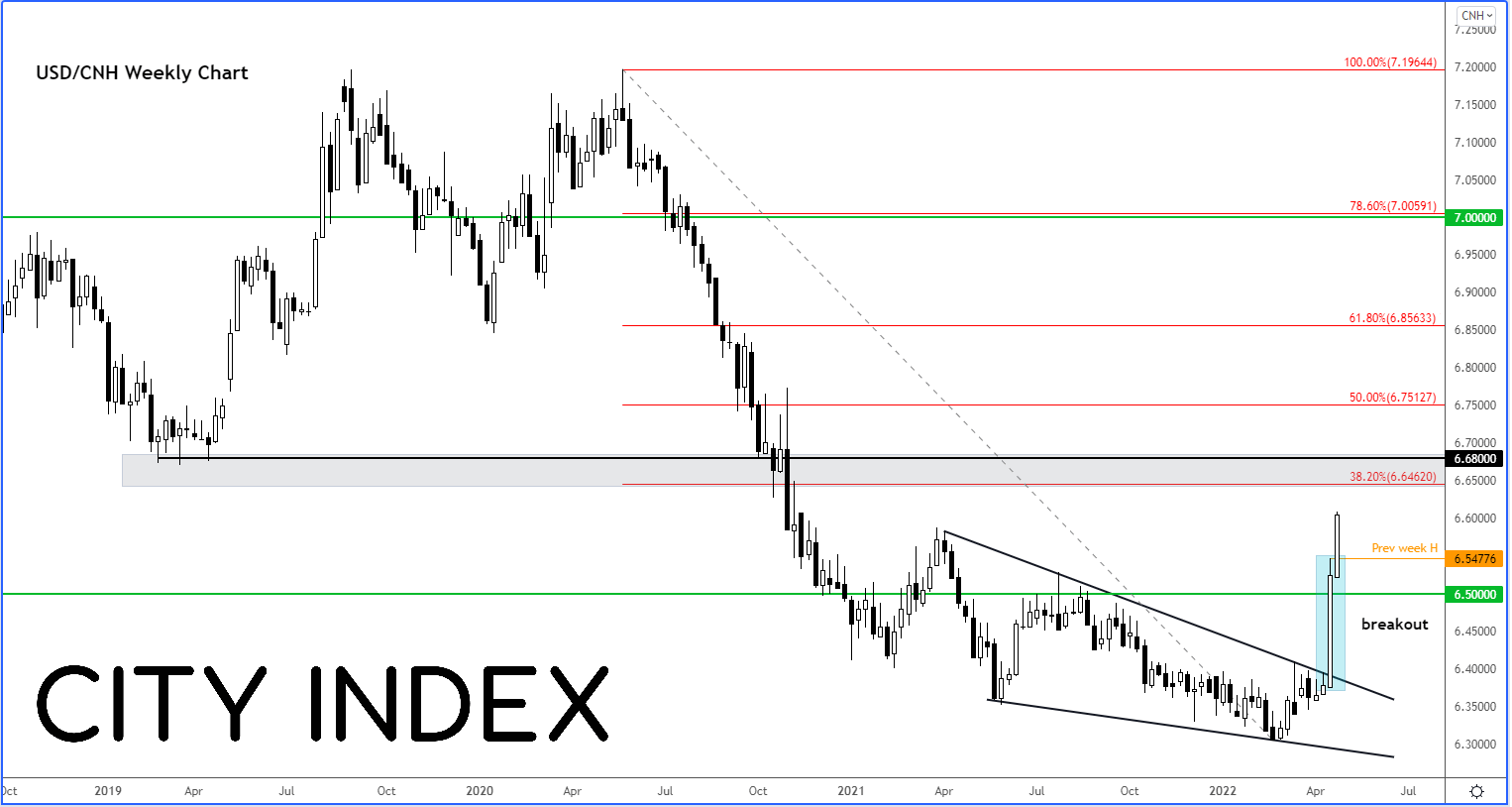
Indeed, fears over the Chinese economy saw the USD/CNH break out from a consolidation pattern last week, leading a big upsurge and follow-up technical buying in this pair (or selling in the yuan):
Source: StoneX and TradingView
For as long as the USD/CNH now remains above last week’s high at 6.5477, the short-term path of least resistance would be to the upside, meaning more weakness is likely for the yuan. From here, a move to the shaded region on the chart between 6.65 to 6.70 looks quite likely. Here, the 38.2% Fibonacci level meets prior support-turned-resistance area. I wouldn’t be surprised if this region were to offer only mild resistance, before the rally continues given expectations that monetary policy of the US will further diverge from that of China.
Well, here we are, more than 2 years into the pandemic and Covid is still roiling financial markets. Concerns about demand have intensified after Beijing locked down parts of Chaoyang District as the virus spread there. This triggered panic as people had hoped that lockdowns would ease in Shanghai rather than more restrictions being imposed elsewhere. But now the prospects of the capital city being put into a full lockdown has unnerved investors worldwide. Not only does this imply weaker demand from China, but it could reignite supply chain woes, further exacerbating inflationary pressures.
The Chinese yuan has fallen for the fifth day in a row, this time by more than 1%, lifting the USD/CNH to its highest level since November 2020. The Aussie and other commodity dollars have followed suit. Chinese equities dropped more than 5% overnight, with European and US futures also feeling the pain. Crude oil, copper and other metals all fell on demand concerns.
So, while the rest of the world’s largest economy are tightening belts, it looks like China might have to loosen its policy in order to keep its economy ticking over at the target rate in the second quarter. A couple of months ago, China set an economic growth target for the year of around 5.5%. This was the lowest level in more than a quarter-century of economic planning. But in light of the recent lockdowns, it might struggle to even achieve that target.
Indeed, fears over the Chinese economy saw the USD/CNH break out from a consolidation pattern last week, leading a big upsurge and follow-up technical buying in this pair (or selling in the yuan):
For as long as the USD/CNH now remains above last week’s high at 6.5477, the short-term path of least resistance would be to the upside, meaning more weakness is likely for the yuan. From here, a move to the shaded region on the chart between 6.65 to 6.70 looks quite likely. Here, the 38.2% Fibonacci level meets prior support-turned-resistance area. I wouldn’t be surprised if this region were to offer only mild resistance, before the rally continues given expectations that monetary policy of the US will further diverge from that of China.
How to trade with City Index
You can trade with City Index by following these four easy steps:
- Open an account, or log in if you’re already a customer
• Open an account in the UK
• Open an account in Australia
• Open an account in Singapore
- Search for the company you want to trade in our award-winning platform
- Choose your position and size, and your stop and limit levels
- Place the trade
Related tags:
Latest market news



Open an account in minutes
Experience award-winning platforms with fast and secure execution, and enjoy tight spreads from 0.5 pts on FX and 0.3 pts on indices.
Economic calendar
Web Trader platform
Our sophisticated web-based platform is packed with features.
Related articles
EUR/USD Outlook: AI sentiment returns as French debt fears fades
French debt was the market's obsession a week ago. Now, short-term correlations suggest technology sentiment may be calling more of the shots, with central bank decisions and heavyweight tech earnings threatening to accelerate the euro's decline.
AUD, NZD, CAD: Commodity FX Faces a 24-Hour Central Bank Storm
Australian CPI and rate decisions from the RBNZ, BoC and Fed put AUD, NZD and CAD to the test, with inflation surprises and policy guidance in focus.

FOMC Meeting Preview: Is Warsh Even Capable of Delivering a Hawkish Hold?
Fed Funds futures traders are pricing in ~90% odds that the FOMC leaves rates unchanged this week, but the big question is whether FOMC Chairman Warsh can deliver a true hawkish hike.

This report is intended for general circulation only. It should not be construed as a recommendation, or an offer (or solicitation of an offer) to buy or sell any financial products. The information provided does not take into account your specific investment objectives, financial situation or particular needs. Before you act on any recommendation that may be contained in this report, independent advice ought to be sought from a financial adviser regarding the suitability of the investment product, taking into account your specific investment objectives, financial situation or particular needs.
StoneX Financial Pte. Ltd., may distribute reports produced by its respective foreign entities or affiliates within the StoneX group of companies or third parties pursuant to an arrangement under Regulation 32C of the Financial Advisers Regulations. Where the report is distributed to a person in Singapore who is not an accredited investor, expert investor or an institutional investor (as defined in the Securities Futures Act), StoneX Financial Pte. Ltd. accepts legal responsibility to such persons for the contents of the report only to the extent required by law. Singapore recipients should contact StoneX Financial Pte. Ltd. at 6826 9988 for matters arising from, or in connection with the report.
In the case of all other recipients of this report, to the extent permitted by applicable laws and regulations neither StoneX Financial Pte. Ltd. nor its associated companies will be responsible or liable for any loss or damage incurred arising out of, or in connection with, any use of the information contained in this report and all such liability is hereby expressly disclaimed. No representation or warranty is made, express or implied, that the content of this report is complete or accurate.
StoneX Financial Pte. Ltd. is not under any obligation to update this report.
Trading CFDs carries a high level of risk that may not be suitable for some investors. Consider your investment objectives, level of experience, financial resources, risk appetite and other relevant circumstances carefully. The possibility exists that you could lose some or all of your investments, including your initial deposits. If in doubt, please seek independent expert advice. Visit www.forex.com/en-sg/terms-and-policies for the complete Risk Disclosure Statement.