



Currency Pair of the Week EURUSD
Will this run continue or is it time for a correction?
Share this:

The EUR/USD has had quite a run over the last few weeks, trading from a low of 1.0800 on May 18th to a high of 1.1385 on Friday. Will this run continue or is it time for a correction?
Last week, stimulus continued in Europe as the ECB increased PEPP by 600 billion Euros and said they would extend the program through 2021 and would reinvest the maturing principal until the end of 2022. In addition, Germany agreed they would add in another 130 billion Euros to their stimulus funding. Also, 2 weeks ago, the EU proposed additional and revised language to the France/Germany proposal, which included 500 billion Euros in grants and 240 billion Euros in loans. With huge supply of funds, logic would suggest that the Euro should be lower.
The economic data has not been kind to the Euro either. Just looking at Germany alone, one may expect the Euro to be lower. Germany reported a 26% drop in April factory orders on Friday (EUR/USD did actually trade lower that day.) And as recently as today, industrial output was worse than expected, coming in at -17.9% vs -16.8% expected. In addition, UK/EU Brexit talks have stalled, which is also not supportive for the Euro.
However, there is one caveat that has been overlooked so far here, and it is that of the tremendous weakness of the US Dollar! As we discussed in the chart of the week in the week ahead report, the US Dollar Index and the S&P 500 have a -.94 correlation coefficient, meaning that the DXY and the S&P 500 trade inversely with each other 94% of the time! As the Euro makes up a majority of the DXY index, it makes sense that the Euro would also trade in the opposite direction of the DXY. Therefore, stocks and EUR/USD have a high positive correlation and trade together a majority of the time. So, as the S&P 500 goes, so does EUR/USD.
In addition, the Fed meets on Wednesday. As with all central bank meetings lately, the key to determining if the EUR/USD continues its move higher will be to see if the Fed is still in extreme dovish mode. Remember, the ECB is already in negative rate territory while the Fed has rates at 0%. So, who has more room to lower rates if needed? The Fed. And if the Fed goes negative, the US Dollar will weaken, and EUR/USD bid will continue.
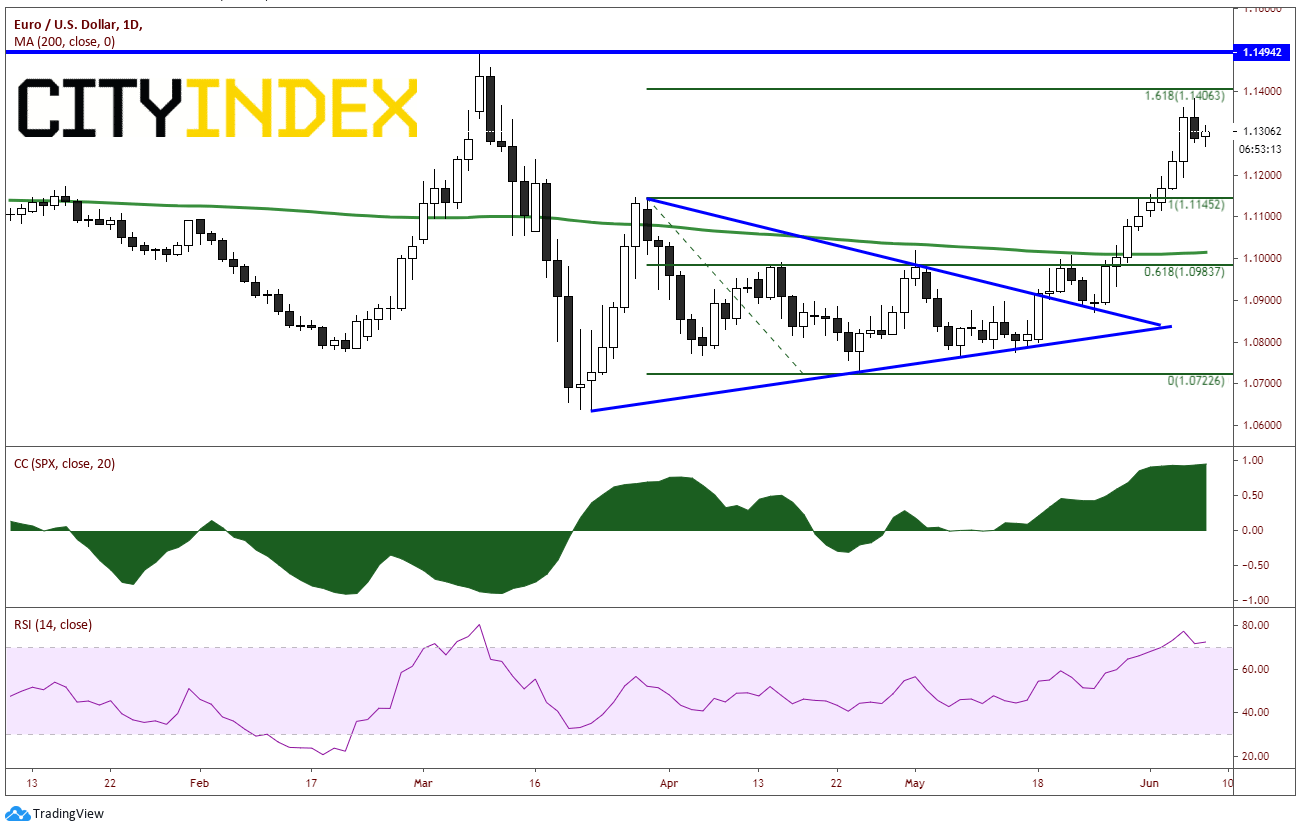
Technically, we can see on the daily EUR/USD chart below that the correlation coefficient between the EUR/USD and the S&P 500 is indeed high, at +.96. Price traded out of the symmetrical triangle and moved aggressively towards the 161.8% Fibonacci extension from the highs on March 30th to the lows of April 24th, near 1.1400. The RSI turned lower on Friday, however, still remains in overbought territory. There may be some profit taking or unwind from the trade ahead of the FOMC meeting on Wednesday.
Source: Tradingiew, City Index
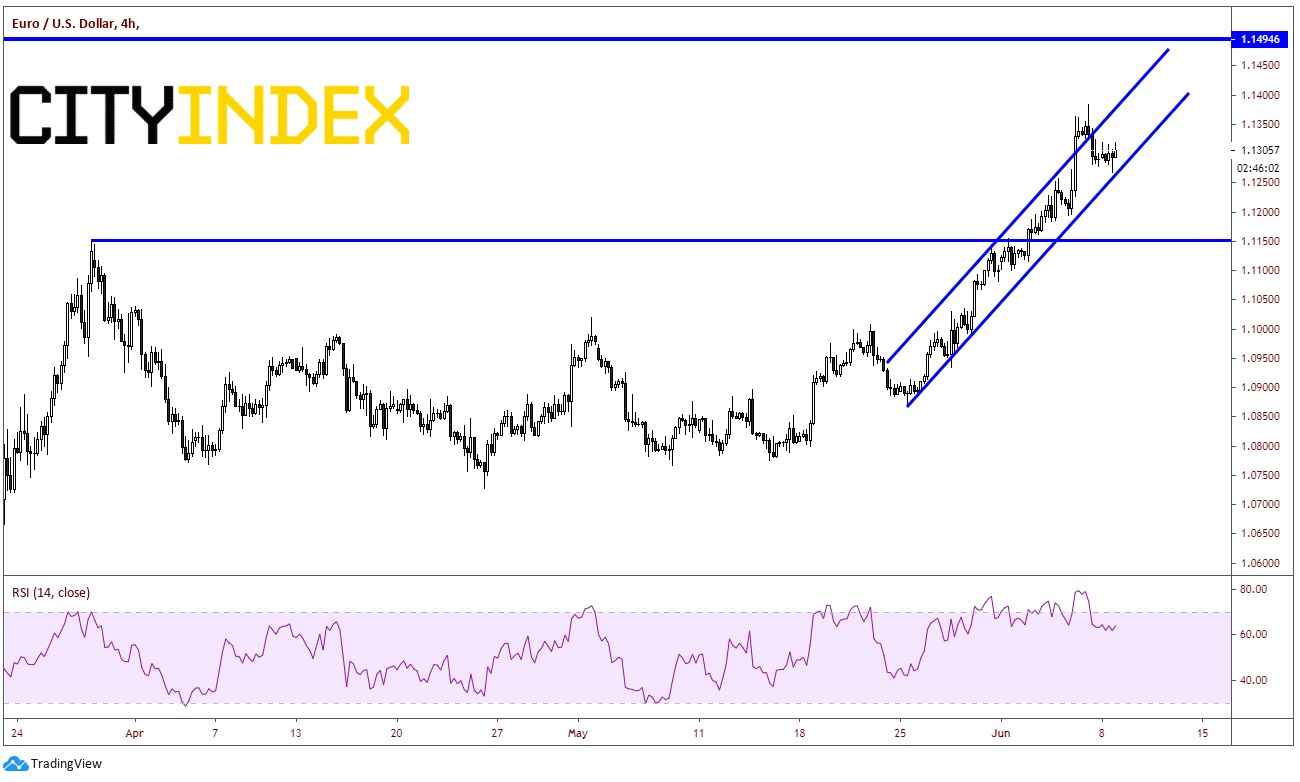
On a 4-hour timeframe, EUR/USD has been in a strong upward channel since May 25th. Last week, the pair had a false breakout above the top of the channel and traded back into it. First support is at the bottom of the channel near 1.1300. If price breaks below the channel, the next support is horizontal support near 1.1150, where buyers may be aggressive to buy the dip. If price moves higher, initial resistance is Friday’s highs near 1.1400 and then the highs from early March near 1.1495.
Source: Tradingiew, City Index
The next move in EUR/USD will depend on one of two things: 1) Stocks: with such a high correlation at the moment, if stocks turn lower, EUR/USD is likely to follow 2) The Fed Interest Rate Decision on Wednesday: depending on the degree of dovishness, it could affect the US Dollar, which is turn will affect the Euro. In addition, watch for potential profit taking ahead of the FOMC meeting on Wednesday!
The EUR/USD has had quite a run over the last few weeks, trading from a low of 1.0800 on May 18th to a high of 1.1385 on Friday. Will this run continue or is it time for a correction?
Last week, stimulus continued in Europe as the ECB increased PEPP by 600 billion Euros and said they would extend the program through 2021 and would reinvest the maturing principal until the end of 2022. In addition, Germany agreed they would add in another 130 billion Euros to their stimulus funding. Also, 2 weeks ago, the EU proposed additional and revised language to the France/Germany proposal, which included 500 billion Euros in grants and 240 billion Euros in loans. With huge supply of funds, logic would suggest that the Euro should be lower.
The economic data has not been kind to the Euro either. Just looking at Germany alone, one may expect the Euro to be lower. Germany reported a 26% drop in April factory orders on Friday (EUR/USD did actually trade lower that day.) And as recently as today, industrial output was worse than expected, coming in at -17.9% vs -16.8% expected. In addition, UK/EU Brexit talks have stalled, which is also not supportive for the Euro.
However, there is one caveat that has been overlooked so far here, and it is that of the tremendous weakness of the US Dollar! As we discussed in the chart of the week in the week ahead report, the US Dollar Index and the S&P 500 have a -.94 correlation coefficient, meaning that the DXY and the S&P 500 trade inversely with each other 94% of the time! As the Euro makes up a majority of the DXY index, it makes sense that the Euro would also trade in the opposite direction of the DXY. Therefore, stocks and EUR/USD have a high positive correlation and trade together a majority of the time. So, as the S&P 500 goes, so does EUR/USD.
In addition, the Fed meets on Wednesday. As with all central bank meetings lately, the key to determining if the EUR/USD continues its move higher will be to see if the Fed is still in extreme dovish mode. Remember, the ECB is already in negative rate territory while the Fed has rates at 0%. So, who has more room to lower rates if needed? The Fed. And if the Fed goes negative, the US Dollar will weaken, and EUR/USD bid will continue.
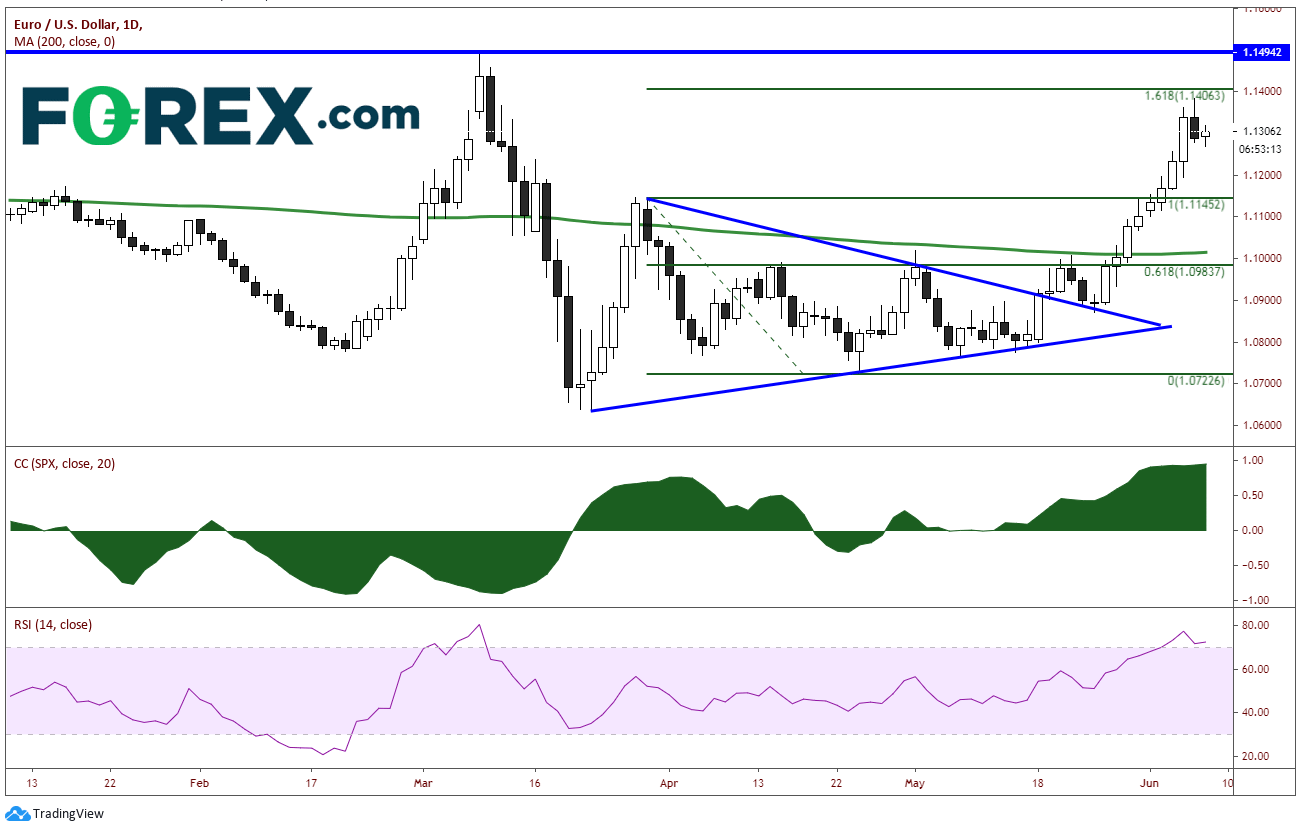
Technically, we can see on the daily EUR/USD chart below that the correlation coefficient between the EUR/USD and the S&P 500 is indeed high, at +.96. Price traded out of the symmetrical triangle and moved aggressively towards the 161.8% Fibonacci extension from the highs on March 30th to the lows of April 24th, near 1.1400. The RSI turned lower on Friday, however, still remains in overbought territory. There may be some profit taking or unwind from the trade ahead of the FOMC meeting on Wednesday.
Source: Tradingiew, Forex.com
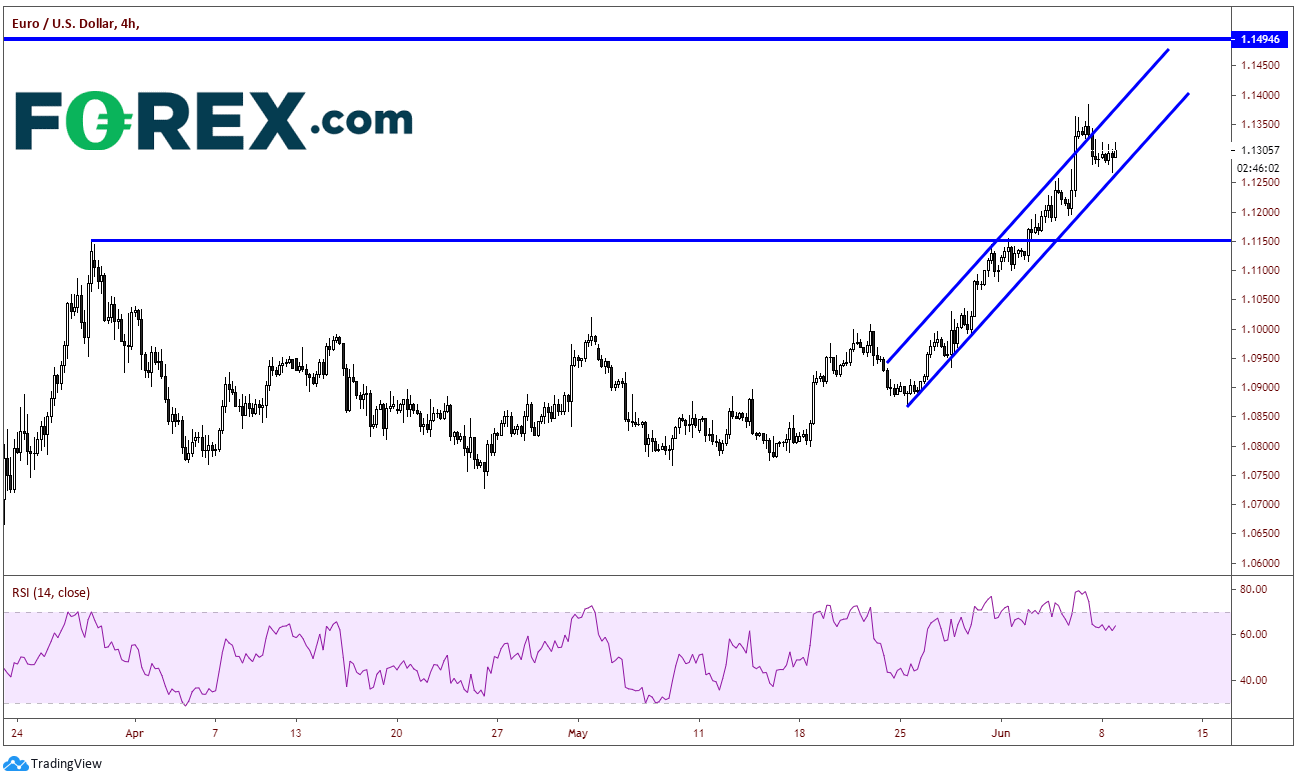
On a 4-hour timeframe, EUR/USD has been in a strong upward channel since May 25th. Last week, the pair had a false breakout above the top of the channel and traded back into it. First support is at the bottom of the channel near 1.1300. If price breaks below the channel, the next support is horizontal support near 1.1150, where buyers may be aggressive to buy the dip. If price moves higher, initial resistance is Friday’s highs near 1.1400 and then the highs from early March near 1.1495.
Source: Tradingiew, Forex.com
The next move in EUR/USD will depend on one of two things: 1) Stocks: with such a high correlation at the moment, if stocks turn lower, EUR/USD is likely to follow 2) The Fed Interest Rate Decision on Wednesday: depending on the degree of dovishness, it could affect the US Dollar, which is turn will affect the Euro. In addition, watch for potential profit taking ahead of the FOMC meeting on Wednesday!
Related tags:




Open an account in minutes
Experience award-winning platforms with fast and secure execution, and enjoy tight spreads from 0.5 pts on FX and 0.3 pts on indices.
Economic calendar
Web Trader platform
Our sophisticated web-based platform is packed with features.
Related articles
Dollar forecast: NFP provides dollar, already supported amid tech sell-off, additional boost
The US dollar has found some mild amid the tech rout in recent days, most visibly against risk sensitive and commodity dollars. Today, we have so far seen a bit of a recovery in global indices from their overnight lows. Investors will be watching the markets to see whether fresh losses will be on the again once Wall Street gets going. Ahead of that, we have just seen the release of the October US non-farm payrolls report – and it was much stronger at 165K than expected.

Canadian Dollar Short-term Outlook: USD/CAD Plunge Stalls at Pivotal Support—Range Break in Focus 11 5 2026
Friday’s U.S. and Canadian employment reports could trigger a decisive USD/CAD move as bulls and bears battle for control at critical support.

GBP/USD Forecast: BoE Caution Leaves the Pound Searching for Direction
Although GBP/USD has gained close to 0.5% over the last three trading sessions, reflecting a period of relative strength for the British pound, today's session has started to show a more neutral tone and the bullish momentum seen earlier in the week has begun to slow.

This report is intended for general circulation only. It should not be construed as a recommendation, or an offer (or solicitation of an offer) to buy or sell any financial products. The information provided does not take into account your specific investment objectives, financial situation or particular needs. Before you act on any recommendation that may be contained in this report, independent advice ought to be sought from a financial adviser regarding the suitability of the investment product, taking into account your specific investment objectives, financial situation or particular needs.
StoneX Financial Pte. Ltd., may distribute reports produced by its respective foreign entities or affiliates within the StoneX group of companies or third parties pursuant to an arrangement under Regulation 32C of the Financial Advisers Regulations. Where the report is distributed to a person in Singapore who is not an accredited investor, expert investor or an institutional investor (as defined in the Securities Futures Act), StoneX Financial Pte. Ltd. accepts legal responsibility to such persons for the contents of the report only to the extent required by law. Singapore recipients should contact StoneX Financial Pte. Ltd. at 6826 9988 for matters arising from, or in connection with the report.
In the case of all other recipients of this report, to the extent permitted by applicable laws and regulations neither StoneX Financial Pte. Ltd. nor its associated companies will be responsible or liable for any loss or damage incurred arising out of, or in connection with, any use of the information contained in this report and all such liability is hereby expressly disclaimed. No representation or warranty is made, express or implied, that the content of this report is complete or accurate.
StoneX Financial Pte. Ltd. is not under any obligation to update this report.
Trading CFDs carries a high level of risk that may not be suitable for some investors. Consider your investment objectives, level of experience, financial resources, risk appetite and other relevant circumstances carefully. The possibility exists that you could lose some or all of your investments, including your initial deposits. If in doubt, please seek independent expert advice. Visit www.forex.com/en-sg/terms-and-policies for the complete Risk Disclosure Statement.