





EUR/USD analysis: Attention turns to ECB and US data
The ECB is unlikely to lower interest rates until June as concerns over wage inflation remains high among the Governing Council. Today, the US dollar has been weighed down as tech-rally and China support underpin risk-sensitive currencies. Eurozone PMIs were mixed. US GDP and Core PCE to come later in the week.
Share this:

- EUR/USD analysis: ECB unlikely to lower interest rates until June
- Dollar weighed down as tech-rally and China support underpin risk-sensitive currencies
- Eurozone PMIs mixed, US GDP and Core PCE to come
- EUR/USD back above 200-day moving average
The EUR/USD pushed higher in the first half of Wednesday’s session, boosted by positive signals from the equity markets, as the dollar eased back against most major currencies. The lates Eurozone PMI data revealed a mixed picture ahead of the ECB’s policy decision on Thursday. The US dollar will be in sharp focus later in the week with the release of GDP and Core PCE price index. Will the EUR/USD be able to hold above its 200-day average this week?
EUR/USD analysis video and insights on AUD/USD, DAX, Nasdaq, Copper, Silver and Gold
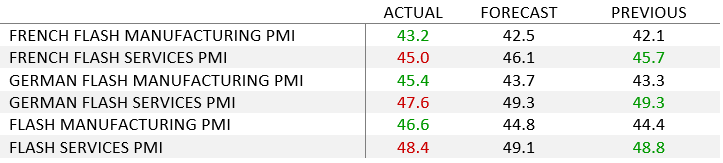
Eurozone PMIs mixed
Today’s release of the latest PMIs suggests the eurozone economy continues to remain stagnant, with both manufacturing and services PMIs remaining in contraction of below 50.0. Though there might be signs that PMIs are potentially bottoming out, as indicated for example by slowing pace of contracting orders, price pressures are still rising in the service sector. This argues against a sooner-than-expect ECB rate cut, even if the current data flow remains in a negative trajectory.
The composite PMI for January rose from 47.6 to 47.9, raising hopes for a bottom but the Eurozone’s largest economies Germany and France produced falling PMIs, suggesting that it was the smaller countries responsible for the slight slowdown in the contraction of economic activity. Meanwhile, the service sector PMI revealed another acceleration in input costs, raising the prospects of inflation remaining sticky.
EUR/USD analysis: ECB unlikely to lower interest rates until June
Today’s latest PMI data will not make a material difference in what the ECB is going to communicate on Thursday. The central bank will acknowledge that GDP growth is around zero, but more worrying are signs that inflation is not trending down towards their 2% goal quickly, especially as wage pressures remain high. This suggests that a rate cut before June is highly unlikely.
Indeed, before the blackout period of the ECB, we heard from several officials of the Governing Council who opposed the notion of early rate cuts, echoing sentiments expressed by Federal Reserve speakers. In the United States, this resistance stems mainly from the relatively robust economy, while in other regions, notably the UK and Eurozone, central bank officials are contending with concerns about persistent inflation and ongoing wage pressures. ECB President Christine Lagarde hinted that the decrease in borrowing costs might occur in the summer rather than the spring, aligning with other ECB officials expressing concerns about wage inflation. We eagerly await signals from the ECB at this meeting to gauge their position. The more cautious and resistant the ECB appears to be regarding rate cuts, the more likely the EUR is to find support.
US dollar falls on positive risk sentiment, China support and UK PMI
After rising on Tuesday, the Dollar Index was trading lower at the time of writing. This was mainly driven because of renewed gains in global stock markets amid tech and A.I. optimism and news that China is cutting the reserve requirement ratio for banks within two weeks and hinted at more support measures to come, which saw the risk-sensitive commodity dollars rise. We also had a stronger set of PMI data from the UK, sending the GBP/USD higher, causing the Dollar Index to ease back down a little. Meanwhile, the Japanese yen, which couldn’t hold onto its BoJ-related gains the day before, was back down below 147.50. As a result, the DXY was back below key resistance and 200-day average at 103.50 ahead of key macro events later in the week.
The US dollar is going to be in sharp focus later in the week. The US economic calendar is filled with some market-moving data, including the ‘Advanced’ estimate of GDP on Thursday and Core PCE price index, which is the Fed’s favourite inflation measure, on Friday.
After the recent release of predominantly stronger-than-anticipated data over the past few weeks, the dollar has been gaining momentum, exerting downward pressure on the EUR/USD. Concerns have resurfaced regarding the Federal Reserve's inclination to prolong higher interest rates, particularly following comments from Fed governor Christopher Waller and FOMC’s Raphael Bostic, both advocating for a cautious approach. If the upcoming GDP data indicates further strength in the US economy, expectations for an imminent interest rate reduction will likely be pushed further into the future. The EUR/USD bulls will be monitoring US data for signs of weakness, including Thursday's GDP figures and the Core PCE data the following day. Projections suggest a slowdown in US GDP growth to an annualized rate of 2.0% in Q4, compared to 4.9% in Q3. The Core PCE price index is expected to show a month-on-month increase of 0.2%, up from 0.1% the previous month.
EUR/USD technical analysis

The EUR/USD continues to trade around its 200-day moving average support ahead of ECB rate decision and key US data later in the week. These events should move the single currency more decisively. But the overall feeling you get from looking at the chart of the EUR/USD is one that shows very little commitment from both the bulls and the bears alike, making it an ideal range-trading currency pair.
A daily close below the 200-day average around 1.0845 would appease the bears. In this potential scenario, we could see follow-up technical selling towards 1.0800 and subsequently to December's low at 1.0723.
The bulls will be eyeing a close back above the broken trend line to pave the way towards 1.10 handle and potentially beyond.
EUR/USD analysis: What needs to happen for EUR/USD to climb above 1.10?
Resisting calls for an early rate cut, the ECB has caused the euro to exhibit a stronger performance when compared to currencies such as the Swiss franc, whose central bank is adopting a progressively dovish stance. However, for the euro to register stronger gains against the US dollar, it requires swift and unfavourable shifts in US economic data. Only under such circumstances can the euro regain momentum and convincingly breach the 1.10 barrier. Currently, those optimistic about the euro will need to see evidence that the 200-day moving average is going to hold, which has, until now anyway, been successfully defended. However, the lack of substantial upward follow-through raises concerns from a bullish perspective.
-- Written by Fawad Razaqzada, Market Analyst
Follow Fawad on Twitter @Trader_F_R
How to trade with City Index
You can trade with City Index by following these four easy steps:
- Open an account, or log in if you’re already a customer
• Open an account in the UK
• Open an account in Australia
• Open an account in Singapore
- Search for the company you want to trade in our award-winning platform
- Choose your position and size, and your stop and limit levels
- Place the trade
Related tags:



Open an account in minutes
Experience award-winning platforms with fast and secure execution, and enjoy tight spreads from 0.5 pts on FX and 0.3 pts on indices.
Economic calendar
Web Trader platform
Our sophisticated web-based platform is packed with features.
Related articles

US Dollar Technical Outlook: DXY Bulls Meet Resistance at Yearly Highs 10 1 2026
The U.S. Dollar has held firm despite fading Fed hike bets, but Friday’s payrolls could test the rally’s staying power.


Tankan Backs BOJ Tightening, but Yen Rate Expectations Ease
Japan’s Tankan supports further BOJ tightening, although softer rate expectations could limit support for the Japanese yen.


AUD/USD hammered by US yields and fading RBA hike bets
US yields, dollar strength and fading RBA hike bets have combined to drive AUD/USD to fresh multi-month lows. The macro and technical bias remains bearish, although history suggests parts of the move are now reaching unusually stretched levels.

This report is intended for general circulation only. It should not be construed as a recommendation, or an offer (or solicitation of an offer) to buy or sell any financial products. The information provided does not take into account your specific investment objectives, financial situation or particular needs. Before you act on any recommendation that may be contained in this report, independent advice ought to be sought from a financial adviser regarding the suitability of the investment product, taking into account your specific investment objectives, financial situation or particular needs.
StoneX Financial Pte. Ltd., may distribute reports produced by its respective foreign entities or affiliates within the StoneX group of companies or third parties pursuant to an arrangement under Regulation 32C of the Financial Advisers Regulations. Where the report is distributed to a person in Singapore who is not an accredited investor, expert investor or an institutional investor (as defined in the Securities Futures Act), StoneX Financial Pte. Ltd. accepts legal responsibility to such persons for the contents of the report only to the extent required by law. Singapore recipients should contact StoneX Financial Pte. Ltd. at 6826 9988 for matters arising from, or in connection with the report.
In the case of all other recipients of this report, to the extent permitted by applicable laws and regulations neither StoneX Financial Pte. Ltd. nor its associated companies will be responsible or liable for any loss or damage incurred arising out of, or in connection with, any use of the information contained in this report and all such liability is hereby expressly disclaimed. No representation or warranty is made, express or implied, that the content of this report is complete or accurate.
StoneX Financial Pte. Ltd. is not under any obligation to update this report.
Trading CFDs carries a high level of risk that may not be suitable for some investors. Consider your investment objectives, level of experience, financial resources, risk appetite and other relevant circumstances carefully. The possibility exists that you could lose some or all of your investments, including your initial deposits. If in doubt, please seek independent expert advice. Visit www.forex.com/en-sg/terms-and-policies for the complete Risk Disclosure Statement.