


EUR/USD Outlook: Economic Jaws Continue to Open
Markets have nearly three ECB rate hikes priced, yet EUR/USD cannot gain traction. The widening gap between the US and Eurozone may explain why.
Share this:

- US-Eurozone growth divergence widens
- AI boom boosts US activity
- Eurozone growth continues to flounder
- ECB hikes fail to lift EUR/USD
- Breakdown risk targets 1.1412
Euro Bears Circle
EUR/USD looks increasingly vulnerable to a bearish breakdown as the divergence in economic fortunes between the US and Eurozone continues to widen. While US activity is accelerating, fuelled by strong domestic demand and an AI infrastructure spending boom, Eurozone business activity continues to flounder, leaving the bloc on track for a modest GDP decline this quarter.
Growth Gap Widens

Source: TradingView
Recent survey data only reinforced the widening divide. In the US, the ISM services PMI accelerated to 54.5 in May, with new orders and inventories surging as businesses moved to secure supply and meet demand. Across the Atlantic, the Eurozone composite PMI fell further into contractionary territory, with S&P Global warning current readings are consistent with a modest decline in GDP this quarter.
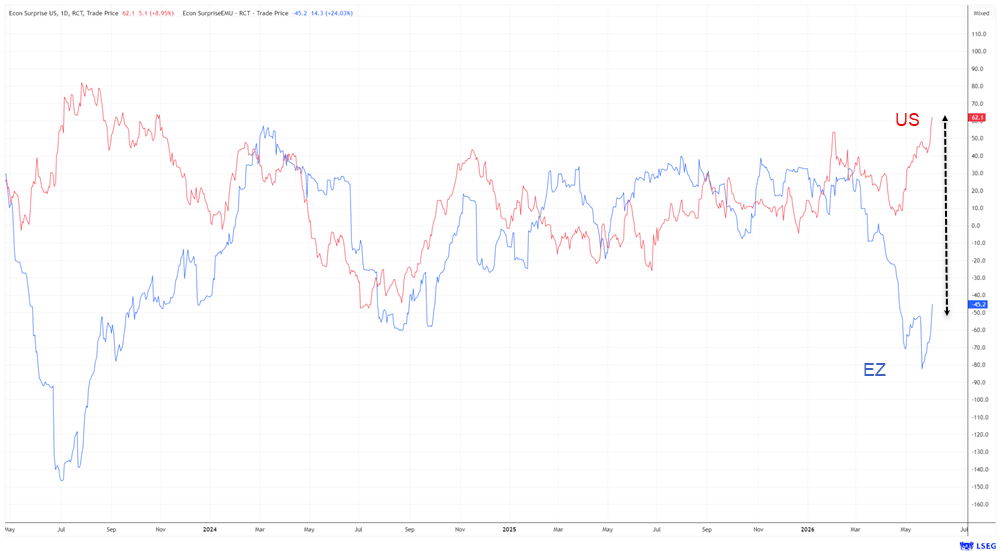
The latest PMI releases merely reinforced a trend that's been evident for months. Citi's economic surprise indices show the jaws between the US and Eurozone continuing to open, with the US measure climbing to its highest level since late 2023 while the Eurozone equivalent remains mired deep in negative territory.
Source: LSEG
For those unfamiliar, economic surprise indices measure whether economic data is coming in above or below market expectations. Positive readings indicate data is generally beating forecasts, while negative readings suggest it is consistently disappointing. The widening gap between the US and Eurozone suggests forecasters continue to underestimate the resilience of the former while overestimating the strength of the latter.
Energy Have and Have Nots
The widening gap reflects more than just a run of stronger US data. The US remains one of the world's energy haves, benefiting from abundant domestic supply and an AI infrastructure spending boom that is now running at levels that would have been considered extraordinary only a few years ago. Spending plans from hyperscalers on data centres, power generation and supporting infrastructure now comfortably exceed two percentage points of GDP, providing a powerful tailwind to activity even as energy prices rise.
The Eurozone finds itself on the other side of the ledger. Heavily reliant on imported energy and already struggling to generate meaningful economic momentum before the latest jump in fuel prices, it remains far more vulnerable to the stagflationary forces unleashed by the conflict in the Middle East.
Trichet 2.0?
Ordinarily, such a backdrop would be offset by a more aggressive ECB tightening cycle. Markets currently have a full 25bp rate increase priced later this month and nearly three hikes discounted by April next year, far exceeding the amount of additional tightening expected from the Federal Reserve over the same period.

Source: Bloomberg
Yet EUR/USD has struggled to respond. While the pair has historically displayed a moderately strong relationship with short-term rate differentials, investors appear increasingly focused on growth, energy security and relative economic performance. On all three fronts, the US currently enjoys a clear advantage.
Yet there may be another reason why EUR/USD has struggled to respond to increasingly hawkish ECB pricing. Hiking rates into an energy-driven supply shock screams Trichet policy error 2.0, doing little to curb inflation but potentially a lot to smash activity.
Higher interest rates won't create more oil or gas, nor will they do much to address the source of the inflation problem. Instead, they risk adding further pressure to an economy already flirting with contraction. Investors may be starting to question whether additional ECB tightening is really euro positive if it comes alongside amplified recession risk.
Like other central banks operating under strict inflation mandates, including the RBNZ, the ECB risks prioritising inflation at a time when activity is already weakening. That doesn't make for an especially appealing destination for capital. Investors generally want exposure to economies generating growth, not those hurtling towards recession.
Breakdown Watch
Source: TradingView
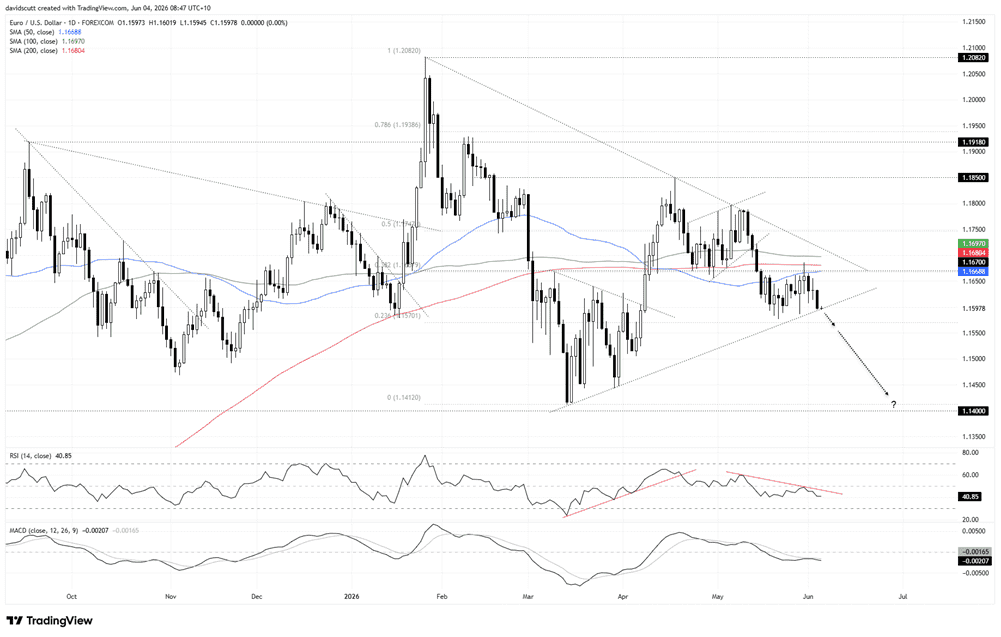
EUR/USD continues to coil within a compression structure, testing support in early Asian trade after failing on multiple occasions to break above a resistance zone comprising the 50, 100 and 200-day moving averages, the 38.2% Fibonacci retracement of the January-March bear move, and horizontal resistance at 1.1670.
While the pair has attracted bids beneath 1.1600 in recent days, the inability to bounce meaningfully, coupled with RSI (14) and MACD confirming downside momentum is building, leaves the risk of a bearish breakdown elevated even before the fundamental picture is considered, which is arguably even more definitive in its messaging.
A downside break of the compression structure would have bears eyeing a retest of the March swing low at 1.1412, with only minor levels such as the 23.6% Fibonacci retracement of the January-March bear move and support around 1.1450 located in between.
Should we see a decisive break of the structure that clears the recent lows and 23.6% retracement level, shorts could be initiated with a stop above the former uptrend for protection, targeting 1.1412. Of course, if the uptrend holds, the option remains to initiate longs with a tight stop beneath for protection, targeting the lower boundary of the overhead resistance zone around 1.1670.


Open an account in minutes
Experience award-winning platforms with fast and secure execution, and enjoy tight spreads from 0.5 pts on FX and 0.3 pts on indices.
Economic calendar
Web Trader platform
Our sophisticated web-based platform is packed with features.
Related articles
AUD/USD, NZD/USD Outlook: Corrective Recoveries Face Growing Headwinds
A weaker US dollar, falling Treasury yields and renewed demand for cyclical assets have supported the Aussie and Kiwi. But with some of those moves reversing on Monday, both currencies face an early test of whether their recent strength can continue.

Canadian Dollar Defies Soft CPI as Inflation Expectations Rise
The Canadian dollar strengthens despite CPI missing expectations, as rising long-term inflation expectations complicate the BoC outlook for USD/CAD and AUD/CAD.


US Dollar, GBP/USD, USD/CAD, USD/CHF, Gold Weekly Technical Outlook 10 19 2026
Sr. Technical Strategist Michael Boutros highlights the levels that matter on the USD Majors, commodities, and equity indices charts this week.

This report is intended for general circulation only. It should not be construed as a recommendation, or an offer (or solicitation of an offer) to buy or sell any financial products. The information provided does not take into account your specific investment objectives, financial situation or particular needs. Before you act on any recommendation that may be contained in this report, independent advice ought to be sought from a financial adviser regarding the suitability of the investment product, taking into account your specific investment objectives, financial situation or particular needs.
StoneX Financial Pte. Ltd., may distribute reports produced by its respective foreign entities or affiliates within the StoneX group of companies or third parties pursuant to an arrangement under Regulation 32C of the Financial Advisers Regulations. Where the report is distributed to a person in Singapore who is not an accredited investor, expert investor or an institutional investor (as defined in the Securities Futures Act), StoneX Financial Pte. Ltd. accepts legal responsibility to such persons for the contents of the report only to the extent required by law. Singapore recipients should contact StoneX Financial Pte. Ltd. at 6826 9988 for matters arising from, or in connection with the report.
In the case of all other recipients of this report, to the extent permitted by applicable laws and regulations neither StoneX Financial Pte. Ltd. nor its associated companies will be responsible or liable for any loss or damage incurred arising out of, or in connection with, any use of the information contained in this report and all such liability is hereby expressly disclaimed. No representation or warranty is made, express or implied, that the content of this report is complete or accurate.
StoneX Financial Pte. Ltd. is not under any obligation to update this report.
Trading CFDs carries a high level of risk that may not be suitable for some investors. Consider your investment objectives, level of experience, financial resources, risk appetite and other relevant circumstances carefully. The possibility exists that you could lose some or all of your investments, including your initial deposits. If in doubt, please seek independent expert advice. Visit www.forex.com/en-sg/terms-and-policies for the complete Risk Disclosure Statement.