



GBP/USD Forecast: Disinflation hopes face a fresh test
Markets remain positioned for further Bank of England easing even as inflation sits above target. The next run of UK labour market and CPI figures will help determine whether that optimism is justified or prematurely priced.
Share this:

- Markets price two further BoE rate cuts in 2026
- UK wages and services CPI in focus
- GBP/USD technicals flag consolidation
- Directional risks skewed higher on stronger UK data
Summary
Markets are confidently pricing rate cuts from the Bank of England even as inflation remains well above target, leaving GBP/USD exposed to any disruption in the disinflation story. With wages and services inflation sitting at the heart of the debate, the next two days carry the potential to reset expectations, volatility, and near-term direction. If pricing is wrong, the move in GBP/USD may not be subtle.
BoE split underscores inflation debate
Despite coming close to easing earlier this month, Bank of England policymakers have continued to emphasise uncertainty around the inflation outlook. Recent commentary and the February MPC minutes indicate that while price pressures are moderating, underlying inflation, particularly within services, remains above levels consistent with the 2% target.
Crucially, officials continue to stress the importance of wages and labour market conditions in shaping that assessment. Pay growth has cooled but is still seen as a potential source of inflation persistence, helping to explain the broad range of views within the MPC and its firmly data-dependent stance ahead of the next run of key releases.
That focus will be tested immediately, with labour market figures due on Tuesday, followed by inflation data on Wednesday, both carrying clear implications for rate expectations and near term sterling direction.
Wages, inflation may unlock policy puzzle
Source: TradingView (BST)
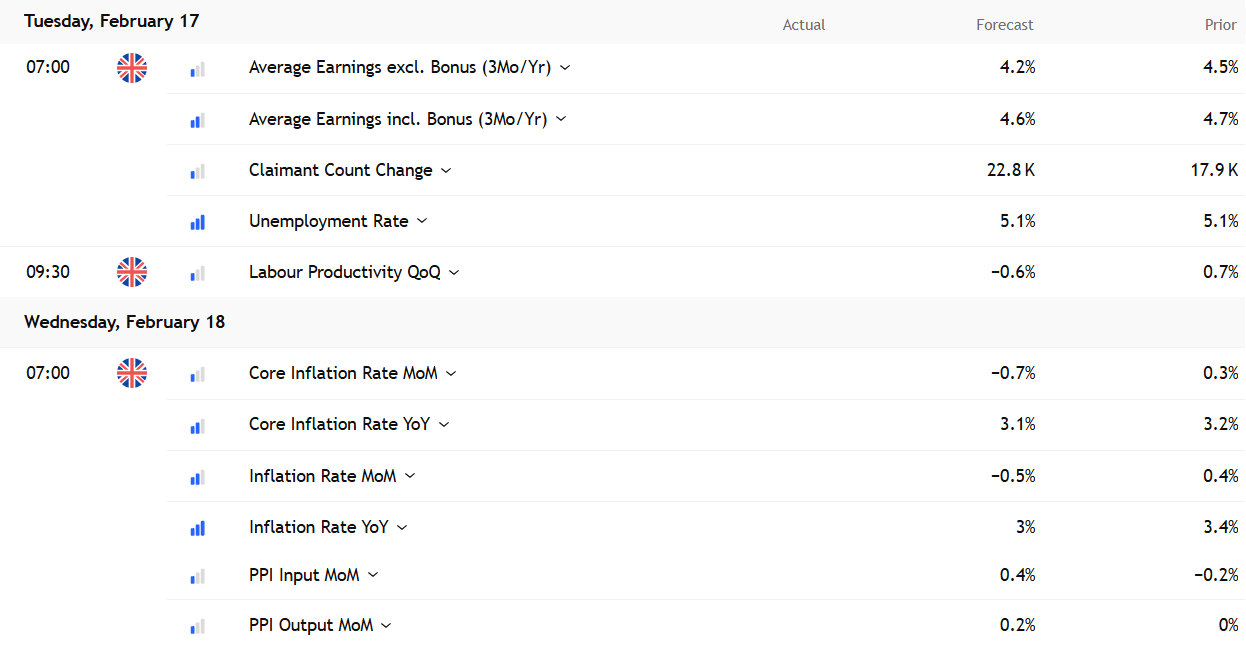
Tuesday brings the usual raft of UK labour market indicators, although many remain questionable as reliable signals given the well documented response rate and sampling issues. With unemployment expected to hold at 5.1%, attention is likely to centre instead on the average earnings measures.
Both bonus and non-bonus pay growth have followed a steady disinflationary trend over the past year, broadly mirroring the moderation seen in services inflation. Excluding bonuses, earnings are expected to slow to 4.2%, while the headline measure including bonuses is tipped at 4.6%.
Details within the wage figures may help frame expectations for inflation dynamics in the months ahead. Both core and headline CPI are forecast to decline sharply in January, driven largely by seasonal reversals, base effects and earlier price distortions rather than any sudden shift in underlying demand conditions. If realised, and assuming prior data are left unrevised, the outcome would extend the broader disinflationary trend in year-ended measures.
Core inflation is seen easing to 3.1% from 3.2%, while headline CPI is tipped to fall to 3.0%. While directionally encouraging for policymakers, both readings would still remain comfortably above the Bank of England’s 2% target. Although not shown on the accompanying graphic, services inflation is also expected to moderate further, with the annual rate forecast to slow to 4.3% from 4.5% in December.
Rate cut bets face a test
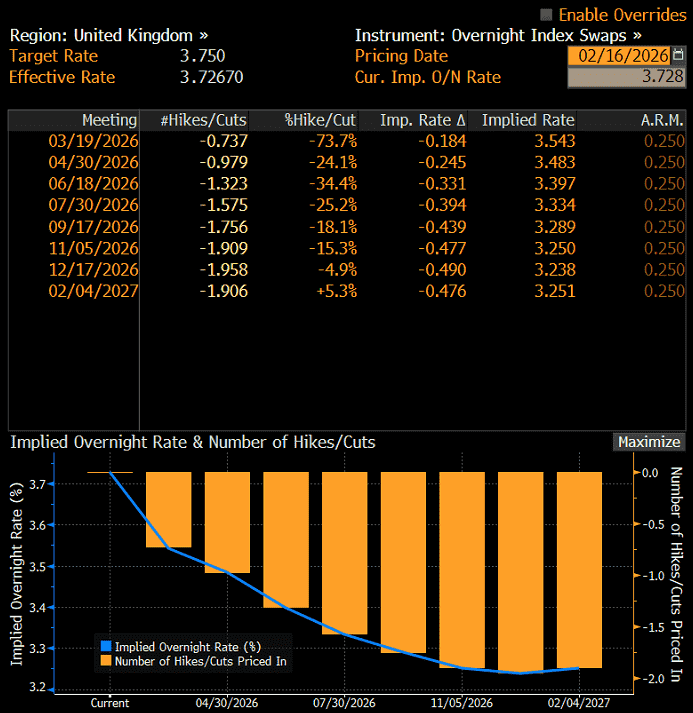
While inflation remains well above the Bank of England’s target, market pricing suggests investors, much like many within the MPC, expect the disinflationary trend to persist. Following the 5-4 split decision to hold the bank rate at 3.75% earlier this month, rate cut pricing implies the burden of proof now rests with incoming data to explain why further easing should not proceed in the months ahead.
Source: Bloomberg
Ahead of the March 19 policy decision, swaps imply a roughly 74% probability of a rate reduction. A full 25-point cut is priced by June, with around a one-in-three probability of a second move by that meeting. By December, an additional 25-point reduction is close to fully discounted. With pricing already mildly dovish, near term directional risks for GBP/USD may be skewed asymmetrically to the upside should data surprise on the firm side, rather than generating equivalent downside if releases undershoot expectations.
Outside of the UK data events, attention may soon shift to the United States where the calendar begins to thicken later in the week. Several potentially market-moving releases are scheduled, including the core PCE deflator, income and consumption data for December, and the advance estimate of Q4 GDP. Markets may also be alert to a possible ruling from the US Supreme Court on the legality of Donald Trump’s reciprocal tariffs. More details can be found here.
Correlations offer limited guidance
Outside of the key risk events, what stands out is that GBP/USD has not been particularly sensitive to rate differentials, Fed pricing, or broader measures of market risk appetite over the past week or month. The pair did show a strong inverse relationship with the broader US dollar index on a rolling 20-day basis earlier this month, although that correlation has weakened more recently.
Links with both short and longer-dated yield differentials have also remained relatively soft, hinting that price action may carry greater influence in the near term as markets wait for the next clear fundamental catalyst to emerge.
Technicals flag consolidation
Source: TradingView
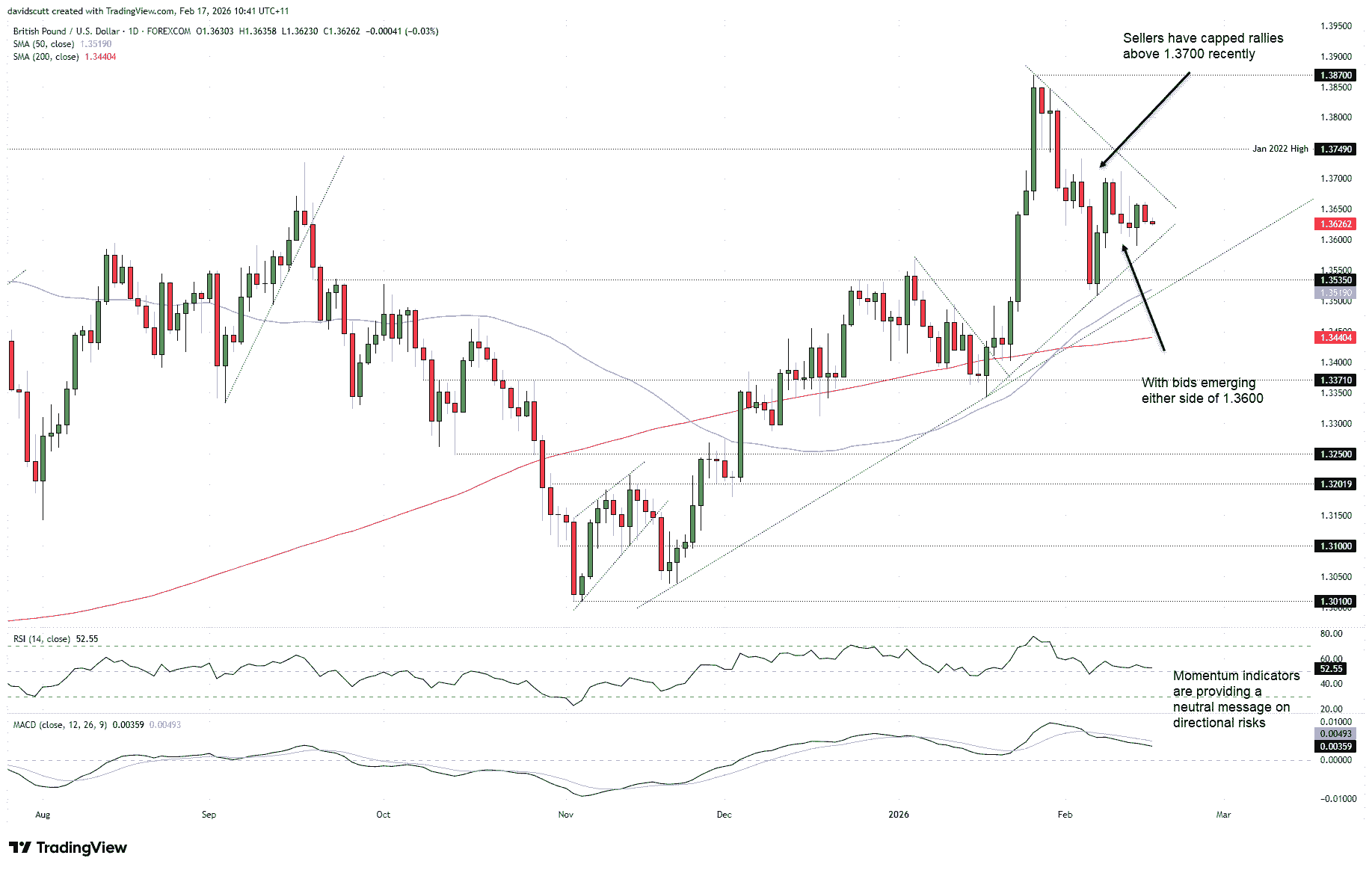
GBP/USD has slipped into consolidation following the sharp rejection from the January highs, with momentum stalling after the prior advance. While a symmetrical triangle formation may be developing, the structure remains far from textbook given the limited number of clean touches since the pattern emerged.
The triangle itself may offer only limited information on directional risks. Price could easily trade through the pattern, although the convergence of the boundaries still makes it a structure worth monitoring in the days ahead.
Momentum signals tell a similarly neutral story. RSI (14) continues to flatline near the 50 level, while MACD has crossed below its signal line in positive territory and is now drifting lower. Together, the signals point to fading upside momentum rather than outright bearish pressure, leaving neither bulls nor bears clearly in control.
Beyond the triangle, several levels stand out. On the downside, 1.3600 remains important after attracting buyers last week, followed by 1.3535 support, the 50-day moving average, and the rising trendline drawn from the late November lows. On the topside, rallies have repeatedly stalled above 1.3700 in recent weeks, providing traders with a narrow horizontal range down to 1.3600 to work with as markets wait for a more decisive move. Above 1.3700, resistance at 1.3749 and the January swing high of 1.3870 become the next levels of interest.
Given the direction of travel prior to this consolidation, prevailing market pricing for BoE rate cuts, and signs of softness in parts of the US data flow, a marginal bullish bias is favoured overall.


Open an account in minutes
Experience award-winning platforms with fast and secure execution, and enjoy tight spreads from 0.5 pts on FX and 0.3 pts on indices.
Economic calendar
Web Trader platform
Our sophisticated web-based platform is packed with features.
Related articles
EUR/USD, GBP/USD Outlook: RSI Hits 2020 Oversold Levels
EUR/USD, GBP/USD Outlook: The EUR/USD daily RSI has fallen to oversold levels last seen in 2020, raising the risk of a reversal across correlated currency pairs, including the US dollar and GBP/USD.

Dow Jones forecast: Stock markets under pressure from multiple sources
When looking at the major tech-heavy US indices like the S&P 500 or the Nasdaq 100, you wouldn’t think that the stock market is particularly weak. Yet, beneath the surface, the market is far from healthy right now. Investors are evidently just piling into the big tech and AI names, and as a result, market breadth is deteriorating. Other indices like the small cap Russell 2000 and the Dow Jones are starting to reflect that weakness.


Tankan Backs BOJ Tightening, but Yen Rate Expectations Ease
Japan’s Tankan supports further BOJ tightening, although softer rate expectations could limit support for the Japanese yen.

This report is intended for general circulation only. It should not be construed as a recommendation, or an offer (or solicitation of an offer) to buy or sell any financial products. The information provided does not take into account your specific investment objectives, financial situation or particular needs. Before you act on any recommendation that may be contained in this report, independent advice ought to be sought from a financial adviser regarding the suitability of the investment product, taking into account your specific investment objectives, financial situation or particular needs.
StoneX Financial Pte. Ltd., may distribute reports produced by its respective foreign entities or affiliates within the StoneX group of companies or third parties pursuant to an arrangement under Regulation 32C of the Financial Advisers Regulations. Where the report is distributed to a person in Singapore who is not an accredited investor, expert investor or an institutional investor (as defined in the Securities Futures Act), StoneX Financial Pte. Ltd. accepts legal responsibility to such persons for the contents of the report only to the extent required by law. Singapore recipients should contact StoneX Financial Pte. Ltd. at 6826 9988 for matters arising from, or in connection with the report.
In the case of all other recipients of this report, to the extent permitted by applicable laws and regulations neither StoneX Financial Pte. Ltd. nor its associated companies will be responsible or liable for any loss or damage incurred arising out of, or in connection with, any use of the information contained in this report and all such liability is hereby expressly disclaimed. No representation or warranty is made, express or implied, that the content of this report is complete or accurate.
StoneX Financial Pte. Ltd. is not under any obligation to update this report.
Trading CFDs carries a high level of risk that may not be suitable for some investors. Consider your investment objectives, level of experience, financial resources, risk appetite and other relevant circumstances carefully. The possibility exists that you could lose some or all of your investments, including your initial deposits. If in doubt, please seek independent expert advice. Visit www.forex.com/en-sg/terms-and-policies for the complete Risk Disclosure Statement.