



Gold outlook: Inflation, oil and yields keep downside risks elevated
With inflation still the Federal Reserve’s main concern and elevated oil prices keeping pressure on bond yields, the near-term gold outlook remains tilted to the downside, even if the longer term view remains constructive.
Share this:

Not much has changed in terms of the direction of travel for gold prices. The near-term remains somewhat bearish, while the longer-term bullish story is still quite strong. This leaves gold in a bit of limbo in the near-term. This morning found gold prices a bit higher than Friday’s close, a day when the metal came under renewed pressure despite the weaker US jobs report that had initially provided the metal some support. Weaker employment data may have offered gold that short-lived bounce, but it has not altered the broader macro backdrop. With inflation still the Federal Reserve’s main concern and elevated oil prices keeping pressure on bond yields, the near-term gold outlook remains tilted to the downside, even if the longer term view remains constructive.

Inflation remains the Fed’s priority
The softer US jobs figures do little to resolve the Federal Reserve’s central problem: inflation remains uncomfortably high. While labour-market weakness can strengthen the case for lower interest rates, the Fed is unlikely to respond aggressively if price pressures remain persistent.
That appears to be how the market interpreted the situation after Friday’s jobs report. Gold found buyers initially, but the rebound ran into resistance and failed to develop into a more meaningful reversal.
The dollar also proved relatively resilient. I had my doubts about whether the greenback would fall much further following Friday’s data, and sure enough, it has since resumed its upward move. That is a big headwind for gold.
Oil remains a problem for gold
Elevated oil prices are making the inflation story more complicated. Higher energy costs risk keeping inflation sticky for longer, while simultaneously putting pressure on government bond markets.
For gold, that combination is far from ideal. Higher Treasury yields increase the opportunity cost of holding a non-yielding asset, while a stronger dollar add obvious, direct, pressure.
Unless oil prices begin to fall meaningfully, the macro environment is therefore likely to remain challenging for gold.
The next major test will come from US CPI on 14 October. A hotter-than-expected inflation reading could reinforce expectations that the Fed will keep policy tighter for longer, potentially providing another catalyst for dollar strength and higher yields.
Conversely, a significant downside surprise in inflation could give gold some breathing room.
Technical gold outlook and levels to watch
From a technical analysis point of view, gold remains vulnerable. The metal tested its bearish trend line following the jobs report but failed to break it, although equally it has failed to break its bearish trend as well.
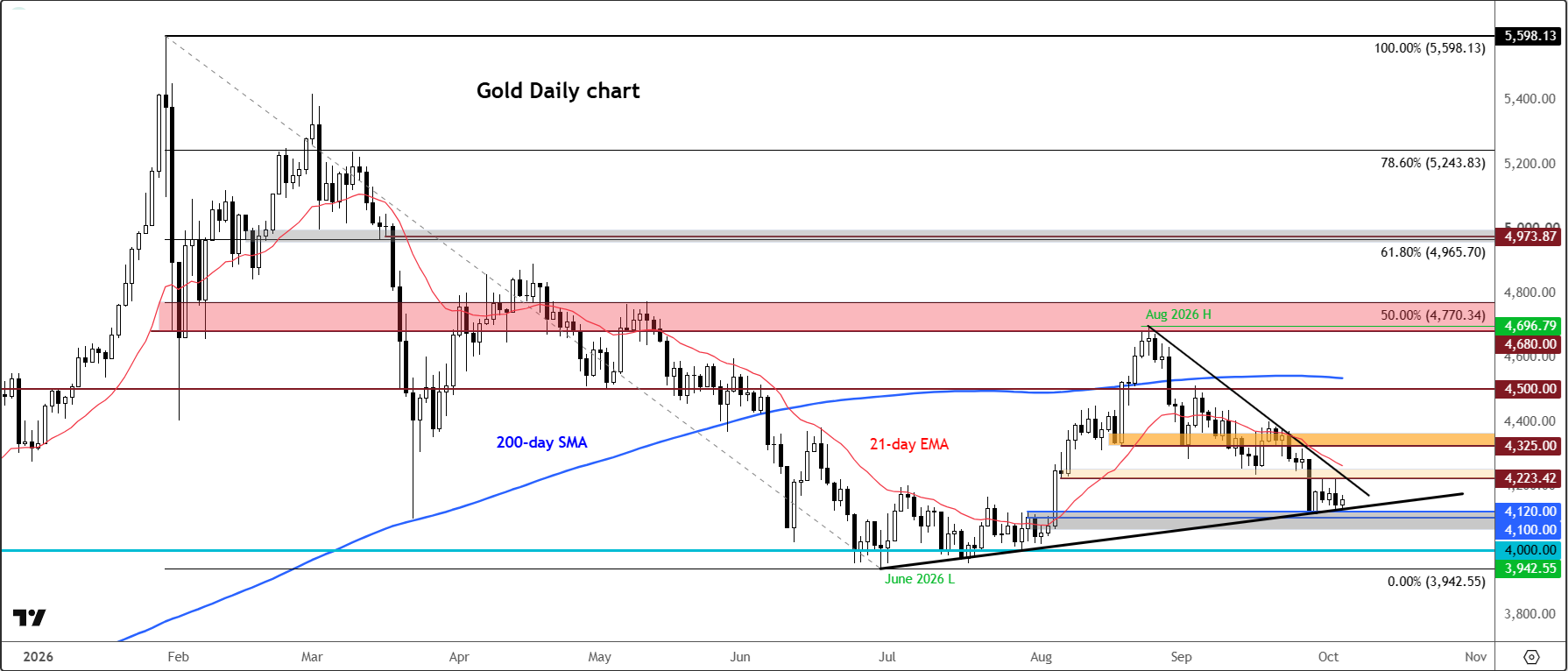
A sustained break above the bearish trend line would be the first indication that the downside bias is losing momentum. More importantly, XAUUSD would need to reclaim the former support zone around $4,220-$4,235 area to potentially trigger a proper short squeeze rally. In that cast, $4,280 - $4,300 would become the first upside target.
On the downside, $4,100 - $4,120 is the most important area of support to watch. This was the base of the early-August breakout and was tested during last week’s sharp decline, and it is where that short-term bullish trend lines comes into focus.
A sustained break below that zone would leave relatively little in the way of major technical support before the psychologically important $4,000 level. Given the recent price action, a move towards $4,000 later this month cannot be ruled out, although buyers could still emerge before then.
Central banks provide a longer-term cushion
The bearish near-term setup does not mean the longer-term case for gold has disappeared. Central-bank demand remains an important structural source of support. Persistent concerns about fiscal sustainability and the heavy concentration of global reserves in US Treasuries could reinforce that trend. Further diversification away from dollar-denominated assets would provide a structural floor beneath gold, potentially limiting the depth of any correction.
If persistent stress in the US bond market starts to undermine confidence in the country’s fiscal position, rising yields could eventually become negative for the dollar rather than supportive. Investors could increasingly look towards alternative stores of value, including gold, silver and Bitcoin.
This is something we have discussed in our Gold Q4 outlook.
Watch: Technical analysis on gold and Dow
Related tags:


Open an account in minutes
Experience award-winning platforms with fast and secure execution, and enjoy tight spreads from 0.5 pts on FX and 0.3 pts on indices.
Economic calendar
Web Trader platform
Our sophisticated web-based platform is packed with features.
Related articles

Gold Builds Range After Descending Triangle Breakdown
Gold prices started last week in a violent manner, but since setting a low last Tuesday prices have been range-bound, begging the question as to whether a reversal might be nearby.

EUR/USD forecast: Currency Pair of the Week | October 5, 2026
There’s not much in the way of data this week, meaning the EUR/USD forecast will be mainly driven by political and fiscal concerns, as well as the bond and oil markets.

Gold outlook: Inflation, oil and yields keep downside risks elevated
With inflation still the Federal Reserve’s main concern and elevated oil prices keeping pressure on bond yields, the near-term gold outlook remains tilted to the downside, even if the longer term view remains constructive.
This report is intended for general circulation only. It should not be construed as a recommendation, or an offer (or solicitation of an offer) to buy or sell any financial products. The information provided does not take into account your specific investment objectives, financial situation or particular needs. Before you act on any recommendation that may be contained in this report, independent advice ought to be sought from a financial adviser regarding the suitability of the investment product, taking into account your specific investment objectives, financial situation or particular needs.
StoneX Financial Pte. Ltd., may distribute reports produced by its respective foreign entities or affiliates within the StoneX group of companies or third parties pursuant to an arrangement under Regulation 32C of the Financial Advisers Regulations. Where the report is distributed to a person in Singapore who is not an accredited investor, expert investor or an institutional investor (as defined in the Securities Futures Act), StoneX Financial Pte. Ltd. accepts legal responsibility to such persons for the contents of the report only to the extent required by law. Singapore recipients should contact StoneX Financial Pte. Ltd. at 6826 9988 for matters arising from, or in connection with the report.
In the case of all other recipients of this report, to the extent permitted by applicable laws and regulations neither StoneX Financial Pte. Ltd. nor its associated companies will be responsible or liable for any loss or damage incurred arising out of, or in connection with, any use of the information contained in this report and all such liability is hereby expressly disclaimed. No representation or warranty is made, express or implied, that the content of this report is complete or accurate.
StoneX Financial Pte. Ltd. is not under any obligation to update this report.
Trading CFDs carries a high level of risk that may not be suitable for some investors. Consider your investment objectives, level of experience, financial resources, risk appetite and other relevant circumstances carefully. The possibility exists that you could lose some or all of your investments, including your initial deposits. If in doubt, please seek independent expert advice. Visit www.forex.com/en-sg/terms-and-policies for the complete Risk Disclosure Statement.