


S&P 500 forecast: AI linked stocks remain under pressure
And just like that, it is Friday again and the end of a volatile week. Today offers little on the macro calendar to change the prevailing narrative, leaving markets largely at the mercy of risk appetite, oil prices and the growing unease around the AI trade.
Share this:

And just like that, it is Friday again and the end of a volatile week. Today offers little on the macro calendar to change the prevailing narrative, leaving markets largely at the mercy of risk appetite, oil prices and the growing unease around the AI trade. In the week ahead, we have plenty of central bank meetings, but we will tackle those next week. This morning finds European equities lower, led by France’s benchmark index, which fell more than 1%, while Germany’s DAX was down around 0.7% and US index futures were also in the red. The selling was not confined to equities. Gold briefly slipped below $4,000 overnight as the liquidation in metals continued, while crude oil pushed higher again as the situation in the Middle East remained unresolved heading into the weekend. Against this backdrop, we maintain a modestly bearish S&P 500 forecast today.
Risk remains off the table
Yesterday’s session was particularly damaging for risk appetite, and there is little so far to suggest a meaningful change in tone. Equities and metals came under intense pressure as higher oil prices further fanned inflation concerns, while renewed doubts over the economics of AI investment added to a list of growing uncertainties, which markets do not like. Bonds, meanwhile, rallied as investors sought safety, pulling yields lower. Interestingly, the traditional dollar safe-haven trade has yet to emerge. The yen and Swiss franc have instead been the main beneficiaries of the defensive rotation, suggesting investors are looking for protection without necessarily wanting to add exposure to the US currency.
Negative bonds and stocks correlation re-asserts itself
It looks like the negative correlation between bonds and equities appears to be reasserting itself. Ten-year Treasury yields fell back below 5% for the first time in a month, despite the renewed rise in oil prices. That is significant because it suggests the latest equity weakness is beginning to overwhelm concerns about a more aggressive Federal Reserve response to energy-driven inflation.
That does not necessarily mean the dollar is about to embark on a sustained decline. The bar for markets to completely price out the prospect of a December Fed hike remains relatively high, which should limit the scope for a deeper USD correction for now.
There is, however, a more worrying interpretation of falling yields. Rather than simply reflecting lower expectations for Fed tightening, they could be signalling that investors are becoming increasingly defensive as the AI trade loses momentum. The current cycle of enthusiasm around AI has been built on the assumption that enormous investment in chips, data centres and infrastructure will ultimately translate into equally enormous returns. But that assumption is now being tested.
Short bets grow on expensive tech stocks
According to Bloomberg, hedge funds have been building bearish equity positions at a pace not seen in years. Goldman Sachs says its prime brokerage clients have been shorting stocks at roughly five times the rate at which they have been buying them, pushing short exposure towards a five-year high while overall bullish positioning has also been reduced.
That positioning is clearly a warning sign for equities, but it also creates the conditions for a sharp squeeze if sentiment suddenly improves. Markets can become oversold quickly when positioning becomes this one-sided.
For now, though, the bigger issue is that several sources of uncertainty are reinforcing each other. Higher energy prices are reviving inflation concerns, geopolitical risks are keeping investors defensive, and questions over whether AI spending can generate sufficient returns are putting pressure on the very stocks that have driven much of the equity market’s gains.
The result is an increasingly fragile backdrop for risk assets. Until oil prices stabilise and confidence in the AI investment cycle improves, rallies in equities may continue to look more like opportunities to reduce risk than the start of a durable recovery.
S&P 500 forecast: technical analysis and levels to watch
In fact, if the S&P 500 now breaks the short-term trend line that has been in place since the summer decisively, then it could give rise to further technical selling and long-side liquidations. Yesterday, it tested the trend line and broke it momentary before bouncing off the lows. The bears are having another go at it today.
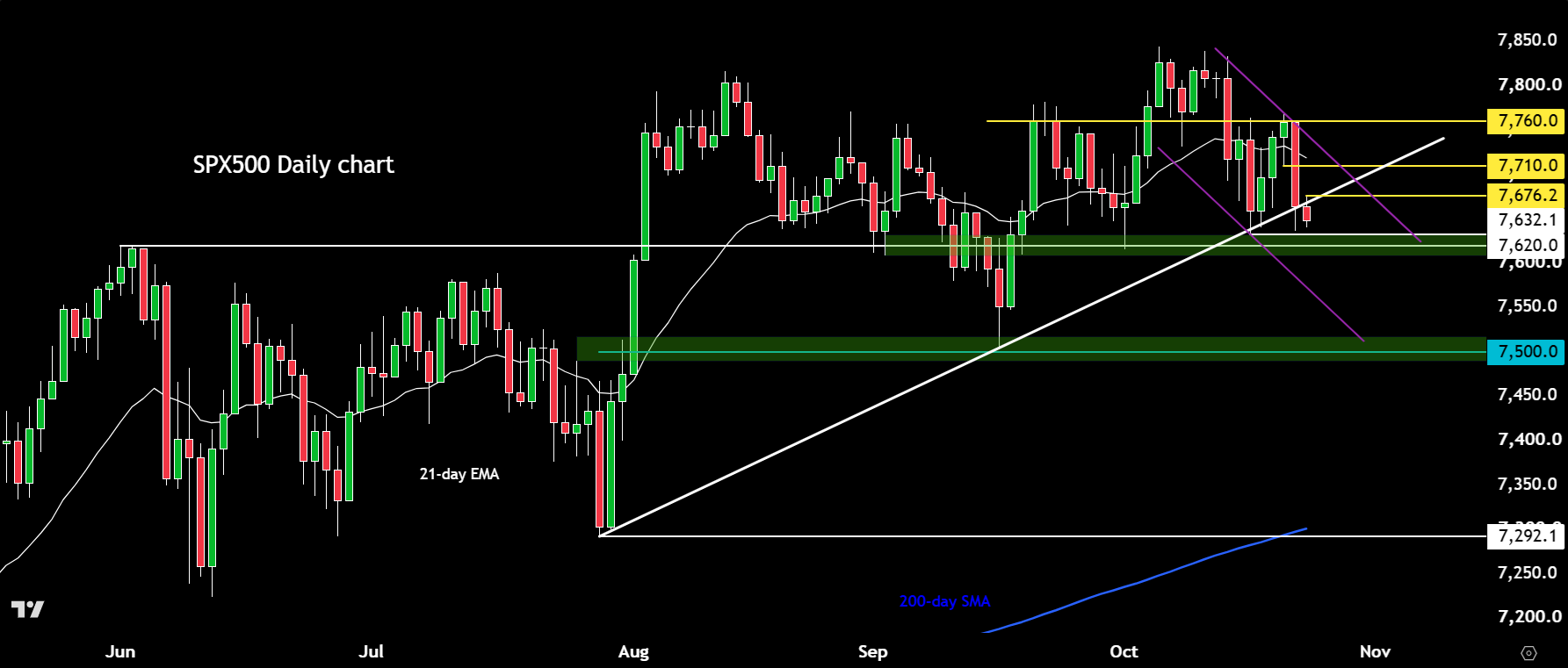
Meanwhile key short-term support sits at around 7620-35 area on S&P 500 chart. This is the zone to watch for a potential breakdown that could then pave the way for a deeper correction with the next obvious support not seen until around 7,500.
On the upside, initial resistance is the underside of the trend line and today’s earlier highs near 7676. Above that Wednesday’s low of 7,710 comes into focus next, followed by the bear resistance trend of the bearish channel slightly above. Break that and things will start to improve from a technical analysis view point for the S&P 500 forecast.




Open an account in minutes
Experience award-winning platforms with fast and secure execution, and enjoy tight spreads from 0.5 pts on FX and 0.3 pts on indices.
Economic calendar
Web Trader platform
Our sophisticated web-based platform is packed with features.
Related articles

S&P 500 forecast: AI linked stocks remain under pressure
And just like that, it is Friday again and the end of a volatile week. Today offers little on the macro calendar to change the prevailing narrative, leaving markets largely at the mercy of risk appetite, oil prices and the growing unease around the AI trade.
Nasdaq 100 Slides as Meta Posts Strong Results and Drops 6%
The Nasdaq 100 sell-off is being driven by doubts over AI spending, as investors punish strong earnings that fail to justify stretched valuations.

USD/JPY, Nikkei Break Lower as AI Meltdown Spreads
Thursday’s tech tantrum has become Friday’s fire sale. With Nikkei support giving way and the yen strengthening, could the selling start feeding on itself?

This report is intended for general circulation only. It should not be construed as a recommendation, or an offer (or solicitation of an offer) to buy or sell any financial products. The information provided does not take into account your specific investment objectives, financial situation or particular needs. Before you act on any recommendation that may be contained in this report, independent advice ought to be sought from a financial adviser regarding the suitability of the investment product, taking into account your specific investment objectives, financial situation or particular needs.
StoneX Financial Pte. Ltd., may distribute reports produced by its respective foreign entities or affiliates within the StoneX group of companies or third parties pursuant to an arrangement under Regulation 32C of the Financial Advisers Regulations. Where the report is distributed to a person in Singapore who is not an accredited investor, expert investor or an institutional investor (as defined in the Securities Futures Act), StoneX Financial Pte. Ltd. accepts legal responsibility to such persons for the contents of the report only to the extent required by law. Singapore recipients should contact StoneX Financial Pte. Ltd. at 6826 9988 for matters arising from, or in connection with the report.
In the case of all other recipients of this report, to the extent permitted by applicable laws and regulations neither StoneX Financial Pte. Ltd. nor its associated companies will be responsible or liable for any loss or damage incurred arising out of, or in connection with, any use of the information contained in this report and all such liability is hereby expressly disclaimed. No representation or warranty is made, express or implied, that the content of this report is complete or accurate.
StoneX Financial Pte. Ltd. is not under any obligation to update this report.
Trading CFDs carries a high level of risk that may not be suitable for some investors. Consider your investment objectives, level of experience, financial resources, risk appetite and other relevant circumstances carefully. The possibility exists that you could lose some or all of your investments, including your initial deposits. If in doubt, please seek independent expert advice. Visit www.forex.com/en-sg/terms-and-policies for the complete Risk Disclosure Statement.