



USD/JPY forecast: Currency Pair of the Week | August 10, 2026
Friday’s US employment report was the first of four major pieces of economic data due before the Federal Reserve’s September meeting. The figures delivered a significant downside surprise, prompting markets to scale back expectations of a September rate hike to around 44%, from above 55% ahead of the release.
Share this:

Friday’s US employment report was the first of four major pieces of economic data due before the Federal Reserve’s September meeting. The figures delivered a significant downside surprise, prompting markets to scale back expectations of a September rate hike to around 44%, from above 55% ahead of the release. Yet, the data hasn’t materially changed the USD/JPY forecast much. The pair has already recovered towards the levels seen before the payrolls release, trading close to 159.00. That leaves the pair once again within striking distance of the psychologically important 160.00 level. Unless upcoming US data deliver further negative surprises, or Japanese authorities step back into the market, USD/JPY could once again test that threshold.
The next major catalyst is US inflation, with CPI due later this week. At the same time, developments in oil markets remain important, particularly as uncertainty surrounding the Strait of Hormuz continues to complicate the inflation outlook.
Oil remains a key variable for the dollar outlook
Crude oil prices continue to find support from the uncertainty surrounding shipping through the Strait of Hormuz. Although Donald Trump has indicated that Washington is “semi-negotiating” with Iran, the language suggests that economic pressure remains central to the strategy rather than an immediate move towards military escalation.
There have also been reports that Iran and Oman are edging towards an understanding over a shipping route through the Strait. However, any meaningful and sustained reopening of the waterway is likely to depend on wider progress in US-Iran negotiations.
A prolonged disruption to energy flows should keep inflationary pressures elevated. That could make it harder for the Fed to ease policy, even if we see further data weakness, potentially providing an underlying source of support for the greenback.
The Fed’s data-dependent approach puts CPI in the spotlight
The latest market reaction reinforces just how important incoming economic data have become for the dollar. Rather than relying heavily on oil prices alone, markets are increasingly being forced to assess individual data release through the Fed’s evolving reaction function.
That shift follows Federal Reserve Chair Kevin Warsh’s decision to move away from providing firm forward guidance. His recent messaging has left greater room for incoming data to reshape expectations around monetary policy.
There are still several important data points to come before the September 16 FOMC meeting: another payrolls report and two further CPI releases, including this week’s figures.
Inflation is particularly important because of Warsh’s admission that the Fed has consistently gotten it wrong and is looking to address it. As a result, any surprises in CPI or other inflation data like PPI could generate much larger moves in the dollar than we have seen from Friday’s jobs report alone.
This also helps explain why the weak payrolls figures did not trigger a sustained collapse in USD/JPY. Markets still have several opportunities to reassess the Fed outlook before September.
What is expected from CPI data?
US CPI is now arguably the most important event on this week’s calendar. The previous CPI report had certainly surprised to the downside. Headline inflation slowed more sharply than expected to 3.5% from 4.2%, while core CPI eased to 2.6%. This time, economists expect moderate weakness. Headline CPI is expected to rise 0.1% month-on-month, taking the annual rate to 3.4%. Core CPI is forecast to increase 0.2% on the month, leaving annual core inflation at 2.5%.
The question now is whether we will see that moderation, and if so, whether it is enough to trigger further dovish repricing in US dollar. But as mentioned, alongside data it is also the developments in oil prices which will determine whether expectations for a tighter Fed are rebuilt or continue to unwind.
Why the yen is struggling to capitalise on softer US data
In theory, the yen should be among the clearest beneficiaries of weaker US economic data because USD/JPY remains highly sensitive to the interest-rate differential between the two economies.
Yet the yen continues to face selling pressure, even following intervention episodes. The USD/JPY sold of sharply in late July as both the US and Japanese authorities jointly intervened in the foreign exchange market to support the yen. Such coordinated action is unusual and suggests that the US Treasury may be taking a more active role in attempts to stabilise the currency.
However, intervention alone is unlikely to deliver a durable change in the direction of USD/JPY. Foreign exchange intervention can disrupt positioning, reduce excessive volatility and alter market psychology. What it generally cannot do is permanently overturn a powerful macroeconomic trend.
Even growing expectations of a September Bank of Japan rate increase have so far struggled to generate a sustained reversal in the pair.
This is partly because the interest-rate gap with the US remains wide enough to keep carry-trade demand for the dollar alive.
Softer US data may improve the fundamental case for a stronger yen, but positioning and yield differentials can continue to work in the opposite direction – especially if oil prices remain elevated for longer.
USD/JPY forecast: 160 remains firmly on the radar
Technically and fundamentally, USD/JPY remains caught between competing forces. The pair has already recovered to above 158.50, effectively returning to the area where it traded before Friday’s payrolls shock.
That recovery suggests the market has not yet fully embraced a sustained dovish repricing of the Federal Reserve. With the USD/JPY now also back above the 200-day average, the near-term path of least resistance is no longer to the downside.
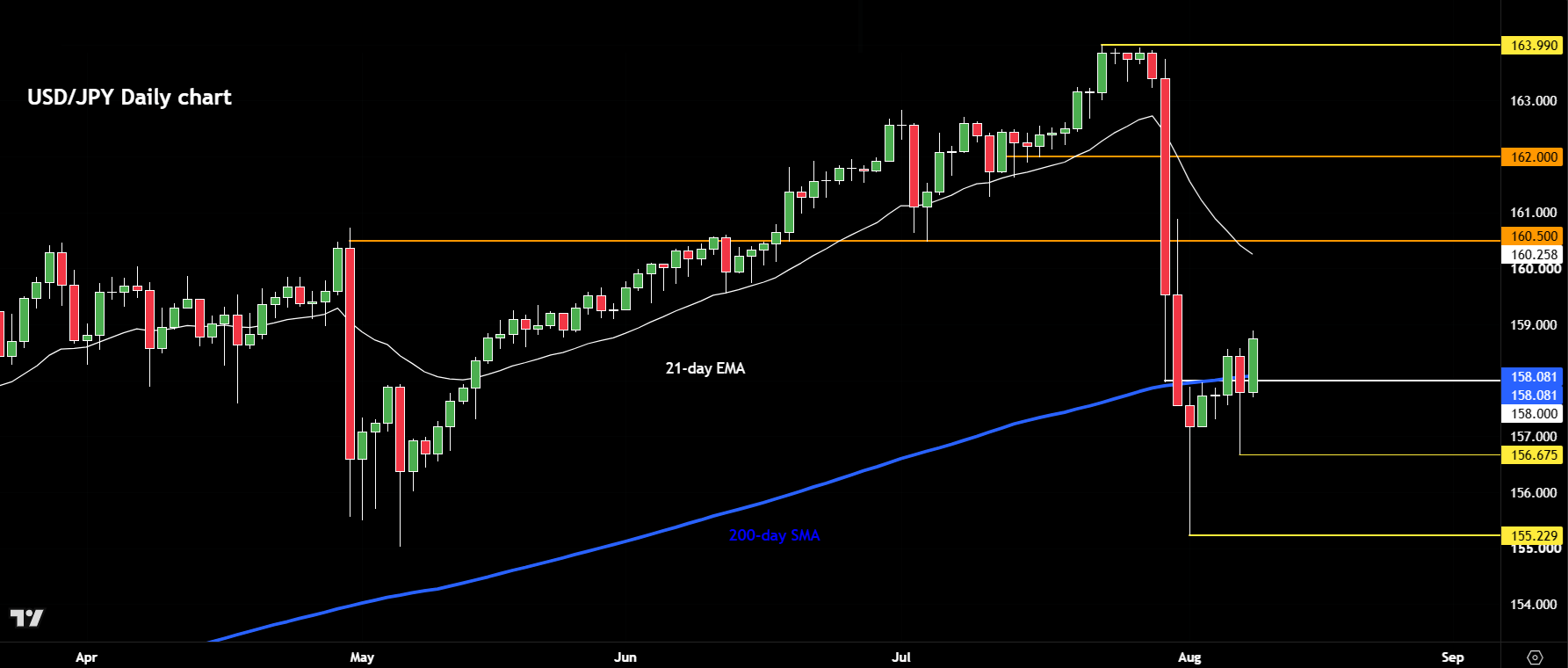
The path ahead is therefore likely to remain volatile. A return towards 160.00 remains a realistic possibility, particularly if US inflation proves sticky or oil prices remain elevated. 160.50 is the next obvious resistance followed by 162.00.
Meanwhile, if support around 158.00 area gives way and price moves below the 200-day again, then in the case, a return to 157.00 and possibly 156.00 will become likely. For that to happen, you’d feel US CPI will have to be quite weak this week.

-- Written by Fawad Razaqzada, Market Analyst
Follow Fawad on Twitter @Trader_F_R
Related tags:
Latest market news




Open an account in minutes
Experience award-winning platforms with fast and secure execution, and enjoy tight spreads from 0.5 pts on FX and 0.3 pts on indices.
Economic calendar
Web Trader platform
Our sophisticated web-based platform is packed with features.
Related articles
USD/JPY Weekly Outlook: Volatility Has Left the Building
The yen has ignored broad dollar weakness, falling Treasury yields and renewed market turbulence. Yet its relationship with US interest rates remains intact. So why is USD/JPY going absolutely nowhere fast?
USD Exhaustion into Bearish Engulf: EUR/USD, GBP/USD, USD/JPY
It was a big week for the Dollar with stronger inflation pushing rate hike themes, with price action diverging as price printed a bearish engulf on the weekly DXY chart.

Swiss Franc Forecast: USD/CHF Seven-Week Rally Reverses From Yearly Highs 10 16 2026
A sharp rejection from fresh highs has shifted momentum in favor of USD/CHF bears, raising the stakes for a critical support test.

This report is intended for general circulation only. It should not be construed as a recommendation, or an offer (or solicitation of an offer) to buy or sell any financial products. The information provided does not take into account your specific investment objectives, financial situation or particular needs. Before you act on any recommendation that may be contained in this report, independent advice ought to be sought from a financial adviser regarding the suitability of the investment product, taking into account your specific investment objectives, financial situation or particular needs.
StoneX Financial Pte. Ltd., may distribute reports produced by its respective foreign entities or affiliates within the StoneX group of companies or third parties pursuant to an arrangement under Regulation 32C of the Financial Advisers Regulations. Where the report is distributed to a person in Singapore who is not an accredited investor, expert investor or an institutional investor (as defined in the Securities Futures Act), StoneX Financial Pte. Ltd. accepts legal responsibility to such persons for the contents of the report only to the extent required by law. Singapore recipients should contact StoneX Financial Pte. Ltd. at 6826 9988 for matters arising from, or in connection with the report.
In the case of all other recipients of this report, to the extent permitted by applicable laws and regulations neither StoneX Financial Pte. Ltd. nor its associated companies will be responsible or liable for any loss or damage incurred arising out of, or in connection with, any use of the information contained in this report and all such liability is hereby expressly disclaimed. No representation or warranty is made, express or implied, that the content of this report is complete or accurate.
StoneX Financial Pte. Ltd. is not under any obligation to update this report.
Trading CFDs carries a high level of risk that may not be suitable for some investors. Consider your investment objectives, level of experience, financial resources, risk appetite and other relevant circumstances carefully. The possibility exists that you could lose some or all of your investments, including your initial deposits. If in doubt, please seek independent expert advice. Visit www.forex.com/en-sg/terms-and-policies for the complete Risk Disclosure Statement.