


USD/JPY weekly outlook: Quarter turn scrambles rates regime
USD/JPY’s tight relationship with front-end US rates broke down sharply last week, but quarter-turn flows and positioning suggest the disconnect may prove temporary.
Share this:

- USD/JPY front-end rates correlation collapsed last week
- Quarter-turn Japanese portfolio flows may explain the disconnection
- Speculative yen longs have more than halved since mid-September
- Fed speak, ISM services and Ueda headline event risk
The dominant rates relationship with USD/JPY deteriorated abruptly last week, coinciding with the calendar turn and the start of the second half of Japan’s fiscal year.
However, the reaction following Friday’s non-farm payrolls report suggests the disconnection may prove only temporary, with a strong rebound in US 2-year yields mirrored by a similar move in USD/JPY.
If the rates regime is to reassert itself, Fed speak and Monday’s ISM services PMI loom as the most likely catalysts for volatility given the dearth of top-tier US economic data. In Japan, a speech from BOJ Governor Kazuo Ueda on Tuesday is another key event, particularly given he has been used in the past to help steer market pricing ahead of looming policy decisions.
USD/JPY rates relationship breaks down
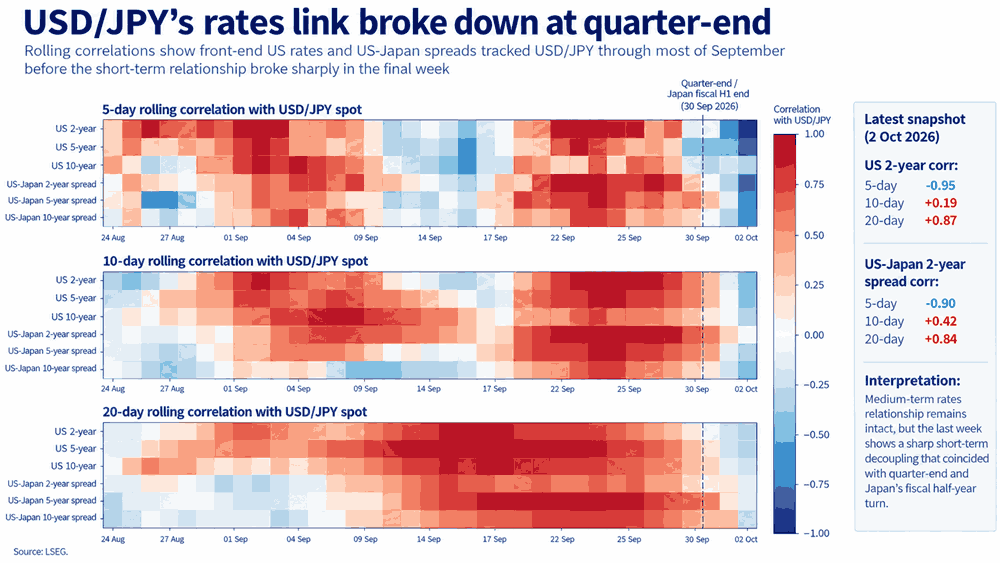
There was something of a changing of the guard when it came to the key drivers for USD/JPY last week, with the strong positive relationship between front-end US Treasury yields and front-end US-Japan rate spreads disintegrating rapidly, as seen in the correlation matrix below.
You can see how quickly that relationship deteriorated in the five-day window at the top. The correlation with the US 2-year yield fell to -0.95, while the relationship with the US-Japan 2-year spread dropped to -0.90, despite both remaining strongly positive over the 20-day window at +0.87 and +0.84 respectively.
Source: LSEG
The breakdown coincided with the calendar turn, the start of the December quarter and, of course, the second half of Japan’s fiscal year, putting something of an asterisk next to the abrupt deterioration.
The question now is whether temporary factors were responsible for the breakdown in this longstanding relationship, or whether something more meaningful is now asserting itself as the key driver for USD/JPY moving forward.
This content was created by an affiliate of FOREX.com and represents the views and opinions of the author/speakers, not the views and opinions of FOREX.com, StoneX Group Inc., or its subsidiaries. The content has not been independently reviewed by FOREX.com.
NISA seasonality adds another piece to the puzzle
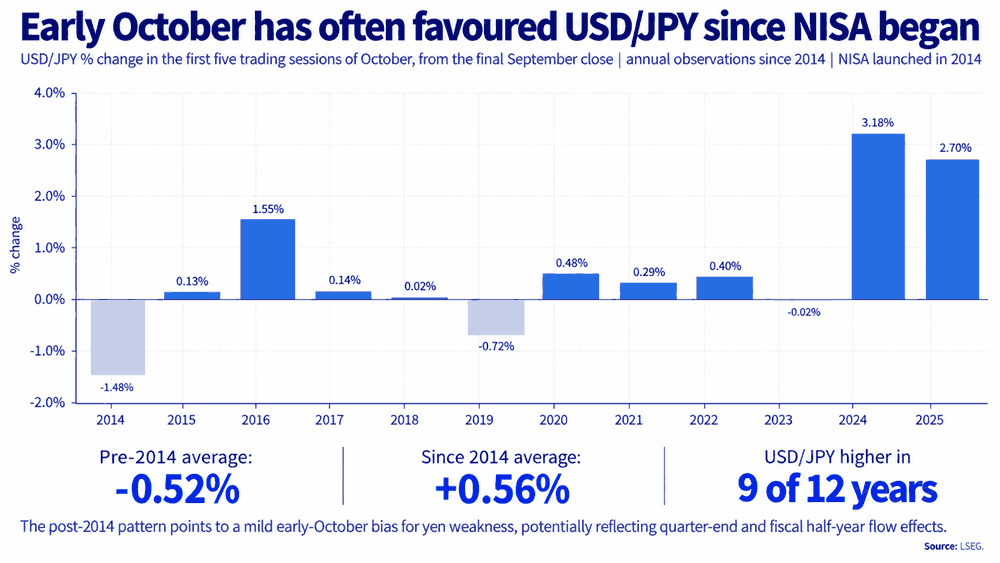
Hinting the disconnection between front-end rates and USD/JPY may be temporary, there is some seasonal evidence that capital outflows following the quarter turn may have played a role, resulting in yen weakness and buoyancy in USD/JPY.
One possible explanation is NISA. Introduced in 2014, Japan’s Nippon Individual Savings Account scheme gives households tax advantages when investing in eligible financial assets. Investment gains and dividends within the accounts can be received tax-free, encouraging households to allocate savings into equities and funds, including products with overseas exposure.
Source: LSEG
Of course, that may not explain what happened last week. But given the similarities in the seasonal pattern during the first week of October in recent years, it fits with the idea that Japanese portfolio outflows may have temporarily disrupted the usual relationship between USD/JPY and rates.
Yen longs are being rapidly unwound
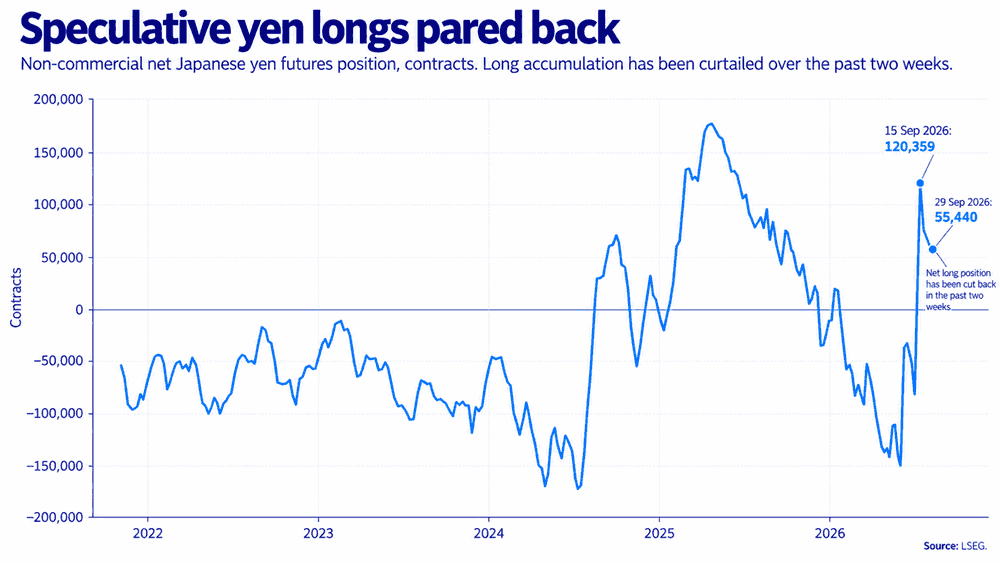
Another factor that may have contributed to the disconnection is a recalibration in market positioning, at least among futures traders. As seen in the graphic below, speculative yen longs had surged to 120,359 contracts in mid-September, according to the CFTC COT report. However, over the past fortnight, that position has more than halved, falling to a net long of 55,440 contracts as of the close of business last Tuesday.

Source: LSEG
Of course, this only captures one part of the market, and speculative accounts remain net long yen. But the unwind in bullish yen positioning, combined with possible seasonal portfolio outflows, provides a plausible explanation as to why USD/JPY held up last week even as the rally in front-end US rates broadly stalled.
Friday hints the rates link is still alive
While the relationship between front-end US yields and USD/JPY deteriorated over the past week, the reaction to Friday’s September non-farm payrolls report over a much shorter timeframe adds to the view that the disconnection may only be temporary.
The initial knee-jerk move lower in US 2-year yields was mirrored by USD/JPY. However, both reversed almost immediately, with 2-year yields pushing back above their pre-payrolls level and USD/JPY staging a similar V-shaped recovery during the session.
So while quarter-turn flows and positioning may have temporarily disrupted the relationship, Friday’s price action suggests it could soon reassert itself in the week ahead.
A placeholder week for US macro
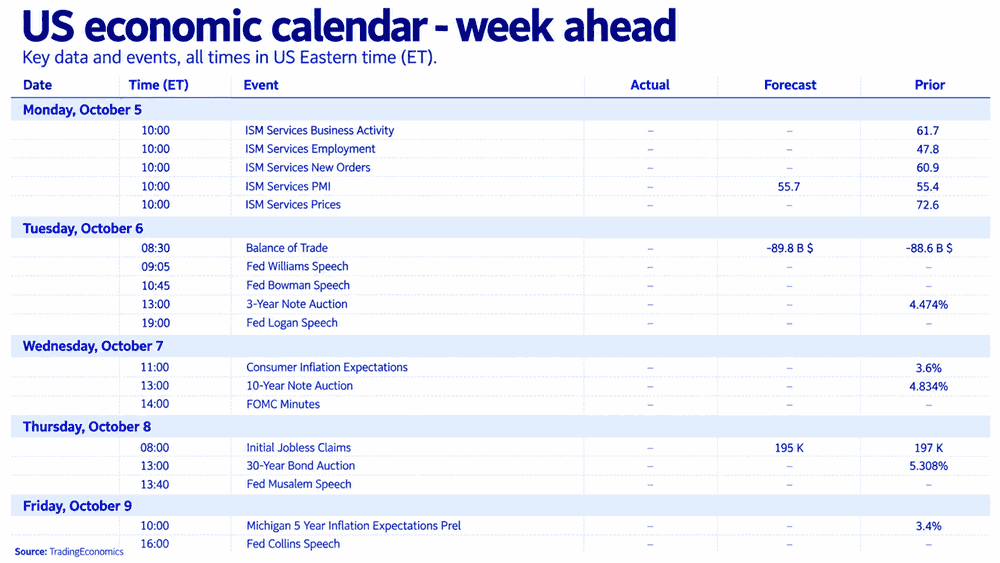
Looking to event risk in the week ahead, there is a dearth of top-tier economic data in the United States, suggesting Fed speak and Monday’s ISM services PMI loom as the most likely catalysts for USD/JPY volatility.
Source: TradingView
Within the ISM report, the prices paid component will be very closely watched after the equivalent gauge in Thursday’s ISM manufacturing PMI surged to 77.9. If that strength is replicated in the far larger services sector, it would reinforce the idea that even with some softness emerging in the labour market, the Fed can’t take its eyes off inflation, with survey-based price pressures still running very hot.
In reality, this week comes across as more of a placeholder as markets await key September inflation data due midway through October, which may provide a much stronger steer on whether the Fed follows September’s rate hike with another move later this month.
Source: TradingView
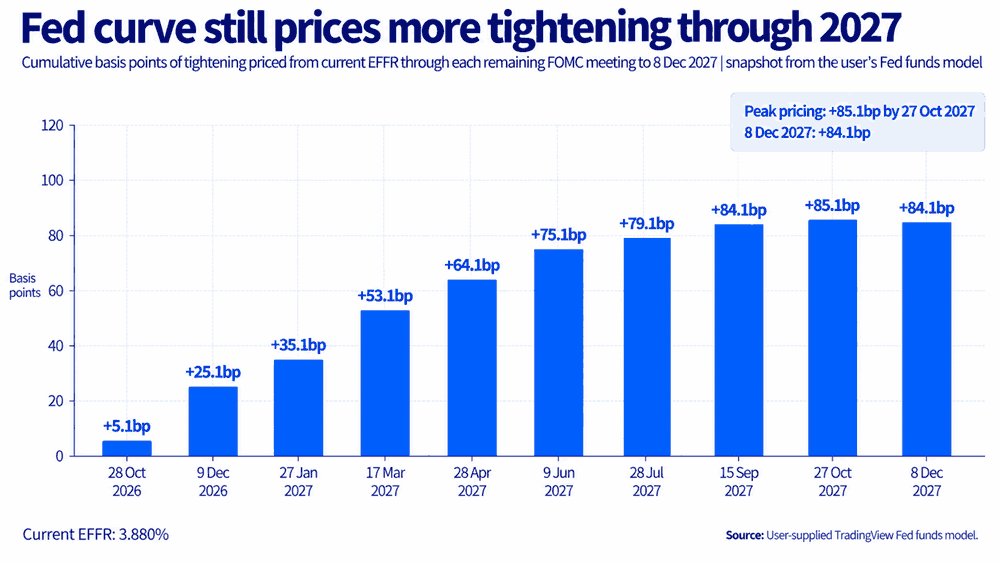
While there was a noticeable unwind in hawkish pricing for the Fed’s October meeting last week, moving from more than 50% priced to less than 25% by Friday, most of that repricing had already occurred before the payrolls report. There was very little change in the implied October probability following the data itself, which may help explain why US 2-year yields rebounded so sharply after the initial knee-jerk move lower.
Looking further out, there is still more than 85 basis points of cumulative tightening priced through to the final quarter of next year, suggesting at least three additional rate hikes, with the risk of a fourth move still priced in.
Ueda could reshape October rate expectations
Source: TradingView
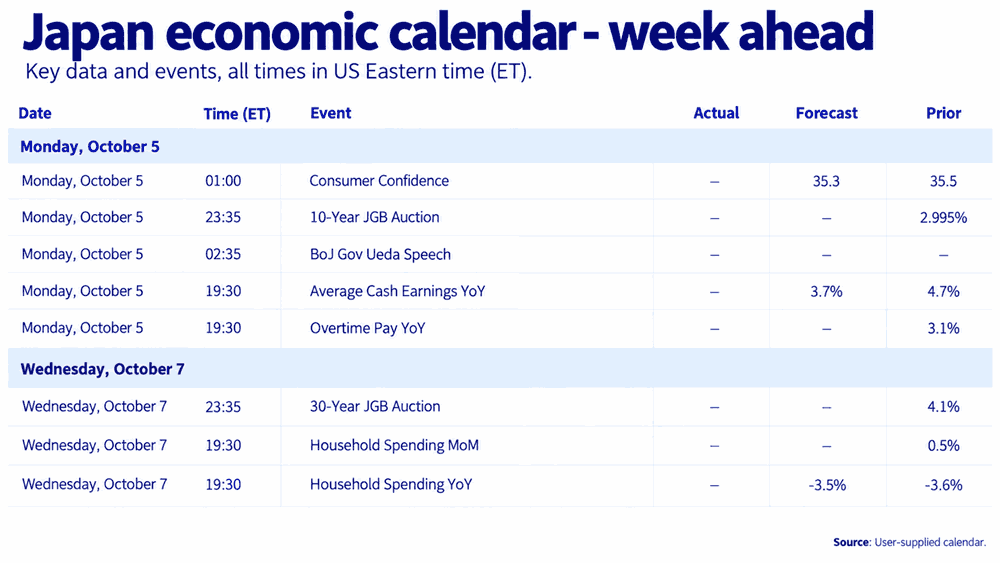
While Japanese-specific data and events have rarely moved USD/JPY recently, as demonstrated by the scorching hot September Tokyo CPI report released on Friday that barely saw yen traders bat an eyelid, the Japanese calendar at face value actually looks a little more interesting than the US.
Key wages data and household spending are due Tuesday, while a speech from BOJ Governor Ueda also lands ahead of the Bank’s October policy decision later this month. In the past, Ueda has been rolled out to shift market pricing when deemed necessary, meaning his remarks could provide clues as to whether the pace of BOJ tightening may accelerate to back-to-back increases rather than the more gradual path markets currently assess.
Price action takes precedence as momentum stays neutral
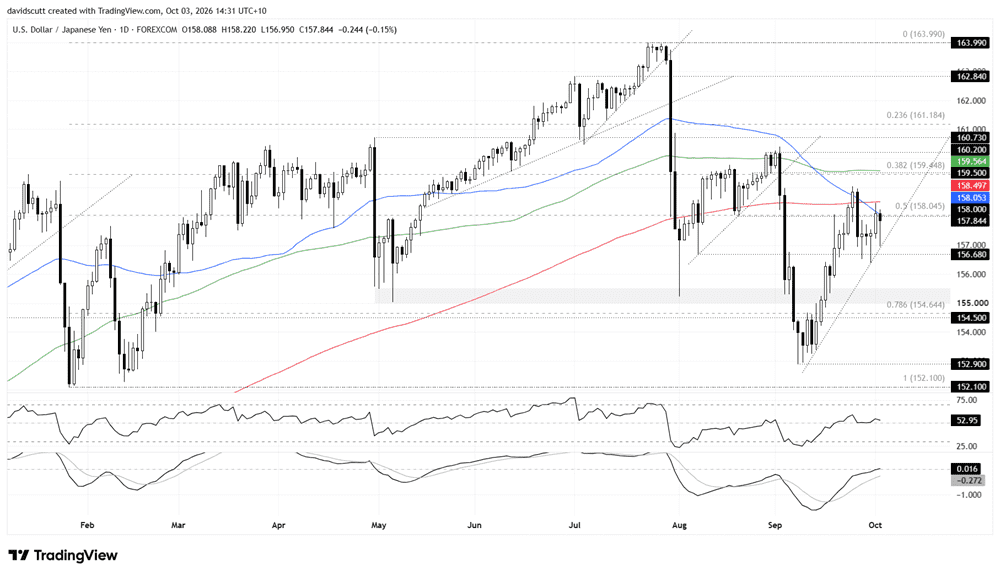
USD/JPY has been range-bound over the past couple of weeks, attracting bids towards and beneath 156.68, the swing low set on August 7. Moves above 158, which also coincides with the 50% retracement of the 2026 low-high, have often brought out not only jawboning from Japanese officials but also offers.
That makes 158 the immediate level to watch overhead, coinciding with where the 50-day moving average is also located. Above that, the 200-day moving average and 159 are the next levels to note, before a more pronounced resistance zone kicks in around 159.50, coinciding with the 38.2% retracement of the 2026 low-high and the 100-day moving average.
Source: TradingView
Underneath where the pair now trades, bids kicked in around 157 on dips last week, making that the initial area of focus on the downside. An emerging uptrend also runs through the area, strengthening it as a support zone.
If we were to see a clean break beneath the uptrend and 156.68, particularly on a closing basis, that may see bears become more emboldened, putting a potential retest of the significant support zone between 155.50 and 155 on the radar. That area absorbed plenty of offers during intervention episodes earlier this year.
The message from the oscillators is entirely neutral, meaning more emphasis should be put on price action around the above-mentioned levels when assessing near-term directional risks.


Open an account in minutes
Experience award-winning platforms with fast and secure execution, and enjoy tight spreads from 0.5 pts on FX and 0.3 pts on indices.
Economic calendar
Web Trader platform
Our sophisticated web-based platform is packed with features.
Related articles
USD/JPY weekly outlook: Quarter turn scrambles rates regime
USD/JPY’s tight relationship with front-end US rates broke down sharply last week, but quarter-turn flows and positioning suggest the disconnect may prove temporary.

USD/CAD forecast: rally could accelerate above June highs at 1.4250
USD/CAD recovered quickly after weaker US jobs data, keeping the bullish trend in focus. A move above the June highs could accelerate the rally as inflation keeps the Fed under pressure.


USD Sets Fresh Yearly High as EUR/USD Drops Dramatically, USD/JPY Stable
Well, it was a week of USD strength that wasn’t entirely pushed by USD/JPY, as a strong sell-off in EUR/USD has pushed the major pair to its most oversold state in a decade.

This report is intended for general circulation only. It should not be construed as a recommendation, or an offer (or solicitation of an offer) to buy or sell any financial products. The information provided does not take into account your specific investment objectives, financial situation or particular needs. Before you act on any recommendation that may be contained in this report, independent advice ought to be sought from a financial adviser regarding the suitability of the investment product, taking into account your specific investment objectives, financial situation or particular needs.
StoneX Financial Pte. Ltd., may distribute reports produced by its respective foreign entities or affiliates within the StoneX group of companies or third parties pursuant to an arrangement under Regulation 32C of the Financial Advisers Regulations. Where the report is distributed to a person in Singapore who is not an accredited investor, expert investor or an institutional investor (as defined in the Securities Futures Act), StoneX Financial Pte. Ltd. accepts legal responsibility to such persons for the contents of the report only to the extent required by law. Singapore recipients should contact StoneX Financial Pte. Ltd. at 6826 9988 for matters arising from, or in connection with the report.
In the case of all other recipients of this report, to the extent permitted by applicable laws and regulations neither StoneX Financial Pte. Ltd. nor its associated companies will be responsible or liable for any loss or damage incurred arising out of, or in connection with, any use of the information contained in this report and all such liability is hereby expressly disclaimed. No representation or warranty is made, express or implied, that the content of this report is complete or accurate.
StoneX Financial Pte. Ltd. is not under any obligation to update this report.
Trading CFDs carries a high level of risk that may not be suitable for some investors. Consider your investment objectives, level of experience, financial resources, risk appetite and other relevant circumstances carefully. The possibility exists that you could lose some or all of your investments, including your initial deposits. If in doubt, please seek independent expert advice. Visit www.forex.com/en-sg/terms-and-policies for the complete Risk Disclosure Statement.