


USD/JPY weekly outlook: US inflation threatens to break the stalemate
USD/JPY has barely budged in October, with the price trapped between key moving averages. Could US inflation finally deliver the catalyst needed to break the stalemate?
Share this:

- US CPI and PPI headline a packed inflation calendar
- Markets price three-plus Fed hikes despite recent disinflation
- Short-term correlations suggest risk appetite is driving USD/JPY
- Narrowing trading range leaves USD/JPY awaiting a catalyst
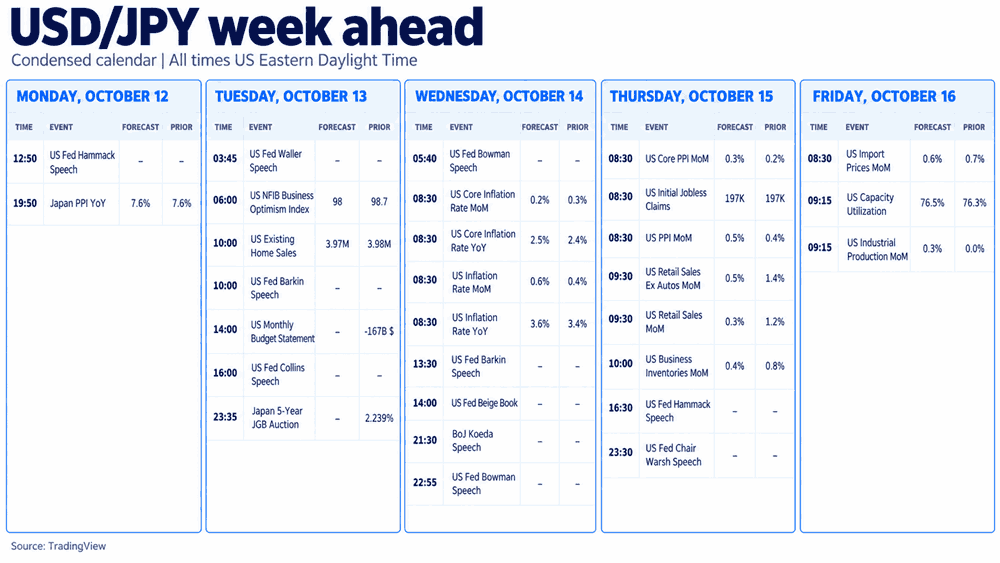
US inflation data dominates the week ahead for USD/JPY, with Wednesday's CPI and Thursday's PPI reports likely to influence Treasury yields and broader risk appetite.
With markets pricing more than three Fed rate hikes by the middle of next year, the onus remains on inflation to stay relatively elevated and sticky to justify those expectations.
However, the recent deterioration in USD/JPY's traditionally strong relationship with US Treasury yields suggests the reaction in riskier assets may be just as important as movements in yields themselves, complicating the outlook for the pair.
US inflation takes centre stage
Source: TradingView
Outside Wednesday's CPI report, Thursday shapes up as another big session for US economic data, with PPI and retail sales released alongside each other. Following strong increases across retail sales measures in August, another solid outcome would reinforce the view that consumer demand remains firm enough to support further Fed tightening.
Friday's import prices will also be worth monitoring for signs of inflation pressures, particularly given elevated energy costs.
There's plenty of Fed speak throughout the week, although remarks after the inflation reports are likely to carry more weight. Governor Christopher Waller will discuss artificial intelligence at the Bloomberg New Economy Forum in New Delhi on Tuesday, while Fed Chair Kevin Warsh will participate in a fireside chat with IMF Managing Director Kristalina Georgieva in Bangkok on Thursday.
While Warsh may face questions about the policy outlook following CPI, he's shown little inclination to provide explicit forward guidance, and that's unlikely to change when discussing the global economy at a forum outside the United States.
In Japan, the calendar is as quiet as a church mouse. Remarks from BOJ board member Junko Koeda provide an opportunity to influence market pricing, which, like the Fed, favours a December move over October. Unless she delivers something truly unexpected, her appearance may come and go with little fanfare.
Core CPI cools, PPI remains hot
Heading into the September CPI report, the brutal truth is that inflation has remained above the Fed's 2% target for more than five years.
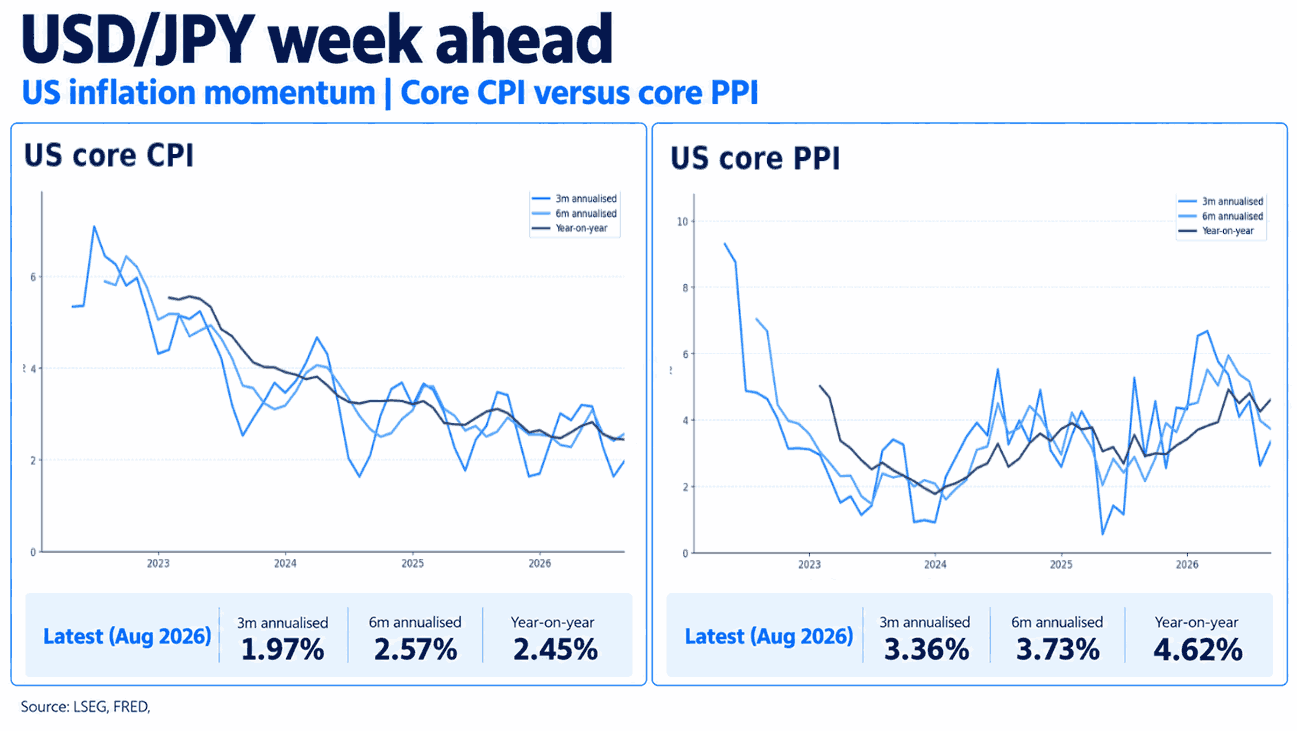
While there have been encouraging signs of near-term disinflation, with core CPI running at an annualised pace of just 1.97% over the past three months, the six-month annualised rate of 2.57% and year-on-year rate of 2.45% show that price pressures remain elevated.
Source: LSEG
For September, headline CPI is expected to rise 0.6%, with core inflation forecast to increase by just 0.2%, down from 0.3% in August.
Core PPI inflation has been running considerably hotter than core CPI, with the three-month annualised rate at 3.36%, the six-month rate at 3.73% and the annual rate at 4.62%.
However, historical analysis dating back to 2010 suggests that while producer inflation has traditionally provided some indication of where consumer inflation may be heading, that relationship has weakened considerably since 2023. More recent predictive testing also suggests PPI has generally made short-term CPI forecasts less accurate, rather than improving them.
While PCE remains the Fed's preferred inflation measure, historically it's been CPI that's generated the larger market reaction in Treasury yields and USD/JPY. That makes Wednesday's report the main event risk, with Thursday's PPI likely to play a secondary role, even though components feed directly into the core PCE deflator.
Three hikes priced, plenty at stake
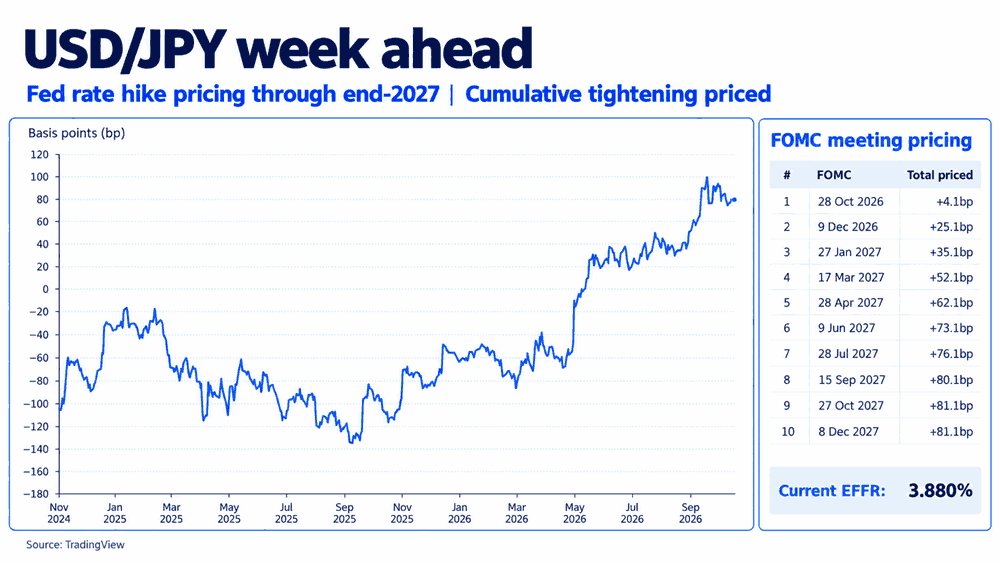
As covered extensively beforehand, there's been an abrupt shift in the Fed interest rate outlook over the past six months, with markets moving from pricing several cuts to more than 80 basis points of tightening by the end of next year.
While there's little expectation of a follow up hike in October following September's increase, markets favour a further 25 basis point move before year-end, followed by at least two, perhaps three, more by the end of 2027.
Source: TradingView
Given how little tightening is priced for October, it would likely take a core CPI reading well north of 0.3% to get markets seriously considering a hike. Otherwise, recent Fed commentary suggests October is being positioned as a placeholder, with December the more likely live meeting when fresh forecasts and dot plot will be issued.
Alternatively, an undershoot in core CPI could pull the rug from underneath hawkish pricing, especially given the softness in payrolls a fortnight ago, potentially dragging Treasury yields lower, particularly at the front end and belly of the curve.
Risk appetite may matter more than yields
While the inflation reports will be influential for Fed pricing, particularly at the front end of the Treasury curve, the more important factor for USD/JPY this week may be how riskier assets digest those releases.
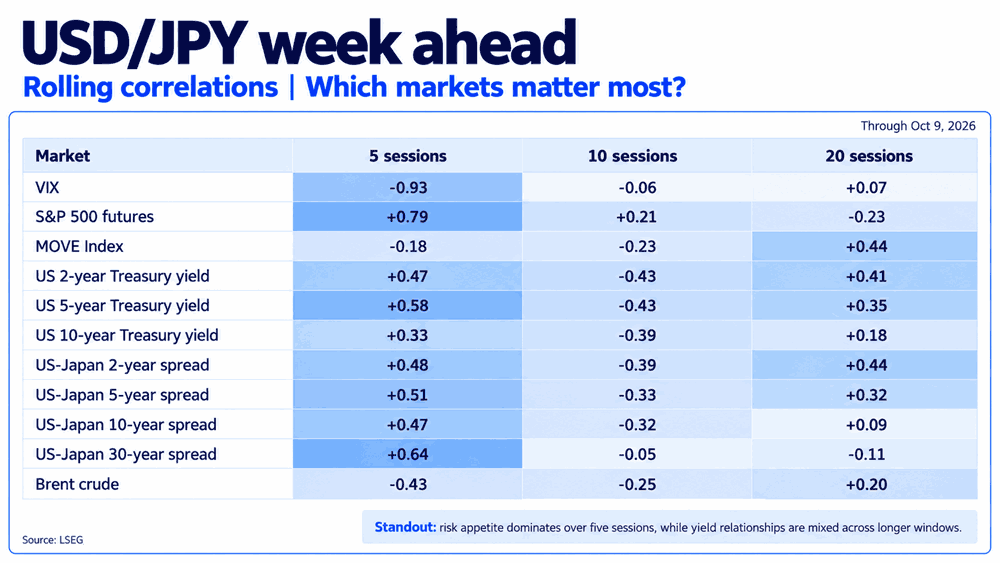
That's because the traditionally strong, positive relationship between USD/JPY, US Treasury yields and US–Japan yield spreads has been inconsistent recently. Over the past five sessions, USD/JPY has shown a correlation of -0.93 with VIX futures and +0.79 with S&P 500 futures, compared with just +0.47 for US two-year Treasury yields and +0.48 for equivalent yield spreads.
Source: LSEG
Over the past fortnight, correlations with US two-year yields and equivalent yield spreads have turned negative at -0.43 and -0.39, respectively, possibly reflecting the influence of quarter-end capital flows.
However, the strong relationships with VIX and S&P 500 futures are largely absent over longer windows, putting a big asterisk next to the recent readings. Five sessions is nowhere near long enough to declare a regime change, especially given the historical influence of interest rate differentials and carry trades.
While risk appetite has played a greater role recently, I suspect rate differentials will reassert themselves as a more influential driver of USD/JPY, particularly if this week's inflation reports trigger a meaningful shift in the Fed rate outlook.
USD/JPY playing pong between moving averages
Source: TradingView
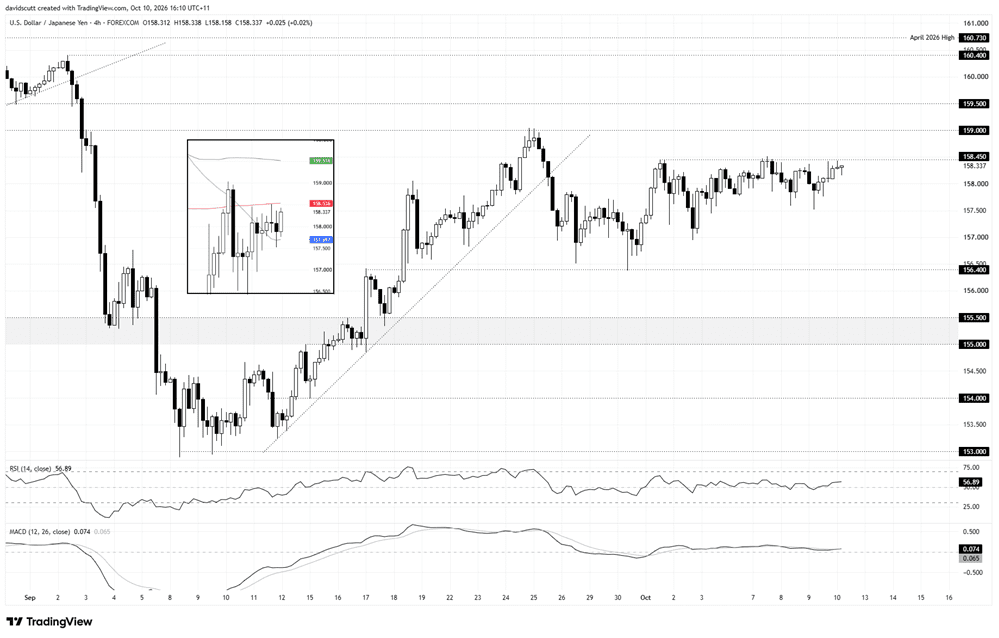
For all the discussion about USD/JPY's changing relationships with yields and risk appetite, the pair has barely moved in October, trading in a range of roughly 150 pips. It feels like the market is waiting for a catalyst.
The broader range between 156.40 and 159.00 has been narrowing, with dips towards 157.50 bought last week, while offers continue to cap moves above 158.45.
As the daily chart inset shows, the latter sits just below the 200-day moving average at 158.54, while the 50-day moving average at 157.70 helps explain the dip buying. For now, USD/JPY is effectively playing pong between these moving averages.
Momentum indicators are providing no strong tell when it comes to directional bias. RSI (14) is marginally above the neutral 50 level but flatlining, while MACD has just crossed above its signal line in positive territory, although there's little velocity behind the move. Both are effectively meandering.
On the upside, 158.45 and the 200-day moving average at 158.54 are the initial levels to watch, followed by 159.00 and 159.50, where horizontal resistance converges with the 100-day moving average. The latter has acted as both support and resistance previously, strengthening its significance.
On the downside, 157.50 is the first level to watch following last week's dip buying, followed by 157.00 and 156.40, which has acted as both support and resistance recently. Below that, a more substantial support zone runs from 155.50 down to 155.00.
The threat of intervention remains a consideration on any sustained push higher. At the same time, the US economy continues to look a better bet than most, deterring prolonged dollar weakness.
For now, it's a stalemate. Perhaps this week's inflation reports will finally shake things up.
Latest market news




Open an account in minutes
Experience award-winning platforms with fast and secure execution, and enjoy tight spreads from 0.5 pts on FX and 0.3 pts on indices.
Economic calendar
Web Trader platform
Our sophisticated web-based platform is packed with features.
Related articles
USD/JPY weekly outlook: US inflation threatens to break the stalemate
USD/JPY has barely budged in October, with the price trapped between key moving averages. Could US inflation finally deliver the catalyst needed to break the stalemate?
USD/JPY Forecast: Japanese Yen Struggles to Find Direction
The trading week has come to an end and a lack of direction around the yen remains evident in the short term. This can be seen in the performance of USD/JPY over the last three trading sessions, where the pair has recorded moves of barely 0.3%, highlighting a market that continues to develop within a broadly neutral environment.

US Dollar Price Action Setups: EUR/USD, USD/JPY, GBP/USD, USD/CAD
The US Dollar remained strong last week even as EUR/USD started to show a series of higher-lows. USD/JPY continues to be bought on dips as the fundamental deviation between the two economies remains front-and-center.

This report is intended for general circulation only. It should not be construed as a recommendation, or an offer (or solicitation of an offer) to buy or sell any financial products. The information provided does not take into account your specific investment objectives, financial situation or particular needs. Before you act on any recommendation that may be contained in this report, independent advice ought to be sought from a financial adviser regarding the suitability of the investment product, taking into account your specific investment objectives, financial situation or particular needs.
StoneX Financial Pte. Ltd., may distribute reports produced by its respective foreign entities or affiliates within the StoneX group of companies or third parties pursuant to an arrangement under Regulation 32C of the Financial Advisers Regulations. Where the report is distributed to a person in Singapore who is not an accredited investor, expert investor or an institutional investor (as defined in the Securities Futures Act), StoneX Financial Pte. Ltd. accepts legal responsibility to such persons for the contents of the report only to the extent required by law. Singapore recipients should contact StoneX Financial Pte. Ltd. at 6826 9988 for matters arising from, or in connection with the report.
In the case of all other recipients of this report, to the extent permitted by applicable laws and regulations neither StoneX Financial Pte. Ltd. nor its associated companies will be responsible or liable for any loss or damage incurred arising out of, or in connection with, any use of the information contained in this report and all such liability is hereby expressly disclaimed. No representation or warranty is made, express or implied, that the content of this report is complete or accurate.
StoneX Financial Pte. Ltd. is not under any obligation to update this report.
Trading CFDs carries a high level of risk that may not be suitable for some investors. Consider your investment objectives, level of experience, financial resources, risk appetite and other relevant circumstances carefully. The possibility exists that you could lose some or all of your investments, including your initial deposits. If in doubt, please seek independent expert advice. Visit www.forex.com/en-sg/terms-and-policies for the complete Risk Disclosure Statement.