



USD/MXN Analysis: Mexican peso remains strong after inflation data release
As the trading week comes to a close, USD/MXN price action has posted a four-session bearish streak, with a decline of more than 2.7% in the short term in favor of the Mexican peso, giving way to a more consistent bearish bias in recent movements.
Share this:

As the trading week comes to a close, USD/MXN price action has posted a four-session bearish streak, with a decline of more than 2.7% in the short term in favor of the Mexican peso, giving way to a more consistent bearish bias in recent movements.
For now, selling pressure has started to emerge due to both the weakness of the U.S. dollar and the latest inflation data in Mexico, which do not show a clear slowdown and reinforce the possibility of a more aggressive stance from Banco de México. In this context, USD/MXN weakness could remain relevant in the coming trading sessions.


New inflation data in Mexico
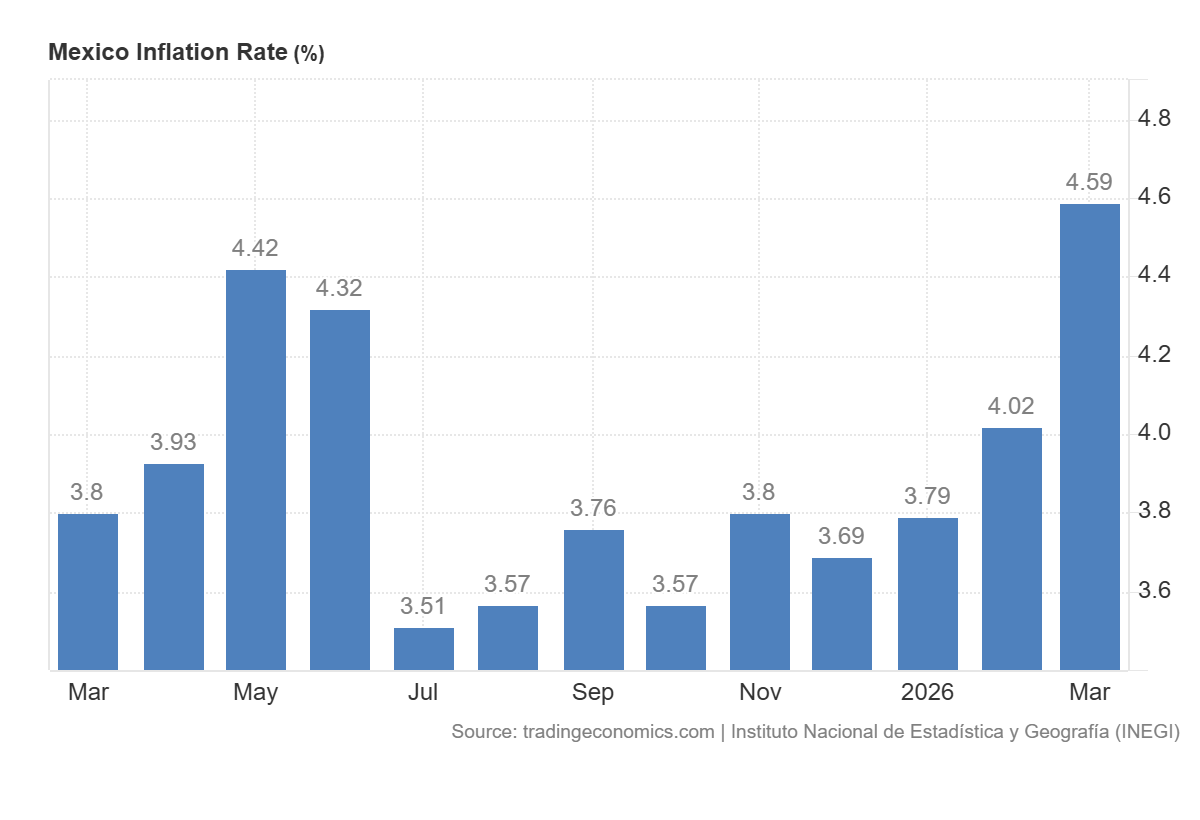
During today’s session, Mexico’s annual inflation rate was released, coming in at 4.59% for March, in line with expectations of 4.6%, but still well above the central bank’s target near 3.00%.
Although the figure matched expectations, what stands out is that inflation has shown a consistent upward trend in recent months, rising from around 3.69% in December to current levels. This reflects a continued divergence from the central bank’s target, suggesting that the current policy approach may require adjustments to maintain price stability in the coming months.
Source: TradingEconomics
This context is particularly relevant, as during its March decision Banco de México cut interest rates to 6.75%, with a divided board awaiting further inflation data. Now, with inflation remaining elevated, this could begin to influence the central bank’s outlook for upcoming monetary policy decisions in 2026, potentially leading to a pause in rate cuts in the coming months.
Considering that Banco de México maintains one of the highest interest rates compared to economies such as Canada or the United States, a more aggressive stance could continue to support the attractiveness of peso-denominated assets. As a result, if inflation pressures persist, selling pressure on USD/MXN could remain relevant in the weeks ahead.
Temporary relief for the U.S. dollar?
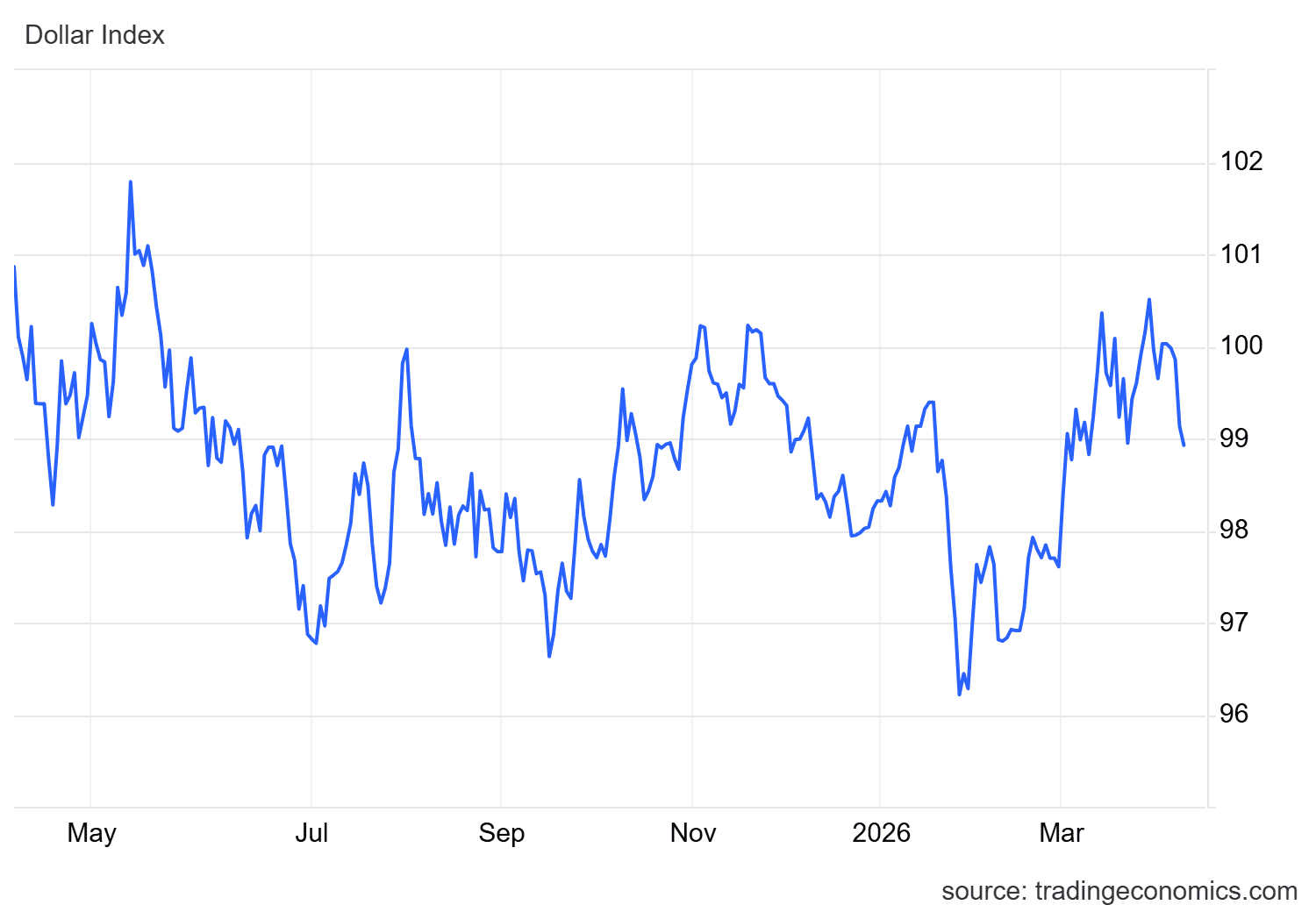
It is also worth noting that the recent strength of the Mexican peso has been supported by the weakness of the U.S. dollar, driven by the truce in the Middle East, which has reduced demand for safe-haven assets such as the dollar.
The DXY index, which measures the strength of the dollar against its major peers, has shown a decline from the 100 level toward levels below 99, reflecting weaker demand for the currency in the short term.
Source: TradingEconomics
In this context, if dollar weakness persists, the peso could continue to gain ground in the short term, further supporting downside pressure in USD/MXN. However, it is important to consider that any renewed escalation in the Middle East conflict could reverse this dynamic and restore demand for the dollar, as seen in previous weeks.
USD/MXN Technical Outlook
Source: StoneX, Tradingview
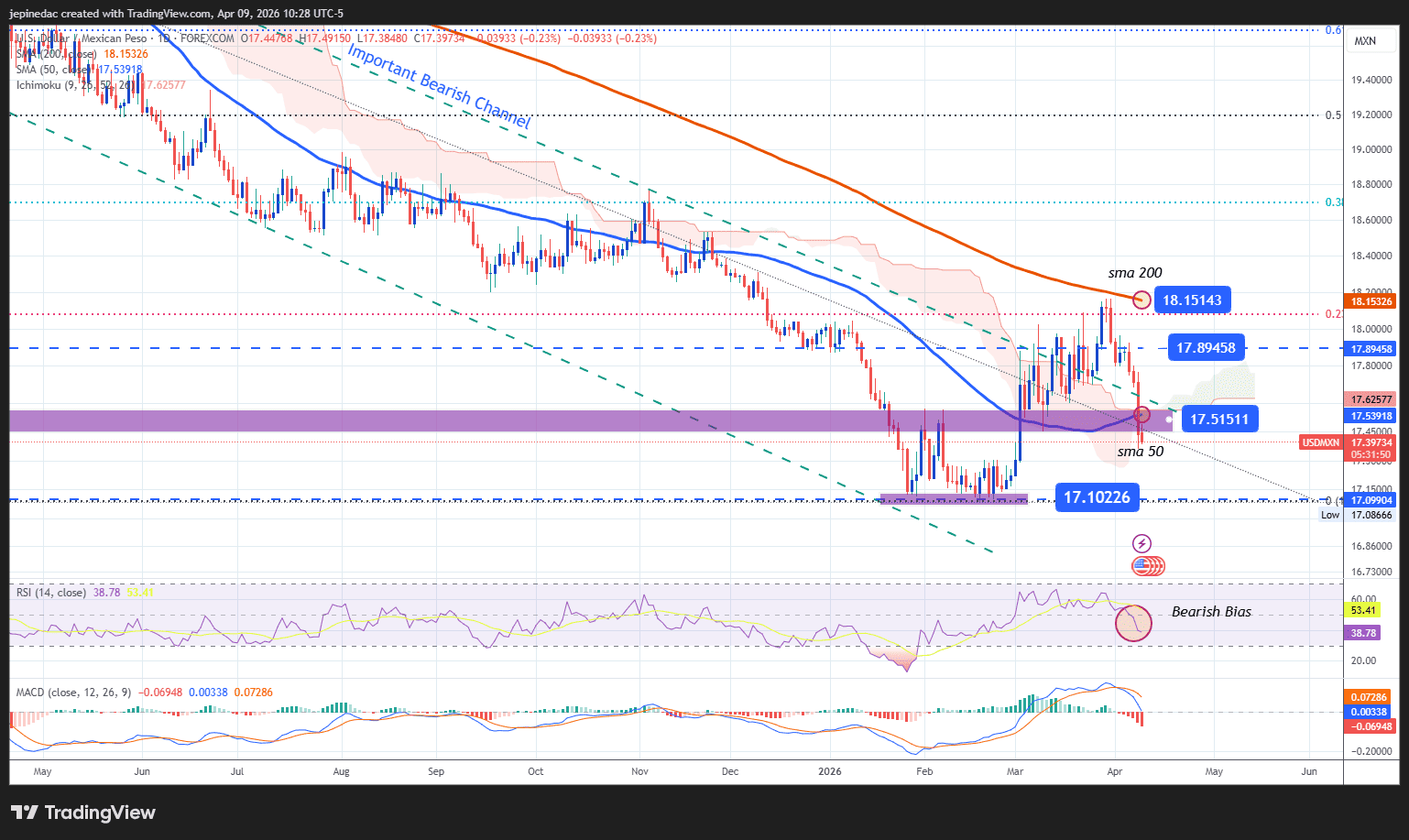
- Long-term bearish channel regains dominance: The recent weakness in USD/MXN has allowed the long-term bearish channel, in place since 2025, to regain relevance in the short term and once again stand out as the most important technical structure. As long as buying pressure fails to consolidate, the dominant bias is likely to remain bearish, as recent upward corrections have not been strong enough to challenge this structure. Therefore, in the coming sessions, the chart bias continues to lean toward the downside.
- RSI: The RSI shows a consistent move below the 50 level, suggesting that selling momentum dominates over the last 14 sessions. As long as this dynamic persists, downside pressure could continue to strengthen.
- MACD: The MACD histogram also remains below the zero line, reflecting that selling pressure continues to dominate short-term moving averages. If this behavior continues, it could reinforce a bearish bias in the coming sessions.
Key levels:
- 17.89 – Key resistance: A previous high located above the bearish channel. A move toward this level could reactivate a bullish bias and challenge the current bearish structure.
- 17.51 – Current barrier: A near-term level aligned with the 50-period moving average. This level could act as a reference point for potential short-term corrective moves.
- 17.10 – Key support: A level corresponding to 2026 lows and the main downside barrier. A break below this level could reinforce stronger selling pressure and extend the bearish channel in the coming weeks.
Written by Julian Pineda, CFA, CMT – Market Analyst
Follow him on: @julianpineda25



Open an account in minutes
Experience award-winning platforms with fast and secure execution, and enjoy tight spreads from 0.5 pts on FX and 0.3 pts on indices.
Economic calendar
Web Trader platform
Our sophisticated web-based platform is packed with features.
Related articles

USD/JPY Update: Can the Japanese Yen Sustain Its Recovery?
Short-term price action around the Japanese yen has started to show some relative improvement over recent sessions. This can be seen in the recent performance of USD/JPY, which has now recorded three consecutive daily declines in favor of the Japanese currency, resulting in a depreciation of roughly 0.35% over the period.

US Dollar Technical Outlook: DXY, Treasury Yields Retreat Despite Hot CPI 10 15 2026
The US Dollar is testing major support despite hotter inflation as Fed pushback cools yields and forces markets to reassess the path for tightening.


S&P 500 Forecast: SPX Falls after hot inflation and as AI debt concerns mount
U.S. stocks are falling after hotter-than-expected readings on producer prices and retail sales, while concerns over AI-related debt are also mounting.

This report is intended for general circulation only. It should not be construed as a recommendation, or an offer (or solicitation of an offer) to buy or sell any financial products. The information provided does not take into account your specific investment objectives, financial situation or particular needs. Before you act on any recommendation that may be contained in this report, independent advice ought to be sought from a financial adviser regarding the suitability of the investment product, taking into account your specific investment objectives, financial situation or particular needs.
StoneX Financial Pte. Ltd., may distribute reports produced by its respective foreign entities or affiliates within the StoneX group of companies or third parties pursuant to an arrangement under Regulation 32C of the Financial Advisers Regulations. Where the report is distributed to a person in Singapore who is not an accredited investor, expert investor or an institutional investor (as defined in the Securities Futures Act), StoneX Financial Pte. Ltd. accepts legal responsibility to such persons for the contents of the report only to the extent required by law. Singapore recipients should contact StoneX Financial Pte. Ltd. at 6826 9988 for matters arising from, or in connection with the report.
In the case of all other recipients of this report, to the extent permitted by applicable laws and regulations neither StoneX Financial Pte. Ltd. nor its associated companies will be responsible or liable for any loss or damage incurred arising out of, or in connection with, any use of the information contained in this report and all such liability is hereby expressly disclaimed. No representation or warranty is made, express or implied, that the content of this report is complete or accurate.
StoneX Financial Pte. Ltd. is not under any obligation to update this report.
Trading CFDs carries a high level of risk that may not be suitable for some investors. Consider your investment objectives, level of experience, financial resources, risk appetite and other relevant circumstances carefully. The possibility exists that you could lose some or all of your investments, including your initial deposits. If in doubt, please seek independent expert advice. Visit www.forex.com/en-sg/terms-and-policies for the complete Risk Disclosure Statement.