



USD/PLN continues lower as nerves settle down
Once it was discovered that the missiles were from Ukraine anti-defense, USD/PLN quickly returned to prior levels.
Share this:

On Tuesday, it was suspected that a stray Russian missile accidentally landed in Poland, which neighbors Ukraine. Polish PM Morawiecki convened an emergency meeting with the Council of Ministers for National Security and Defense Affairs. As a result, Poland is deciding whether it should invoke Article 4, which says “The Parties will consult together whenever, in the opinion of any of them, the territorial integrity, political independence or security of any of the Parties is threatened.” However, NATO Secretary-General Stoltenberg said there will be no calls to invoke Article 4 until after an investigation was complete. It appears now that the debris which landed in Poland was not a stray Russian missile, but rather debris from anti-defense missiles fired from Ukraine. However, it was made perfectly clear by Stoltenberg that “This is not Ukraine’s fault. Russia bears ultimate responsibility”.
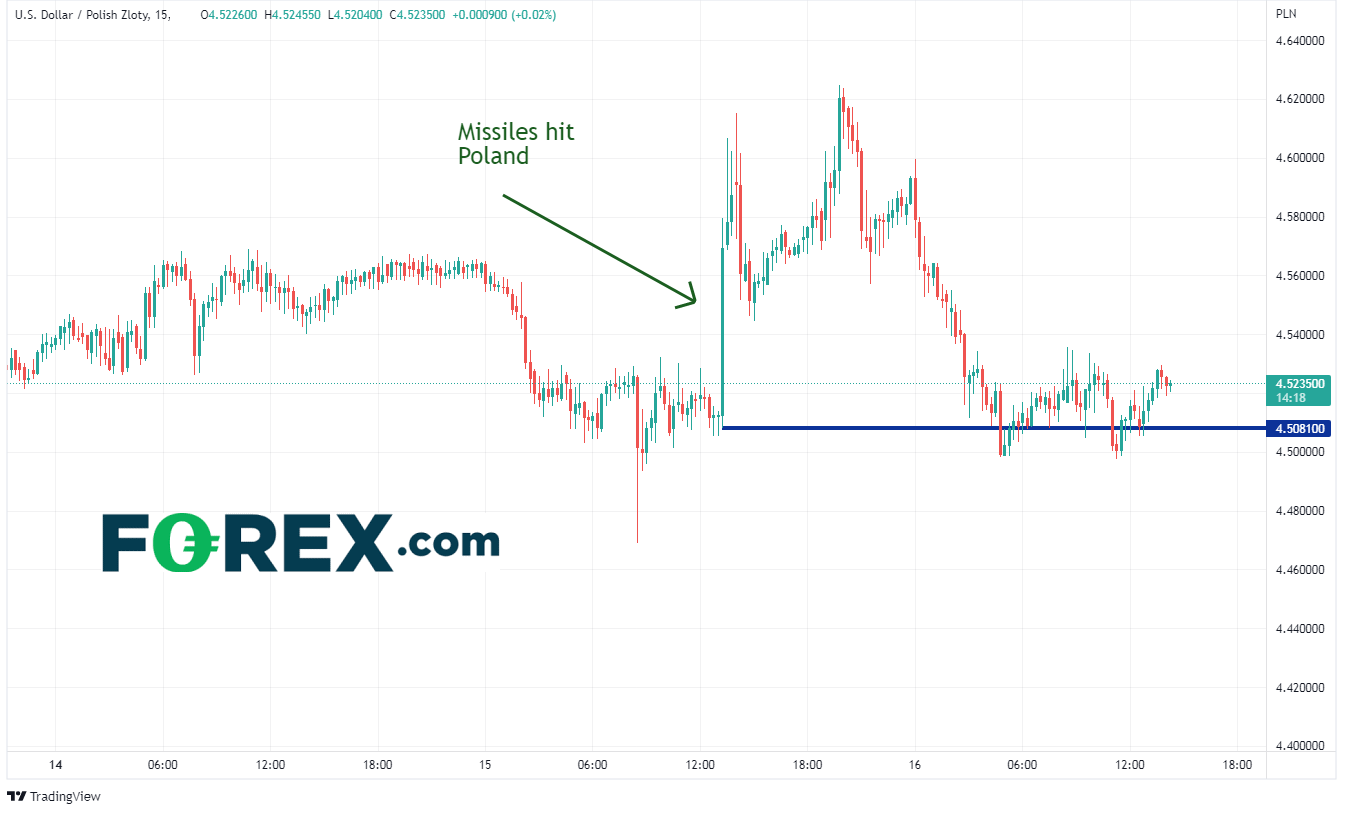
As a result of the initial strike on Poland soil, USD/PLN immediately went bid from a low of 4.5081 to 4.6152. However, as the scenario unfolded over the course of the next 24 hours, the pair moved lower to previous levels.
Source: Tradingview, Stone X
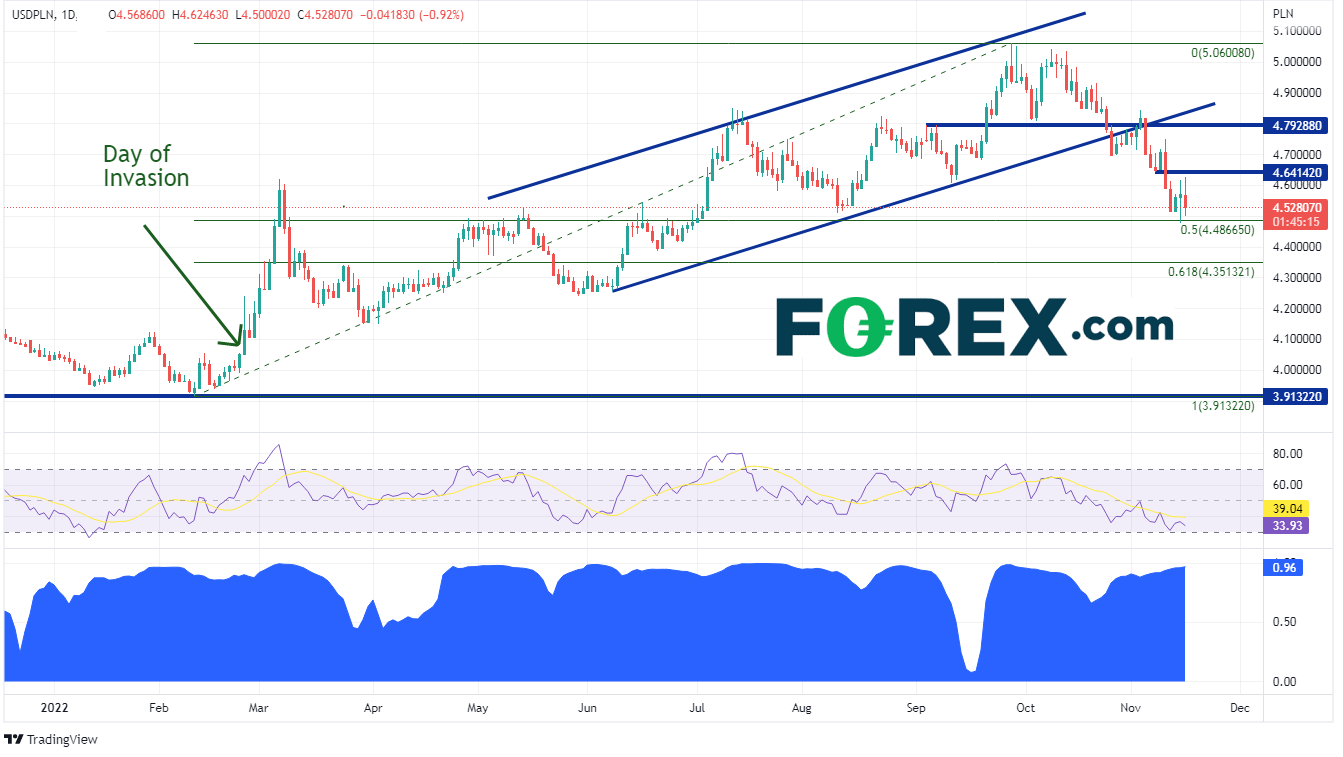
However, the daily timeframe of this chart looks like that of the DXY! Notice the correlation coefficient in the bottom panel of the chart below. The correlation coefficient between USD/PLN and the US Dollar Index (DXY) is +0.96. For guidance, readings of +1.00 indicate there is a perfect positive correlation between the 2 assets and they move in the same direction 100% of the time. A reading of +0.96 is pretty close!
Source: Tradingview, Stone X
USD/PLN had been moving higher since February 10th, just 2 weeks before Russia invaded Ukraine. After the invasion on February 24th, the pair began moving aggressively higher from a low of 4.0505 to a high on March 7th at 4.6199. USD/PLN corrected to 4.1500 but then resumed its trend higher in an orderly channel. The pair tested the top trendline of the channel on September 28th at 5.0601 but has been moving lower since. (The DXY peaked on that same day!) On Tuesday, the day of the alleged missile attack, USD/PLN made a new local low at 4.4764, just below the 50% retracement level from the lows of February 10th to the highs off September 28th.
If USD/PLN continues to move lower, the first support level is the 61.8% Fibonacci retracement level from the above-mentioned timeframe at 4.3513. Below there, support levels are at the prior lows from May 30th and March 30th at 4.2388 and 4.1500, respectively. However, if the current support holds and price bounces, the first resistance is at the lows from November 8th at 4.6414, then the highs from November 10th at 4.7489. Above there, price can move to horizontal resistance at 4.8138.
The missiles which landed in Poland’s territory were initially thought to be stray Russian missiles, which caused USD/PLN to move higher. Once it was discovered that it was from Ukraine anti-defense missiles, the pair quickly returned to prior levels. At the very least, the event showed the markets what could happen if a stray Russian missile really does hit a NATO country. In addition, USD/PLN is heavily correlated to the DXY. Therefore, if the DXY moves in one direction, there is a strong chance that USD/PLN moves in the same direction.
On Tuesday, it was suspected that a stray Russian missile accidentally landed in Poland, which neighbors Ukraine. Polish PM Morawiecki convened an emergency meeting with the Council of Ministers for National Security and Defense Affairs. As a result, Poland is deciding whether it should invoke Article 4, which says “The Parties will consult together whenever, in the opinion of any of them, the territorial integrity, political independence or security of any of the Parties is threatened.” However, NATO Secretary-General Stoltenberg said there will be no calls to invoke Article 4 until after an investigation was complete. It appears now that the debris which landed in Poland was not a stray Russian missile, but rather debris from anti-defense missiles fired from Ukraine. However, it was made perfectly clear by Stoltenberg that “This is not Ukraine’s fault. Russia bears ultimate responsibility”.
As a result of the initial strike on Poland soil, USD/PLN immediately went bid from a low of 4.5081 to 4.6152. However, as the scenario unfolded over the course of the next 24 hours, the pair moved lower to previous levels.

Source: Tradingview, Stone X
Trade USD/PLN now: Login or Open a new account!
• Open an account in the UK
• Open an account in Australia
• Open an account in Singapore
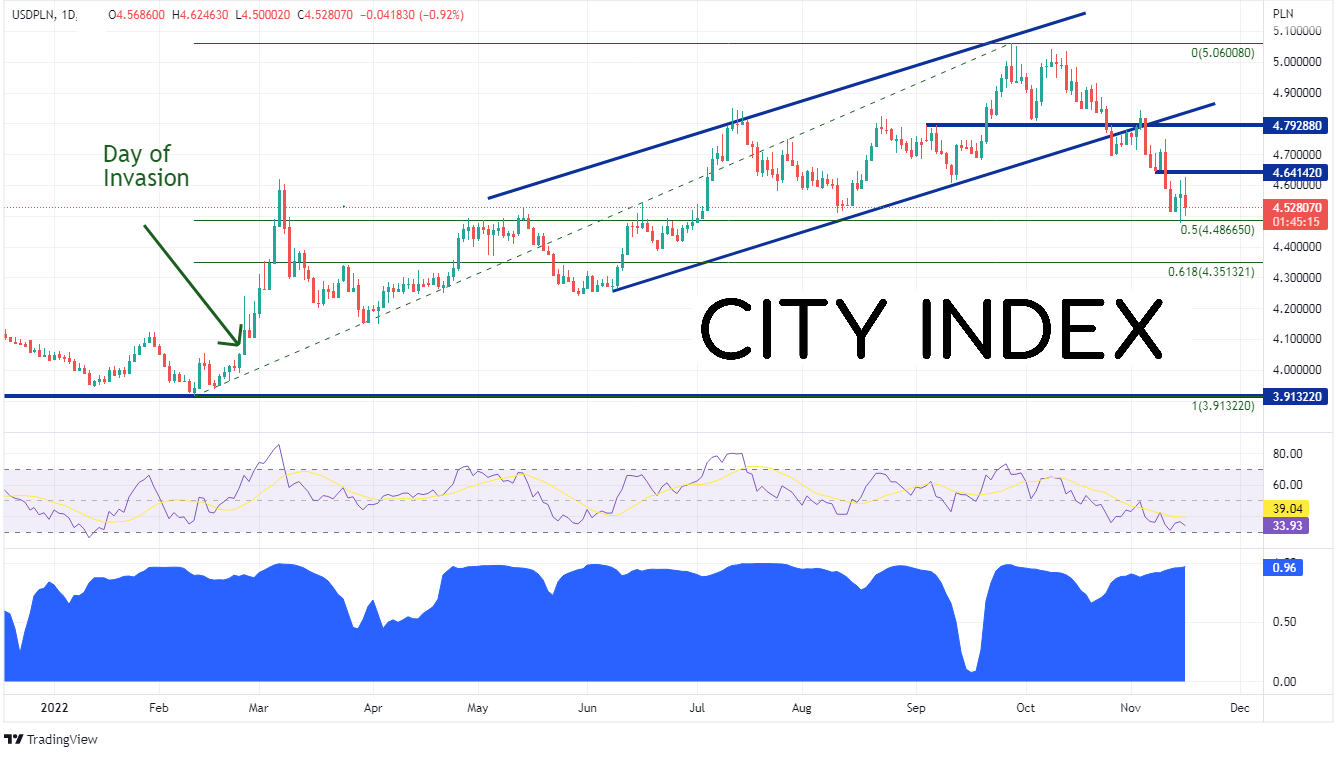
However, the daily timeframe of this chart looks like that of the DXY! Notice the correlation coefficient in the bottom panel of the chart below. The correlation coefficient between USD/PLN and the US Dollar Index (DXY) is +0.96. For guidance, readings of +1.00 indicate there is a perfect positive correlation between the 2 assets and they move in the same direction 100% of the time. A reading of +0.96 is pretty close!
Source: Tradingview, Stone X
USD/PLN had been moving higher since February 10th, just 2 weeks before Russia invaded Ukraine. After the invasion on February 24th, the pair began moving aggressively higher from a low of 4.0505 to a high on March 7th at 4.6199. USD/PLN corrected to 4.1500 but then resumed its trend higher in an orderly channel. The pair tested the top trendline of the channel on September 28th at 5.0601 but has been moving lower since. (The DXY peaked on that same day!) On Tuesday, the day of the alleged missile attack, USD/PLN made a new local low at 4.4764, just below the 50% retracement level from the lows of February 10th to the highs off September 28th.
If USD/PLN continues to move lower, the first support level is the 61.8% Fibonacci retracement level from the above-mentioned timeframe at 4.3513. Below there, support levels are at the prior lows from May 30th and March 30th at 4.2388 and 4.1500, respectively. However, if the current support holds and price bounces, the first resistance is at the lows from November 8th at 4.6414, then the highs from November 10th at 4.7489. Above there, price can move to horizontal resistance at 4.8138.
The missiles which landed in Poland’s territory were initially thought to be stray Russian missiles, which caused USD/PLN to move higher. Once it was discovered that it was from Ukraine anti-defense missiles, the pair quickly returned to prior levels. At the very least, the event showed the markets what could happen if a stray Russian missile really does hit a NATO country. In addition, USD/PLN is heavily correlated to the DXY. Therefore, if the DXY moves in one direction, there is a strong chance that USD/PLN moves in the same direction.
Learn more about forex trading opportunities.
Related tags:
Latest market news




Open an account in minutes
Experience award-winning platforms with fast and secure execution, and enjoy tight spreads from 0.5 pts on FX and 0.3 pts on indices.
Economic calendar
Web Trader platform
Our sophisticated web-based platform is packed with features.
Related articles
Fed, DXY, EUR/USD, GBP/USD, USD/CAD, Gold Weekly Technical Outlook 10 26 2026
Sr. Technical Strategist Michael Boutros highlights the levels that matter on the USD Majors, commodities, and equity indices charts this week.
EUR/USD Update: Euro Weakness Returns Ahead of Central Bank Decisions
A new trading week is underway and the euro continues to show signs of weakness in the short term. This can be seen in the recent performance of EUR/USD, which has fallen nearly 0.5% over the last three trading sessions, reflecting a relatively consistent loss of momentum in the European currency.


US Dollar Bulls Hold Firm, but Euro Warns of Squeeze Risk | COT Report
US dollar bulls remain firmly positioned, but record euro shorts have failed to break EUR/USD support, raising the risk of a short-covering rally.

This report is intended for general circulation only. It should not be construed as a recommendation, or an offer (or solicitation of an offer) to buy or sell any financial products. The information provided does not take into account your specific investment objectives, financial situation or particular needs. Before you act on any recommendation that may be contained in this report, independent advice ought to be sought from a financial adviser regarding the suitability of the investment product, taking into account your specific investment objectives, financial situation or particular needs.
StoneX Financial Pte. Ltd., may distribute reports produced by its respective foreign entities or affiliates within the StoneX group of companies or third parties pursuant to an arrangement under Regulation 32C of the Financial Advisers Regulations. Where the report is distributed to a person in Singapore who is not an accredited investor, expert investor or an institutional investor (as defined in the Securities Futures Act), StoneX Financial Pte. Ltd. accepts legal responsibility to such persons for the contents of the report only to the extent required by law. Singapore recipients should contact StoneX Financial Pte. Ltd. at 6826 9988 for matters arising from, or in connection with the report.
In the case of all other recipients of this report, to the extent permitted by applicable laws and regulations neither StoneX Financial Pte. Ltd. nor its associated companies will be responsible or liable for any loss or damage incurred arising out of, or in connection with, any use of the information contained in this report and all such liability is hereby expressly disclaimed. No representation or warranty is made, express or implied, that the content of this report is complete or accurate.
StoneX Financial Pte. Ltd. is not under any obligation to update this report.
Trading CFDs carries a high level of risk that may not be suitable for some investors. Consider your investment objectives, level of experience, financial resources, risk appetite and other relevant circumstances carefully. The possibility exists that you could lose some or all of your investments, including your initial deposits. If in doubt, please seek independent expert advice. Visit www.forex.com/en-sg/terms-and-policies for the complete Risk Disclosure Statement.