
As October comes to an end and the cryptocurrency market enters the final stretch of 2026, a renewed phase of weakness is becoming increasingly evident across the sector. Most major cryptocurrencies have struggled to maintain consistent demand and have once again started to underperform compared with other financial markets.
The current selling pressure appears to be driven by a combination of weaker investor confidence, an increase in forced liquidations of long positions following the issues surrounding Binance, and a broader cautious tone that continues to affect risk assets after this week's central bank decisions. For now, confidence remains under pressure and, as long as these factors remain at the center of market attention, selling pressure could continue to be relevant in the coming trading sessions.

What Happened at Binance?
The week initially revolved around central bank events, particularly the monetary policy decisions from the United States and Europe. Although there were no major surprises from either institution, expectations began to build around the possibility of additional rate hikes before year-end. Since a higher interest-rate environment tends to increase borrowing costs and reduce liquidity available for risk assets, the cryptocurrency market had already been showing signs of caution and relatively weak demand during much of the week.
However, the situation changed considerably after news emerged regarding Binance. According to the information released, a hack resulted in the diversion of approximately $6.3 billion, of which the company managed to freeze around $3 billion, while also temporarily pausing some withdrawals as the incident was investigated.
The significance of this event lies in the fact that Binance remains one of the largest cryptocurrency exchanges in the world. As a result, any security or custody-related issue tends to have a direct impact on overall confidence across the crypto ecosystem. Consequently, the market reacted quickly by reducing exposure and accelerating the liquidation of long positions.
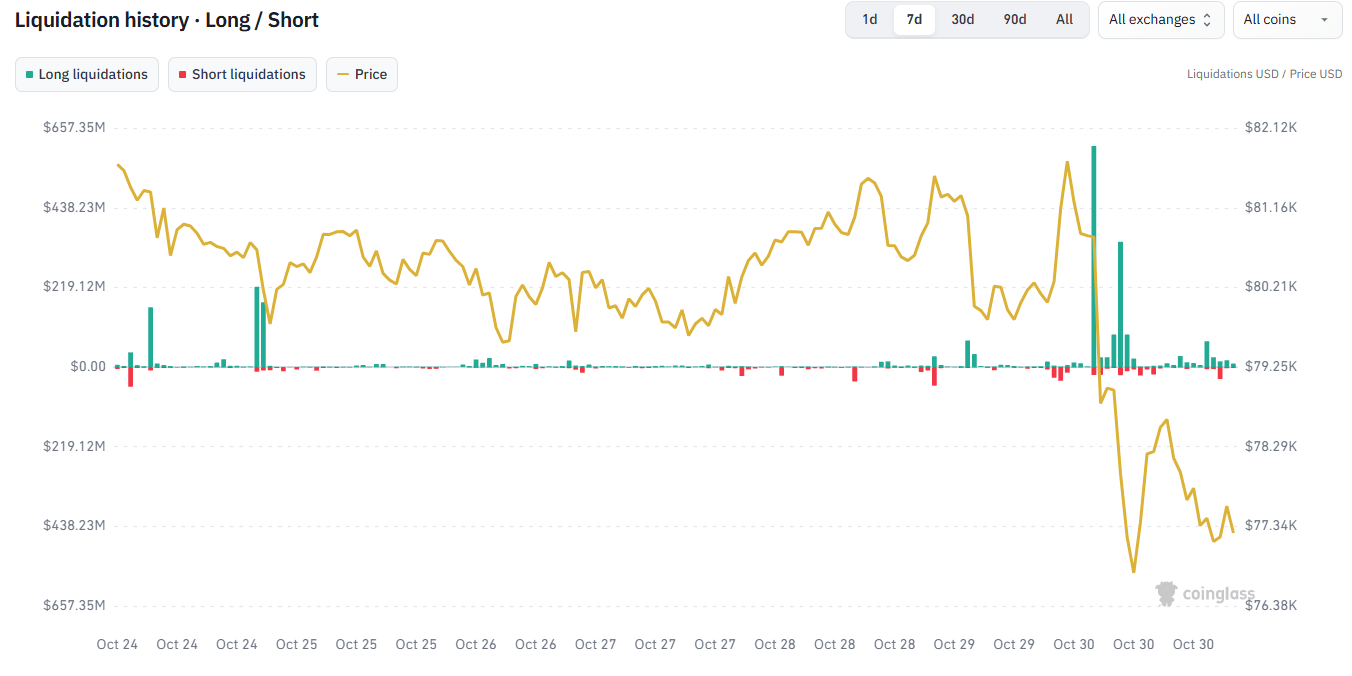
Liquidation data clearly reflects this shift in sentiment. Before the incident became public, total liquidations across long and short positions were running near $330 million. Following confirmation of the news, liquidations surged to approximately $1.5 billion, with the majority concentrated in long positions. This development highlights a significant decline in confidence and a notable reduction in demand toward the end of the week.
Source: Coinglass
What is important to note is that this behavior was accompanied by meaningful declines in cryptocurrencies such as Bitcoin, suggesting that demand has been affected not only by this week's macroeconomic backdrop but also by growing concerns surrounding security within the crypto market. As a result, the Binance incident has reinforced an already existing bearish bias and, until greater clarity emerges regarding the attack and its broader implications, uncertainty could continue to support additional liquidations and sustained selling pressure in the sessions ahead.
Bitcoin Against Other Markets
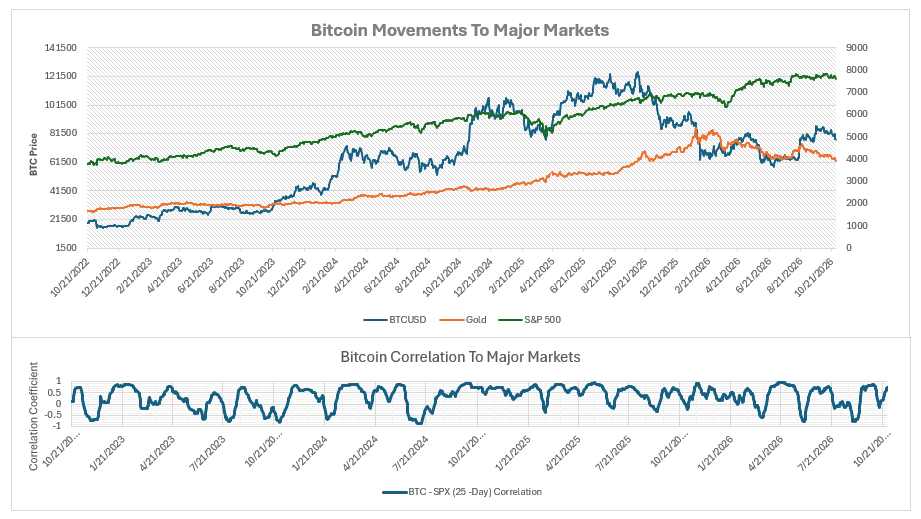
It is also worth paying attention to how Bitcoin has been behaving relative to other financial markets. Over recent weeks, the relationship between BTC and the S&P 500 has once again become increasingly evident, with the correlation coefficient remaining above 0.5 on average during the last 25 trading sessions.
This reflects a relatively strong positive correlation and suggests that Bitcoin continues to trade in a manner similar to other assets generally considered risky. Correlation levels can change over time.
Source: Data – TVC, StoneX, TradingView
This relationship is particularly relevant because U.S. equities have also started to display weakness toward the end of the week. Part of this dynamic stem from concerns about elevated valuations within the technology sector and an environment in which the Federal Reserve does not appear close to beginning an aggressive easing cycle.
What stands out is that Bitcoin has not been able to distance itself from this broader risk-off environment. Over recent weeks, the cryptocurrency has closely mirrored movements observed in traditional risk assets such as the S&P 500, reinforcing the view that a large portion of investors still treat Bitcoin primarily as a risk asset rather than a defensive alternative.
For that reason, beyond crypto-specific issues such as the Binance incident, it is also important to recognize that weakness across broader risk markets may continue limiting any meaningful recovery in demand. Under this scenario, Bitcoin continues to struggle to establish itself as a defensive asset, suggesting that part of the available capital may be shifting toward investments perceived as more stable.
With all this in mind, if Bitcoin continues to move in line with the S&P 500 and both markets fail to generate a sustained recovery in demand, it could reinforce the idea that the crypto market remains trapped in a phase of weakness similar to that observed recently across equity indices. As long as this dynamic remains in place, the lack of appetite for risk assets could continue weighing on confidence and supporting a broader bearish bias across cryptocurrencies.
Confidence Begins to Weaken
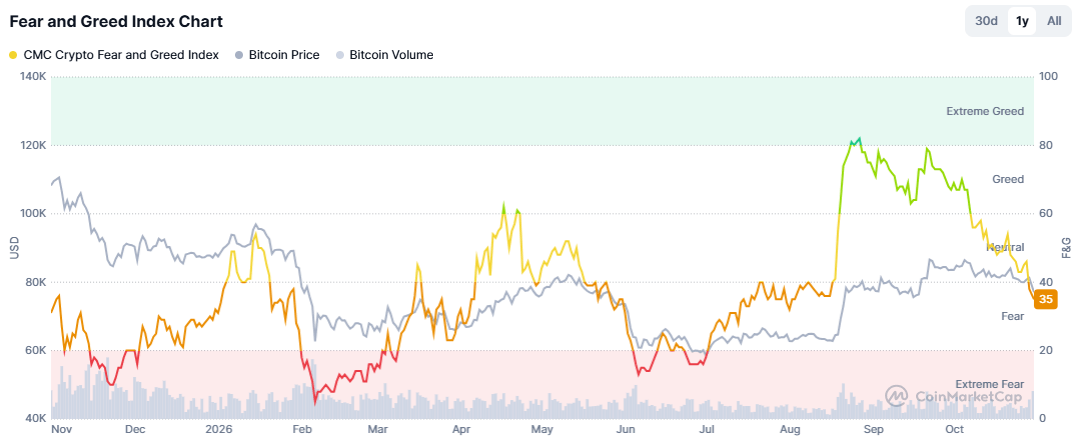
Recent readings from the Fear & Greed Index continue to reflect a deteriorating sentiment backdrop. The indicator is currently trading near 35 points, returning to a fear zone that had not been observed for several months.
This development is important because it reflects a gradual loss of the optimism that had been building during previous weeks and now points toward a more consistent decline in confidence across the crypto sector.
Source: Coinmarketcap
The evolution of this indicator remains relevant because it serves as a gauge of risk appetite within the cryptocurrency market. If confidence struggles to recover, it could continue limiting the market's ability to sustain a stronger demand environment while reinforcing the idea that part of investor interest is shifting toward alternative assets.
Under this scenario, the recent deterioration in sentiment could continue supporting a phase of relative weakness that has become increasingly relevant across the cryptocurrency market and may remain an important theme during the coming trading sessions.
Written by Julian Pineda, CFA, CMT – Market Analyst
Follow him on: @julianpineda25