




DAX: EUR/USD parity has big implications for European indices
The recent price action in EUR/USD should serve as a reminder of the importance of the FX market, even if you’re not trading it directly.
Share this:

As my colleague Fawad Razaqzada noted this morning, the world’s most widely-traded currency pair falling to the critical psychological level of parity (1.00) for the first time in nearly 20 years is a momentous event in the forex market, but the implications of widespread US dollar strength reach far beyond the currency market itself.
One of the clearest cross-market impacts of FX market fluctuations is on stock market indices. Generally speaking, a strengthening currency can boost total returns of assets in that currency, whereas investments denominated in a depreciating currency face a headwind from the so-called “foreign currency effect.” From the perspective of a European trader, if the dollar strengthens relative to the euro, it boosts the return of the Dow Jones Industrial Average (Wall Street) relative to euro-denominated indices like the DAX (Germany 40).
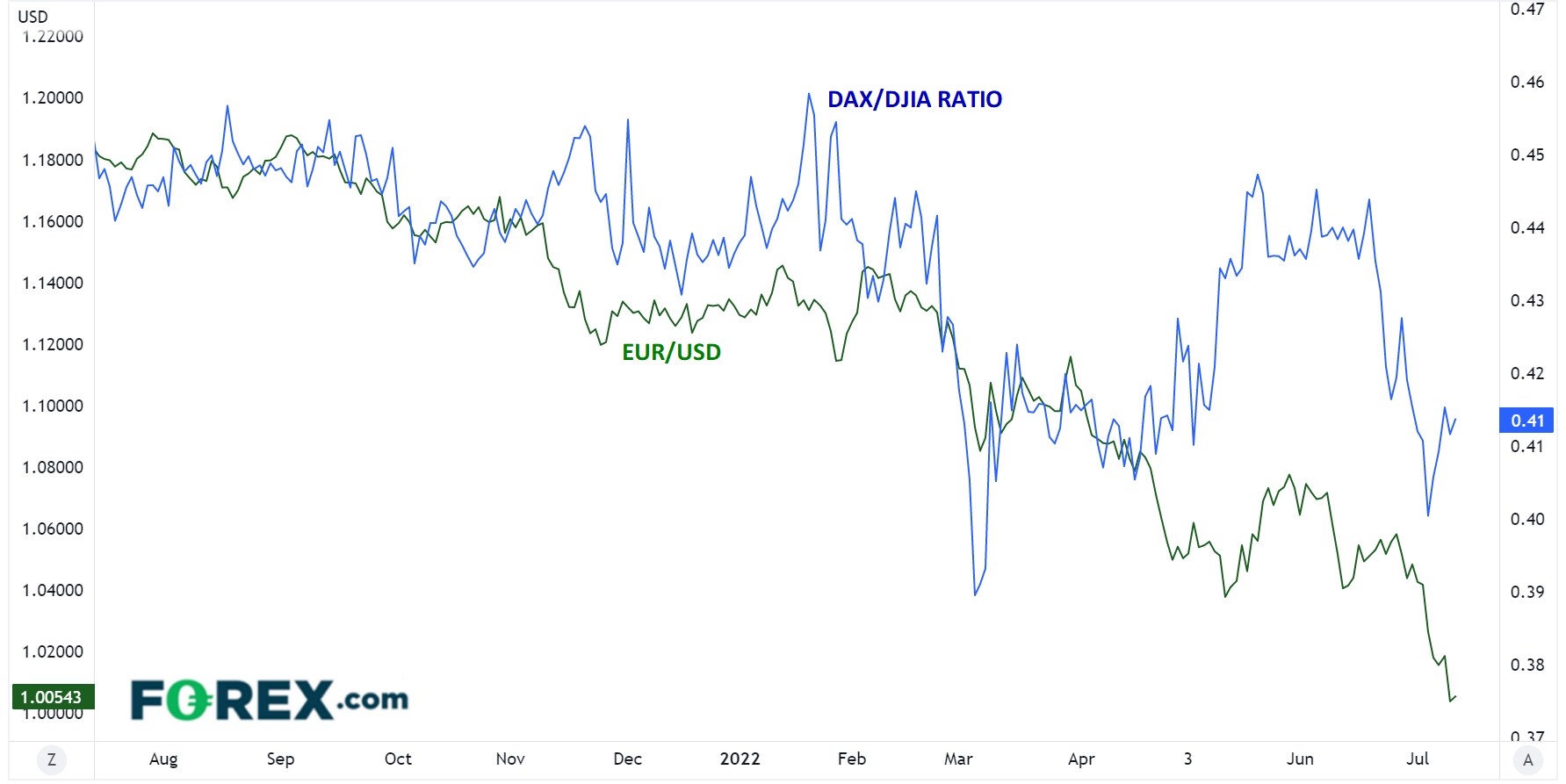
The chart below shows that effect in action:
Source: StoneX, TradingView
Over the last year, the EUR/USD exchange rate (green line, left axis) has fallen from roughly 1.18 last July to the aforementioned parity level today; at the same time, a ratio chart of Germany’s DAX index relative to the Dow Jones Industrial Average (blue line, right axis) has dropped from 0.45 to 0.41. While the move doesn’t sound particularly dramatic, it can have an underappreciated impact on medium- and long-term positions, especially when there are high-volatility moves in the FX market as we’re seeing of late.
The upshot for traders is clear: If you expect the US dollar to continue to strengthen relative to the euro, it makes sense to favor long positions in US indices and short positions in European-based (or other non-US-based) indices, all else equal.
Of course, all else is never exactly equal when it comes to trading, but at a minimum, the recent price action in EUR/USD should serve as a reminder of the importance of the FX market, even if you’re not trading it directly.
How to trade with FOREX.com
Follow these easy steps to start trading with FOREX.com today:
- Open a Forex.com account, or log-in if you’re already a customer.
- Search for the pair you want to trade in our award-winning platform.
- Choose your position and size, and your stop and limit levels.
- Place the trade.
As my colleague Fawad Razaqzada noted this morning, the world’s most widely-traded currency pair falling to the critical psychological level of parity (1.00) for the first time in nearly 20 years is a momentous event in the forex market, but the implications of widespread US dollar strength reach far beyond the currency market itself.
One of the clearest cross-market impacts of FX market fluctuations is on stock market indices. Generally speaking, a strengthening currency can boost total returns of assets in that currency, whereas investments denominated in a depreciating currency face a headwind from the so-called “foreign currency effect.” From the perspective of a European trader, if the dollar strengthens relative to the euro, it boosts the return of the Dow Jones Industrial Average (Wall Street) relative to euro-denominated indices like the DAX (Germany 40).
The chart below shows that effect in action:
Source: StoneX, TradingView
Over the last year, the EUR/USD exchange rate (green line, left axis) has fallen from roughly 1.18 last July to the aforementioned parity level today; at the same time, a ratio chart of Germany’s DAX index relative to the Dow Jones Industrial Average (blue line, right axis) has dropped from 0.45 to 0.41. While the move doesn’t sound particularly dramatic, it can have an underappreciated impact on medium- and long-term positions, especially when there are high-volatility moves in the FX market as we’re seeing of late.
The upshot for traders is clear: If you expect the US dollar to continue to strengthen relative to the euro, it makes sense to favor long positions in US indices and short positions in European-based (or other non-US-based) indices, all else equal.
Of course, all else is never exactly equal when it comes to trading, but at a minimum, the recent price action in EUR/USD should serve as a reminder of the importance of the FX market, even if you’re not trading it directly.
How to trade with City Index
You can trade with City Index by following these four easy steps:
- Open an account, or log in if you’re already a customer
• Open an account in the UK
• Open an account in Australia
• Open an account in Singapore
- Search for the market you want to trade in our award-winning platform
- Choose your position and size, and your stop and limit levels
- Place the trade
Related tags:



Open an account in minutes
Experience award-winning platforms with fast and secure execution.
Economic calendar
Web Trader platform
Our sophisticated web-based platform is packed with features.
Related articles

Nikkei swings harder than Nasdaq as AI fears deepen
Nikkei 225 volatility is running well ahead of Nasdaq 100, with the index construction and Japan's heavy exposure to AI manufacturing potentially explaining the difference.

S&P 500, Nasdaq 100 Claw Back But NVDA Cloud Looms Overhead
Last week was green for both the Nasdaq and S&P 500 but given the sell-off that led into that bounce there’s still a very real question as to whether bears still have a statement to make. And the NVDA situation presents a very real threat.


Nasdaq 100 forecast: Nvidia troubles put AI recovery into question
The recovery for major indices this week has helped repair much of the technical damage inflicted by last week’s sell-off, but the latest developments with Nvidia suggest investors are not quite ready to put the underlying risks behind them. The Nasdaq 100 led other US index futures lower overnight, with falls of around 0.8%.

StoneX Financial Ltd (trading as "FOREX.com") is an execution-only service provider. This material, whether or not it states any opinions, is for general information purposes only and it does not take into account your personal circumstances or objectives. This material has been prepared using the thoughts and opinions of the author and these may change. However, FOREX.com does not plan to provide further updates to any material once published and it is not under any obligation to keep this material up to date.
This material is short term in nature and may only relate to facts and circumstances existing at a specific time or day. Nothing in this material is (or should be considered to be) financial, investment, legal, tax or other advice and no reliance should be placed on it. No opinion given in this material constitutes a recommendation by FOREX.com or the author that any particular investment, security, transaction or investment strategy is suitable for any specific person.
The material has not been prepared in accordance with legal requirements designed to promote the independence of investment research. Although FOREX.com is not specifically prevented from dealing before providing this material, FOREX.com does not seek to take advantage of the material prior to its dissemination. This material is not intended for distribution to, or use by, any person in any country or jurisdiction where such distribution or use would be contrary to local law or regulation. For further details see our full non-independent research disclaimer and quarterly summary.