



EUR/USD Analysis: Euro Confidence Remains Limited After the ECB
The trading week is approaching its end and, for now, a neutral tone continues to dominate the euro's short-term price action. EUR/USD has recorded a move of only around -0.15% during the week, highlighting the pair's inability to establish a clear direction in favor of either the euro or the U.S. dollar.
Share this:

The trading week is approaching its end and, for now, a neutral tone continues to dominate the euro's short-term price action. EUR/USD has recorded a move of only around -0.15% during the week, highlighting the pair's inability to establish a clear direction in favor of either the euro or the U.S. dollar. As a result, a relatively consistent phase of indecision continues to dominate market behavior.
This cautious environment has persisted even after the monetary policy decisions from both the Federal Reserve and the European Central Bank (ECB). Although the dollar has also struggled to develop a particularly strong bullish bias, the ECB's decision has not been enough to restore meaningful demand for the euro. As a consequence, the market continues to trade under a cautious tone that may remain relevant in the sessions ahead.

What Happened with Central Banks?
This week has been especially important from a monetary policy perspective due to decisions from both the Fed and the ECB. What stands out is that, despite the attention surrounding both events, the decisions and subsequent comments ultimately reinforced a relatively similar tone of caution from the two institutions.
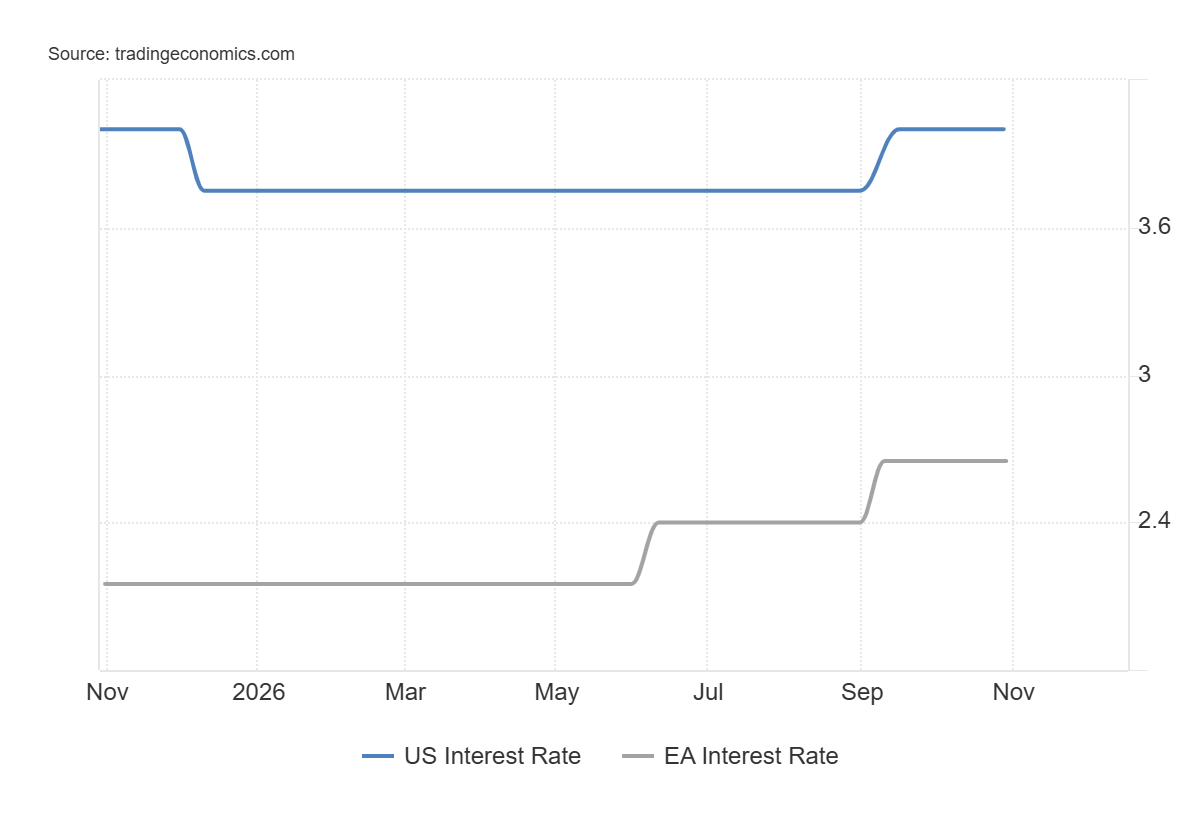
The Federal Reserve was the first to announce its decision, leaving the benchmark rate unchanged at 4.00%. While the institution acknowledged that inflation remains elevated, it also reiterated the need for additional data before considering more aggressive policy actions. In this scenario, the majority of policymakers supported keeping rates unchanged.
Later, the European Central Bank maintained its deposit rate at 2.50% and its refinancing rate at 2.65%. The comments that followed were relatively similar to those seen in the United States. The ECB acknowledged that energy prices continue to pose upside risks to inflation but also stressed the importance of waiting for additional economic data before confirming expectations of higher rates potentially extending into 2027.
Overall, both institutions continue to maintain a cautious stance and have not provided especially clear signals regarding a potential acceleration in monetary tightening over the coming months.
Source: TradingEconomics
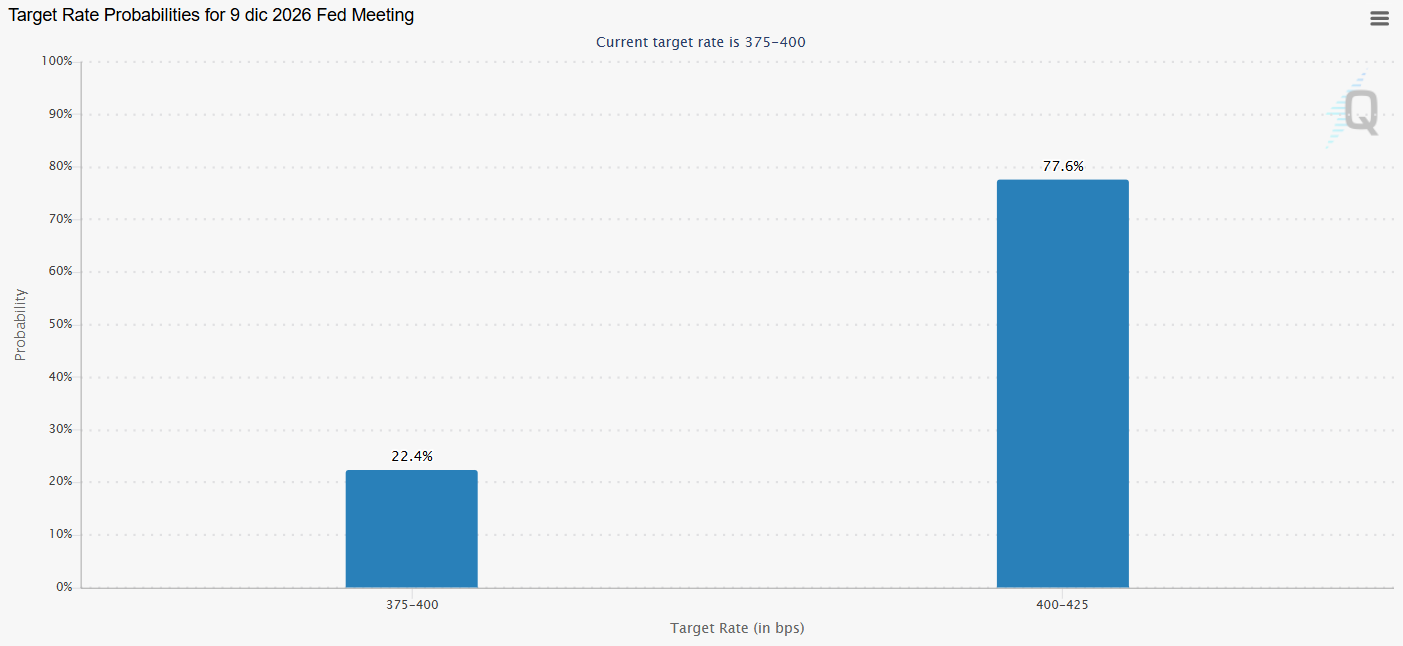
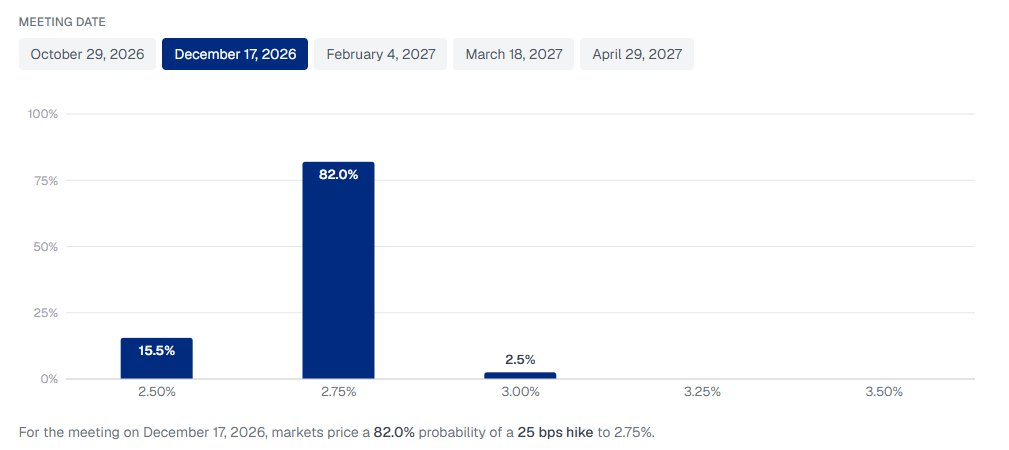
An important takeaway is that this environment increasingly reflects an alignment between both central banks. In fact, for the December meetings, which will be the final policy decisions of the year for both institutions, markets assign more than 77% probability to a rate increase in the United States toward 4.25%, while expectations for the ECB show more than 80% probability that the deposit rate will rise from 2.50% to 2.75%.
This suggests that, while there is still room for slightly higher rates before the end of 2026, recent comments from both institutions do not clearly support a prolonged tightening cycle during the first part of 2027. As a result, caution continues to be the dominant feature within monetary policy expectations.
Source: CMEGROUP
Source: ECBWATCH
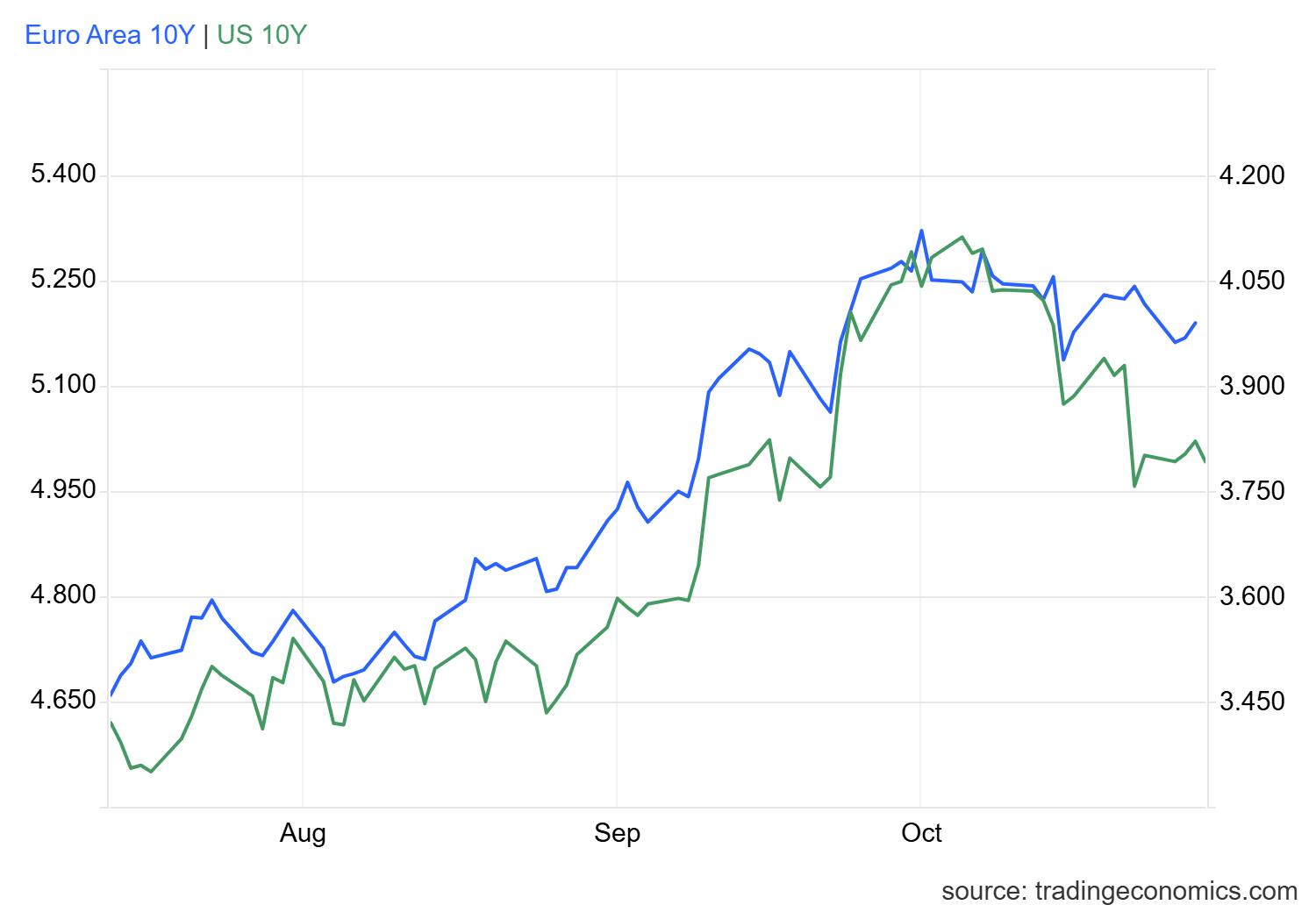
At the same time, this relatively cautious tone has not generated meaningful changes within fixed-income markets. 10-year bond yields in both the United States and Europe continue to follow a moderation trend even after the latest policy decisions.
While European yields continue struggling to establish themselves above the 4.00% area, U.S. yields remain slightly below 5.00%, suggesting that investors still lack conviction regarding a scenario of substantially higher interest rates during the coming months.
Source: TradingEconomics
This remains relevant because, as long as bond markets fail to increase the relative attractiveness of their yields, demand for both euro- and dollar-denominated investments also remains limited. Even though the United States still holds an interest-rate advantage, that differential has not been enough to generate significant dollar strength.
As a consequence, the market continues to operate within a broadly cautious environment where neither central bank expectations nor recent bond market developments have been sufficient to attract significant capital flows into either currency. Rather than generating a meaningful shift in EUR/USD dynamics, this week's central bank events appear to have reinforced an ongoing lack of direction. As long as this alignment in caution remains in place, the current phase of indecision could continue to be a relevant feature of the pair over the coming weeks.
EUR/USD Technical Forecast
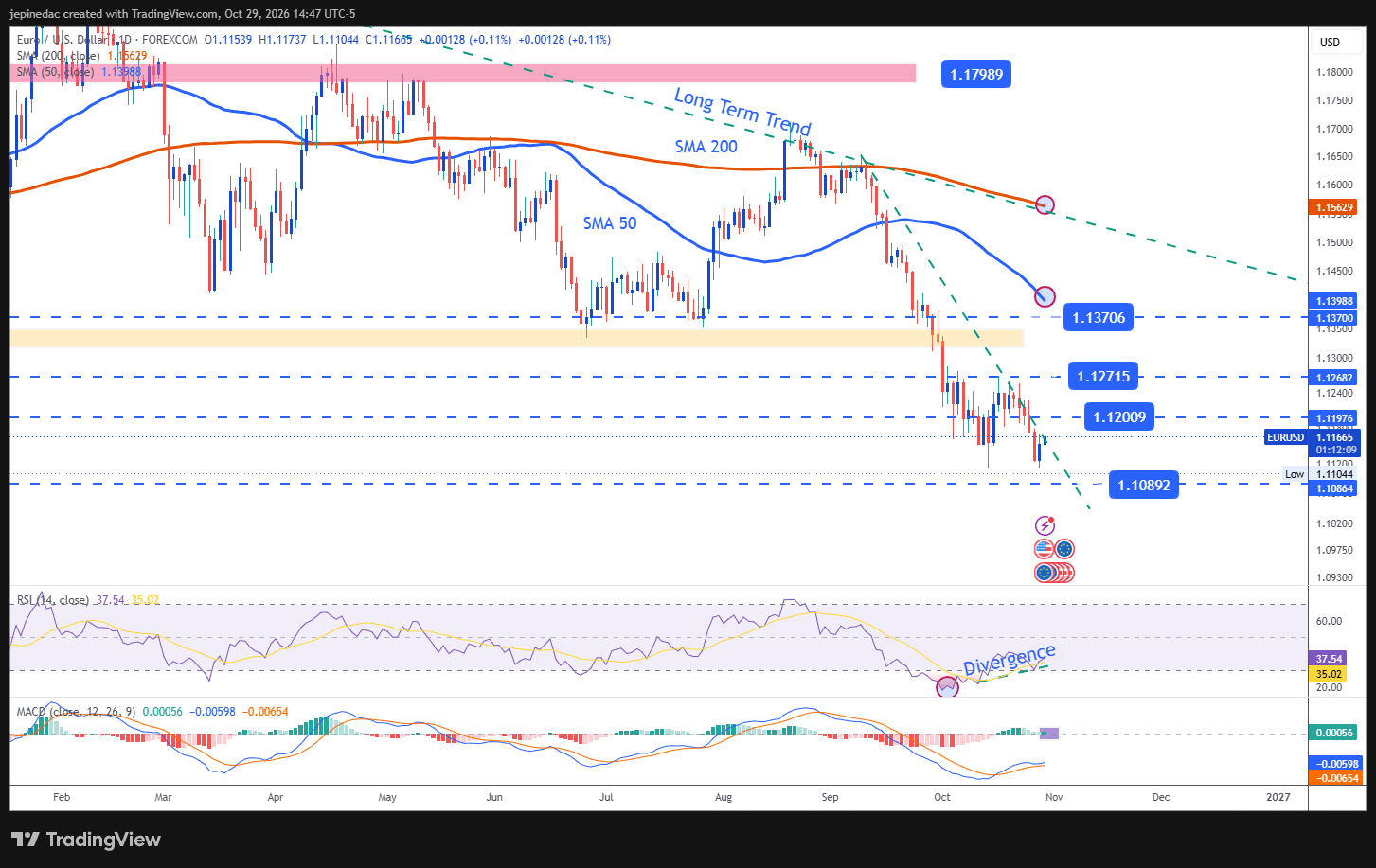
Source: StoneX, Tradingview
- The broader downtrend is beginning to enter a consolidation phase: Since January 2026, EUR/USD has developed an important bearish trendline that remains the dominant technical structure on the daily chart. In recent weeks, this broader trend also gave rise to a short-term bearish trendline as dollar strength gained momentum. Recently, however, price action has begun to change, with the pair struggling to establish new significant lows and increasingly reflecting a lack of direction. This suggests that both the long-term downtrend and the short-term bearish structure may be entering a consolidation phase, favoring a more neutral environment while price remains above key support levels.
- RSI: The RSI has started to flatten noticeably during recent sessions, reflecting a slowdown in the bearish momentum observed in previous weeks. In addition, while EUR/USD has continued to post slightly lower lows, the RSI has developed progressively higher lows, keeping a potential bullish divergence in place. This signal continues to suggest that the market may be reflecting an excessive accumulation of selling pressure and could still leave room for short-term bullish corrections.
- MACD: The MACD histogram continues to trade around the 0 neutral line, a reading that reflects a relatively balanced environment within short-term moving averages. This behavior continues to support the possibility that a phase of indecision remains a relevant characteristic of recent EUR/USD price action.
Key Levels:
- 1.12715 – Key Resistance: This level coincides with an important area of previous highs and currently represents the most relevant upside barrier on the chart. Price action returning toward this zone could reinforce the current neutral environment and even favor the formation of a more established trading range over the coming weeks.
- 1.12009 – Near-Term Barrier: This level coincides with an important retracement area observed in recent weeks and currently serves as one of the market's main equilibrium references. It could become the key level to monitor in the event of short-term bullish corrections.
- 1.10892 – Key Support: A level not seen since May 2025, which remains the most important downside barrier within the current structure. Price action returning toward this area could restore bearish momentum and favor a more aggressive extension of the broader downtrend during the coming weeks as the dominant technical pattern within EUR/USD.
Written by Julian Pineda, CFA, CMT – Market Analyst
Follow him on: @julianpineda25
Latest market news




Open an account in minutes
Experience award-winning platforms with fast and secure execution.
Economic calendar
Web Trader platform
Our sophisticated web-based platform is packed with features.
Related articles
US Dollar Price Action Setups into PCE: EUR/USD, GBP/USD, USD/JPY, USD/CAD
USD/JPY has continued to hold below the 160.00 level but it’s the EUR/USD sell-off below 1.1000 that’s been most attention grabbing around the USD complex.
Canadian Dollar Forecast: USD/CAD Rally Stalls at Yearly High—Correction Risk Builds 11 24 2026
USD/CAD’s November rebound faces its first meaningful setback, with buyers defending trend support as momentum divergence warns of fatigue.

EUR/USD outlook: Fed hawkishness priced in as Ifo hits 3-year high
The euro is bouncing from the 61.8% Fibonacci retracement as the dollar takes a breather after Monday's surge. With Fed hawkishness largely priced in and Germany's Ifo at a three-year high, a close above 1.1000 would signal a near-term low.

StoneX Financial Ltd (trading as "FOREX.com") is an execution-only service provider. This material, whether or not it states any opinions, is for general information purposes only and it does not take into account your personal circumstances or objectives. This material has been prepared using the thoughts and opinions of the author and these may change. However, FOREX.com does not plan to provide further updates to any material once published and it is not under any obligation to keep this material up to date.
This material is short term in nature and may only relate to facts and circumstances existing at a specific time or day. Nothing in this material is (or should be considered to be) financial, investment, legal, tax or other advice and no reliance should be placed on it. No opinion given in this material constitutes a recommendation by FOREX.com or the author that any particular investment, security, transaction or investment strategy is suitable for any specific person.
The material has not been prepared in accordance with legal requirements designed to promote the independence of investment research. Although FOREX.com is not specifically prevented from dealing before providing this material, FOREX.com does not seek to take advantage of the material prior to its dissemination. This material is not intended for distribution to, or use by, any person in any country or jurisdiction where such distribution or use would be contrary to local law or regulation. For further details see our full non-independent research disclaimer and quarterly summary.