
- Fed repricing has driven NZD/USD sharply lower since August
- NZ-US yield spreads remain the most consistent macro driver
- NZD/USD is deeply oversold and testing 0.5639 support
- Payrolls may decide whether support breaks or Kiwi rebounds
The latest hawkish recalibration of the Fed interest rate outlook has weighed heavily on NZD/USD, sending the pair tumbling from the highs hit in late August. It now finds itself dangling just above 0.5639, an important support level that held the last time it was tested in June.
With NZD/USD in a strong downtrend, trading beneath its key medium and long-term moving averages, and downside momentum continuing to build, the macro and technical pictures remain aligned towards further weakness.
However, history shows the Kiwi can stage savage counter-trend bounces after reaching similarly oversold conditions. That means a failure to break beneath 0.5639 could provide the fuel for a similar outcome on this occasion.
Hawkish Fed shift weighs heavily on the Kiwi
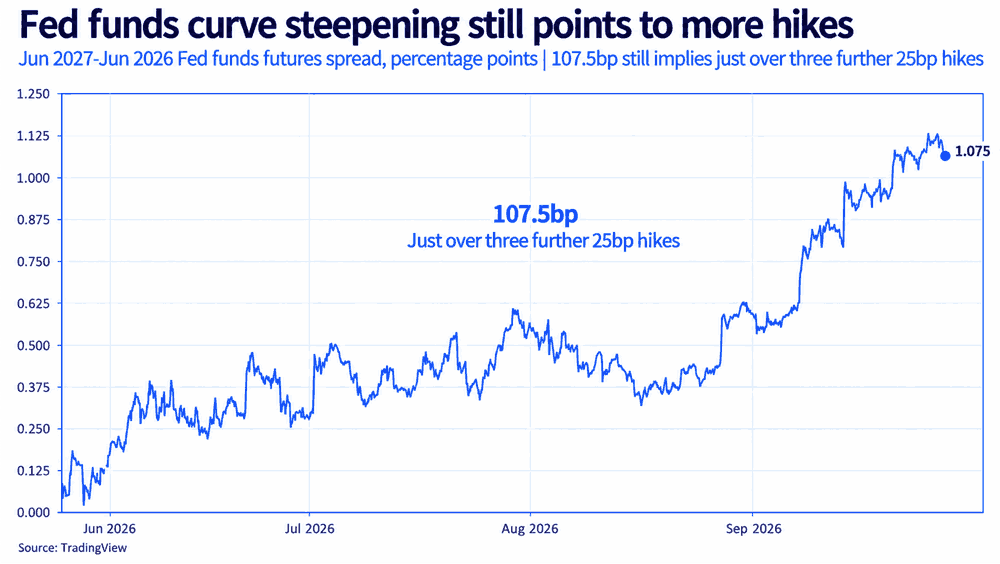
It’s no coincidence that the Kiwi’s latest lurch lower has coincided with a significant hawkish recalibration of the Fed interest rate outlook. As the graphic below shows, pricing that had looked for around two rate hikes from the Fed out to the middle of next year began to increase rapidly in late August.
Source: TradingView
Including the September rate increase we’ve already seen from the Fed, markets still have more than three full 25 basis point hikes priced into the curve, a factor that is clearly weighing on NZD/USD.
A simple correlation test backs that up, with NZ-US yield spreads across the front end and belly of the curve showing the strongest and most consistent relationship with movements in the Kiwi. Over the past 5, 10 and 20 sessions, the correlation with the 2-year spread has been +0.58, +0.64 and +0.67 respectively, while the 5-year spread has come in at +0.61, +0.58 and +0.62.
The RBNZ outlook is similarly hawkish in terms of the magnitude of tightening expected, with markets pricing a similar amount of additional tightening to that expected from the Fed. The key difference is the starting point. New Zealand policy remains comparatively stimulatory, while Fed policy is already assessed to be around neutral or even a touch tight.
So it’s not that the RBNZ isn’t hawkish right now. It clearly is. It’s just that those signals have been overwhelmed by the increasingly hawkish message coming from the Fed.
Kiwi momentum remains firmly skewed lower
Source: TradingView
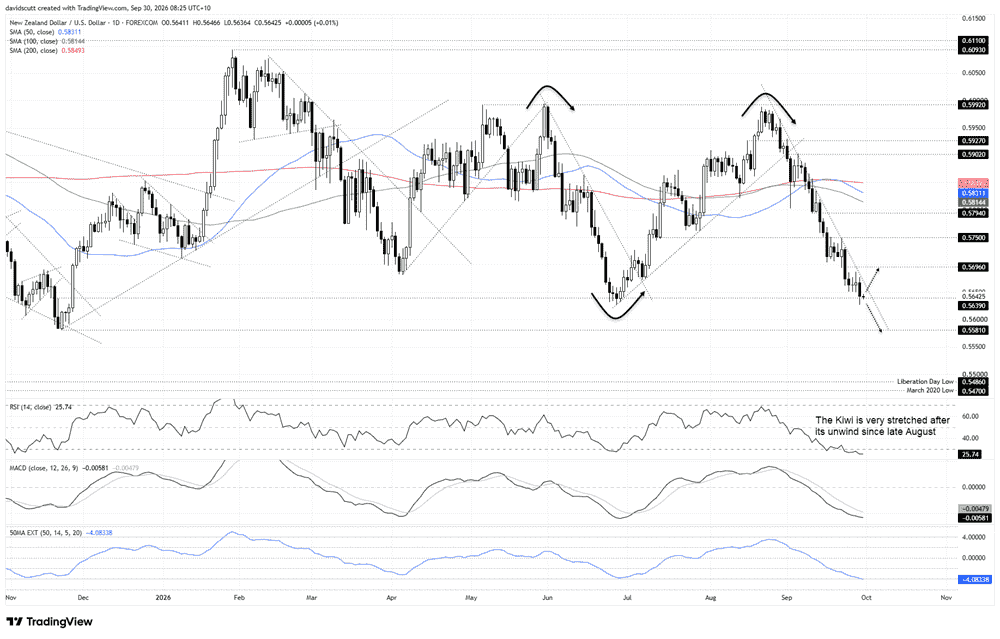
The pressure coming from the macro side of the equation is reinforced by the technical picture, with the Kiwi now in a firm downtrend from the highs set in late August, having broken beneath its key medium and long-term moving averages.
The latest leg lower has seen the pair retrace to 0.5639, a support level that dates back to late last year. The last time it was tested in June, it held, ultimately delivering a decent run higher in the Kiwi.
However, with Tuesday’s candle printing as a bearish engulfing pattern, RSI (14) sitting around 25 and continuing to push lower, already extreme downside momentum continues to build. That message is backed up by MACD, which also sits deeply in negative territory after crossing beneath its signal line.
The potential for an extension of the bearish move is clearly there, putting the swing low set in November last year at 0.5581 in play. If that were to break, a far more important support zone comes into view, comprising the Liberation Day low set in April last year and the COVID low around 0.5470.
Overhead, downtrend resistance is located around 0.5660 today, with 0.5696 the next topside level of note before a more pronounced resistance zone kicks in around 0.5750.
Oversold conditions have often produced sharp rebounds
While the macro and technical signals favour an extension of the current bearish move, history provides a cautionary tale against acting pre-emptively without a definitive break. Similar oversold conditions to those we’re seeing now have often resulted in sharp counter-trend squeezes, and in many instances marked an eventual turning point over the medium term.
Source: TradingView
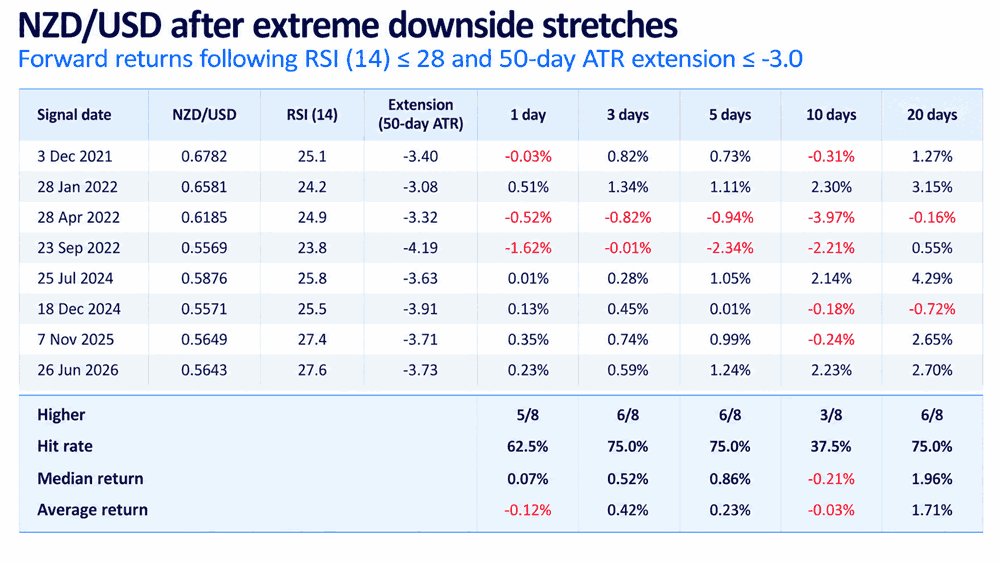
To test that, I screened the daily data for periods when RSI (14) had fallen to 28 or below while price was trading at least 3.0 ATR (50) beneath its 50-day average. To avoid double-counting the same selloff, only independent episodes were included, with RSI needing to recover back above 40 before a fresh signal could be counted. I also excluded the COVID episode given how unique that period was.
That left eight comparable historical instances.
The remaining results are more interesting than definitive, at least in the near term. NZD/USD was higher three sessions later in six of the eight cases, higher after five sessions in six of eight, and higher after 20 sessions in six of eight. The median gain after five sessions was 0.86%, increasing to 1.96% after 20 sessions.
However, as the graphic above shows, the path has not always been smooth. The two notable failures in the sample came in April and September 2022, when the Fed was aggressively hiking interest rates and US dollar strength was building. In those cases, already stretched conditions became even more stretched before the eventual rebound arrived.
And that is highly relevant to what we’re seeing today. The Kiwi is obviously oversold and at risk of some form of counter-trend squeeze. But for something more meaningful to take place, it may require fresh information that makes markets question the degree of hawkishness currently priced into the Fed interest rate outlook.
Payrolls needs to be weak to shift the Fed outlook
Enter September’s non-farm payrolls report, due on Friday.
While we receive the Fed’s preferred core inflation measure, the PCE deflator, later today, history has shown that it now rarely generates much volatility at all. Unless we see some kind of unusual weakness or outlier outcome in the accompanying income and spending data, it really suggests payrolls will loom as the key catalyst capable of providing the spark for a more meaningful rebound in the Kiwi.
The Fed has made it clear that the price stability side of its dual mandate is its primary focus right now. So for payrolls to materially alter the current rates outlook, the outcome would need to be unquestionably weak, enough to force the Fed towards a more symmetric reaction function across both sides of its mandate rather than maintaining such a heavy focus on the inflation outlook.
Put simply, it needs to be very uniformly weak.