
- Historic US rate shock drives USD/JPY breakout
- Markets price nearly four additional Fed hikes
- US yields dominate, but AI linkages persist
- Intervention risks threaten further gains above 160
USD/JPY staged a bullish breakout late last week on the back of a massive hawkish repricing of Fed interest rate outlook, briefly pushing above 160 and triggering a familiar barrage of intervention warnings from Japanese officials.
While the week ahead is packed with Fed speakers, including Chair Kevin Warsh, an absence of top-tier US data provides little new information for officials to respond to, raising questions on just how much their remarks will influence USD/JPY without a concerted effort to shift market pricing. That could leave broader risk appetite, particularly sentiment towards the AI sector, as the key influence on how USD/JPY trades in the week ahead.
US Treasury yields deliver a historic shock
In a year where interest rate volatility has already been elevated, it was taken to a whole new level last week with a massive hawkish recalibration at the front of the US yield curve, sparked by a hot October CPI report and influential Fed Governor Christopher Waller surprising markets by flagging the risk of a 50-basis-point hike given the lack of progress on lowering inflation.
Source: LSEG
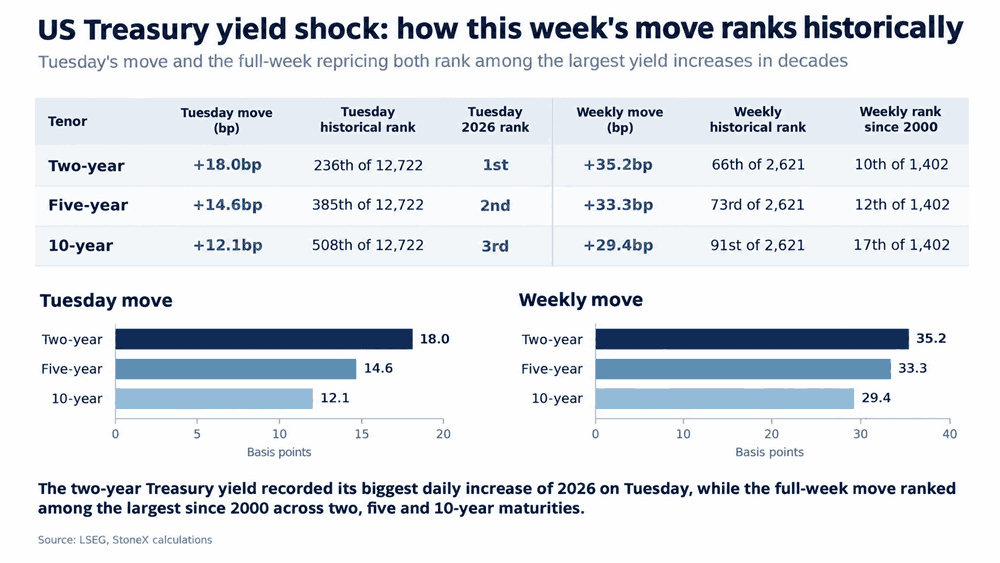
The two-year Treasury yield surged 18 basis points on Tuesday alone, its largest increase of 2026 and among the largest 1.9% dating back to June 1976. Five and 10-year yields also climbed 14.6 and 12.1 basis points respectively, their second and third-largest increases of the year.
And it wasn't just a Tuesday story, with two, five and 10-year Treasury yields rising 35.2, 33.3 and 29.4 basis points respectively over the week. To put the magnitude of those moves into perspective, they ranked as the 10th, 12th and 17th largest weekly increases since 2000, underlining the significance of the repricing.
Fed tightening expectations surge
Source: LSEG
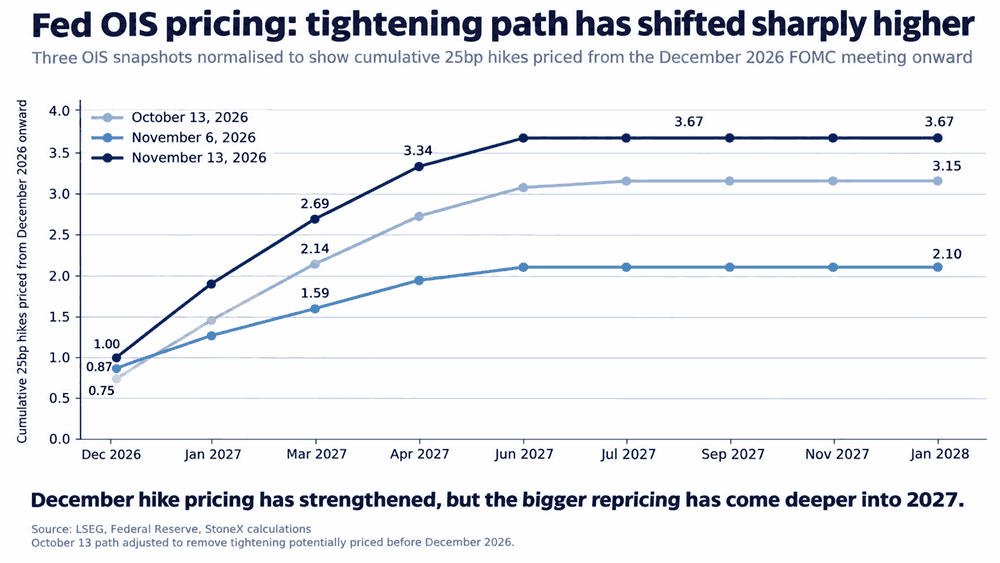
The move out the curve was sparked by an immediate repricing of the Fed rate outlook, with traders now not only fully pricing a 25-basis-point hike at the December FOMC meeting, but also a small risk of a 50-basis-point increase. Our modelling of the US OIS curve suggests traders have now priced 3.7 additional 25-basis-point hikes by the middle of next year, something that would take the policy rate to around 4.8% if realised.
Not only has that been a substantial hawkish recalibration, but it's also happened quickly. As recently as November 6 markets were pricing just 2.1 additional hikes over the same period. That means nearly 40 basis points of tightening has been added in just one week, with much of the adjustment taking place in the first half of 2027.
US yield movements take control of USD/JPY
The upward thrust in the US curve helped spark a breakout in USD/JPY that saw the pair briefly trade above 160 in the latter stages of the week, reflecting the strong and persistent positive relationship between movements in US yields and USD/JPY over the past month.
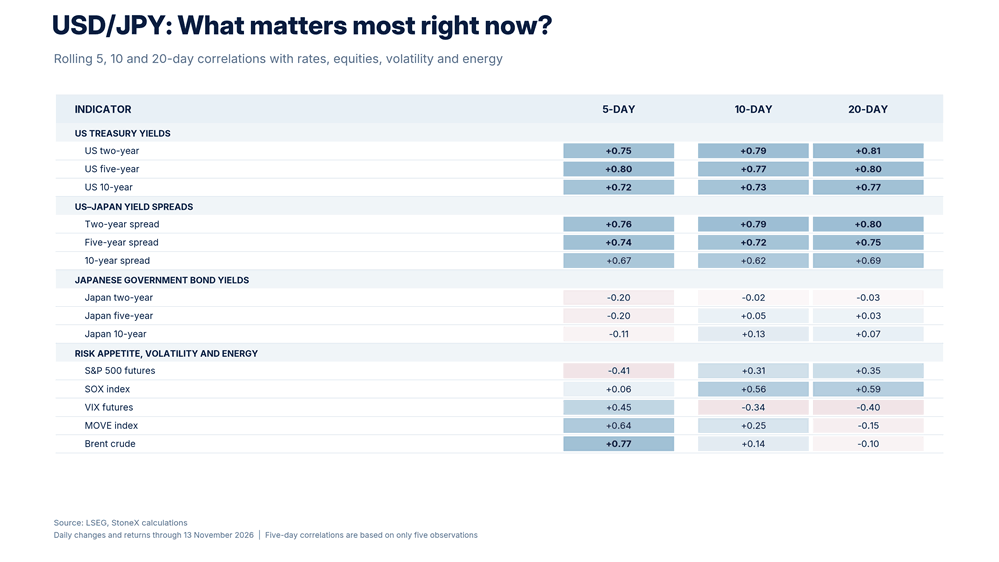
Our analysis shows the 20-day correlation between daily changes in US two-year Treasury yields and USD/JPY stands at +0.81, almost identical to the +0.80 correlation with the equivalent US–Japan yield spread. The relationship is also strong over shorter five and 10-day windows, suggesting US interest rate expectations have become the dominant influence on the pair's recent movements.
Source: LSEG
After a period in which US Treasury yields and the dollar were heavily influenced by swings in the AI sector, the Fed rate outlook appears to have reasserted its influence over USD/JPY. There's still evidence of a relationship with AI-related markets, with the SOX maintaining a reasonably strong positive 20-day correlation, while VIX futures show a similar relationship in the opposite direction, but it's weakened over recent weeks.
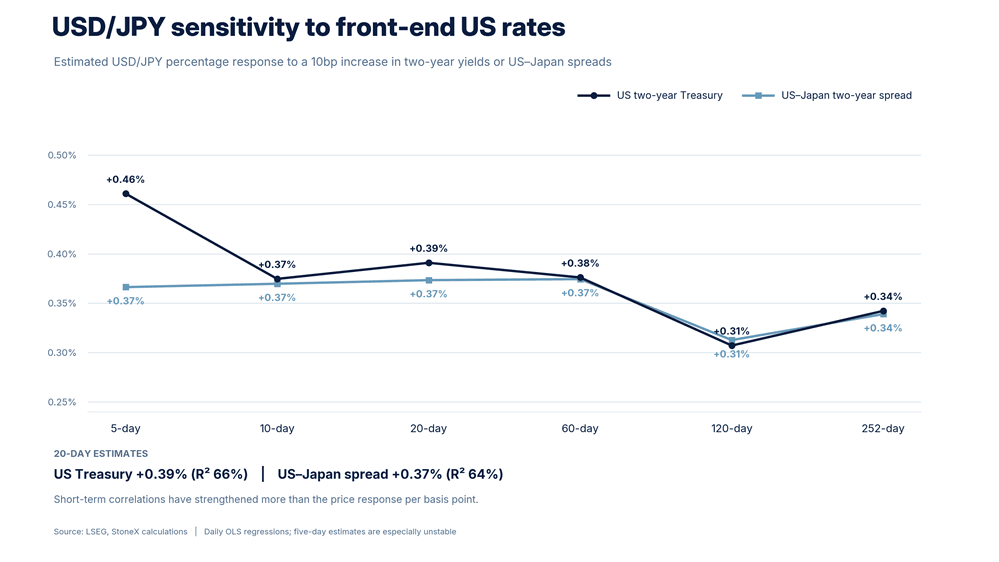
Interestingly, it's not that USD/JPY has become substantially more sensitive to shifts in US interest rates lately. Our regression analysis suggests a 10-basis-point increase in US two-year Treasury yields is associated with a USD/JPY gain of approximately 0.39% over the latest 20 sessions, broadly in line with its sensitivity over longer historical windows.
Source: LSEG
Rather than an unusually large response to each basis point of movement in US yields, the evidence suggests the relationship between US rates and USD/JPY has become stronger and more consistent.
US–Japan economic surprise divergence accelerates
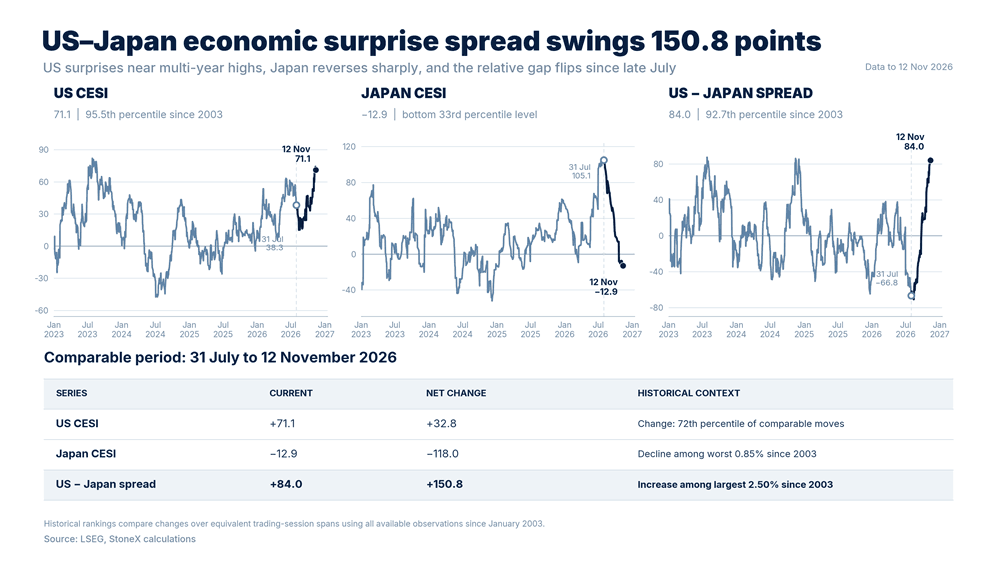
The fundamental basis for the sharp repricing in US rate outlook is evident in the sheer strength of incoming economic data, with Citi's US Economic Surprise Index surging to levels not seen in more than three years. The index measures how economic releases compare with market expectations, with positive readings indicating data are exceeding forecasts on balance.
Source: LSEG
In contrast, positive economic surprises in Japan have completely dried up, with incoming data now marginally undershooting expectations on balance. The reversal has been enormous, with Japan's index plunging 118 points since late July, contributing to a 150.8-point swing in the relative US–Japan spread in favour of the United States.
The rapid divergence matters not only for the respective policy outlooks of the Fed and BOJ, but also for USD/JPY given markets react to shifts in expectations rather than absolute levels.
BOJ tightening priced despite weaker data pulse
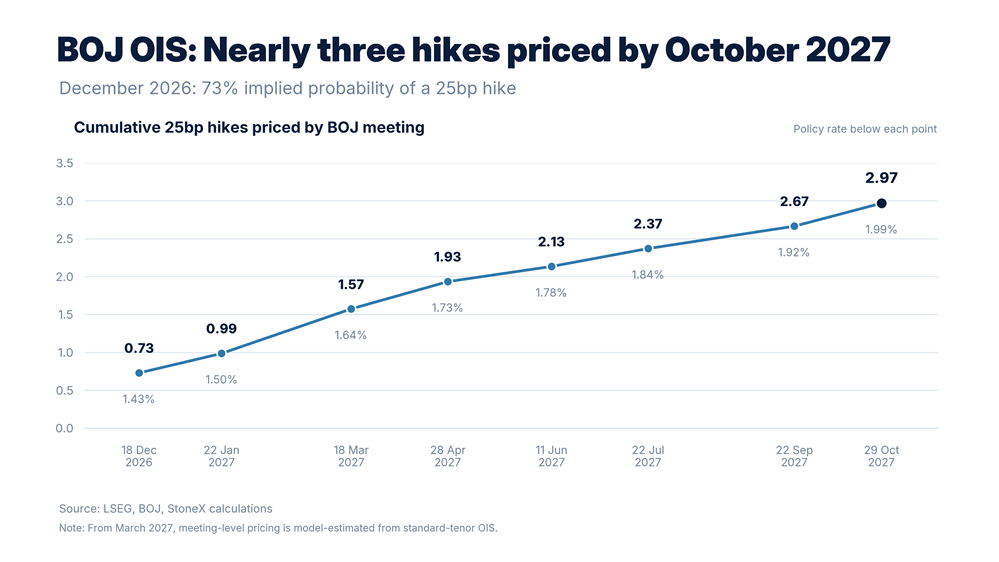
For now, markets continue to price a steady pace of tightening from the BOJ despite the deterioration in Japanese economic surprises. Our modelling of the Japanese OIS curve suggests a 73% implied probability of a 25-basis-point hike at December's meeting, with almost three increases priced through October 2027, taking the implied policy rate towards 2%.
Source: LSEG
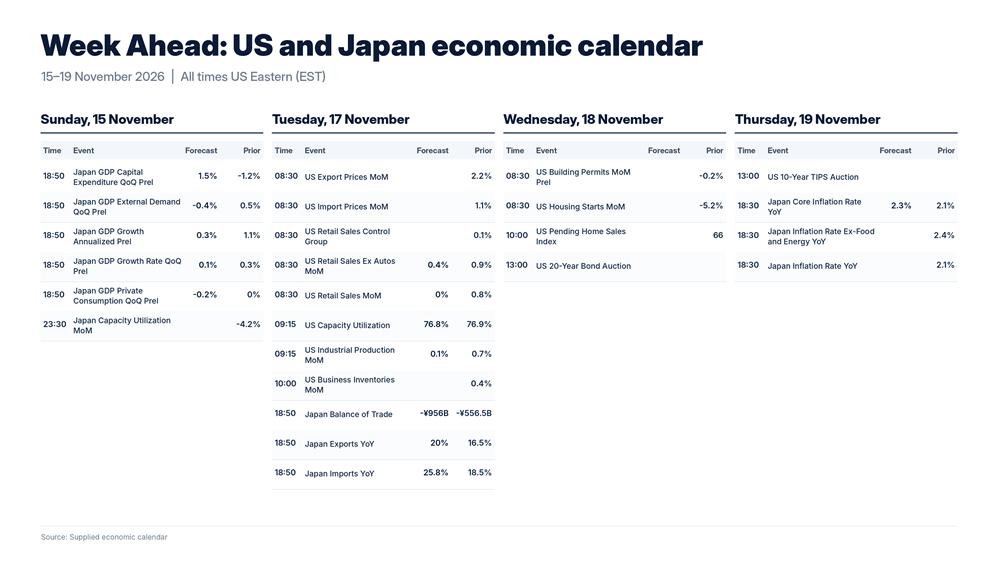
However, should economic data continue to undershoot expectations, the prospect of further policy tightening from the BOJ may start to be questioned given firm demand is one of the key requirements for fostering sustained inflationary pressures across the economy. That puts Monday's preliminary GDP report firmly in focus.
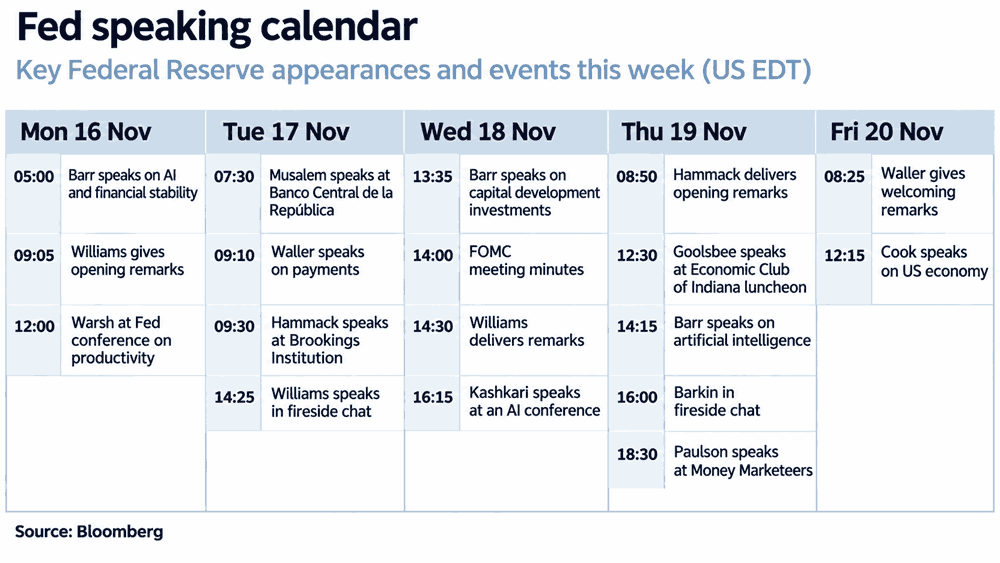
Fed speakers dominate a calendar short on catalysts
Source: TradingView
Monday's GDP report is one of the few Japanese economic releases capable of generating meaningful volatility in USD/JPY, although the impact of even a substantial surprise tends to be short-lived based on recent trends. National inflation figures are also due on Friday, but given their strong correlation with Tokyo's figures which are released three weeks earlier, they rarely generate volatility nowadays.
In the US, there's no top-tier economic data scheduled but there is an avalanche of Fed speakers. But unless officials make a concerted effort to materially tighten or loosen financial conditions by challenging the hawkish shift in market expectations of last week, it's difficult to see much signal emerging from the scheduled events. With so many voices, there's likely to be plenty of noise.
Source: Bloomberg
That suggests broader risk appetite could be far more important for USD/JPY, particularly given the dollar's lingering relationship with the AI sector. That puts Anthropic's slated IPO front and centre of attention, along with broader concerns about AI valuations and fallout from Jensen Huang's resignation as Nvidia CEO, and the substantial uncertainty that brings.
USD/JPY bulls eye a higher trading range
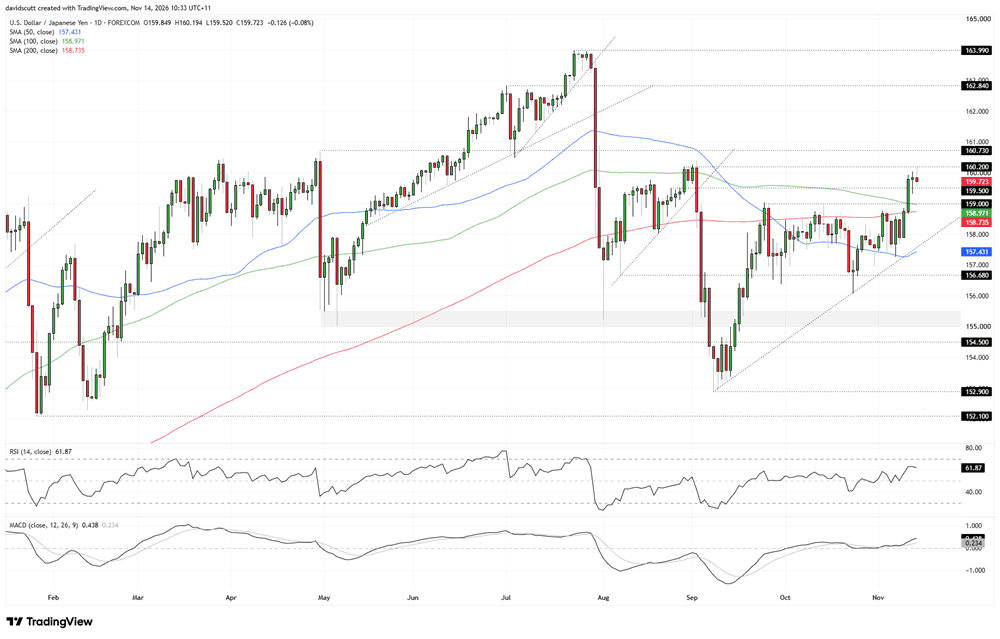
Source: TradingView
Having traded in a relatively narrow range between 159.00 and 156.68 for the better part of two months, the US rate shock helped deliver a strong bullish breakout in USD/JPY late last week, briefly pushing the pair back above the psychologically important 160 level before triggering a torrent of jawboning from Japanese officials, including Finance Minister Katayama.
While the price was unable to sustain the move above 160, stalling at resistance around 160.20, early indications suggest USD/JPY may be starting to establish a new, higher trading range. Price action early next week will be important in assessing whether that shift can stick, with 159.50 an immediate focal point after being tested on several occasions. However, the more important downside area sits around 159.00, followed closely by the 100 and 200-day moving averages, with the latter currently at 158.74.
Momentum indicators, including RSI (14) and MACD, continue to marginally favour long setups over shorts, a view reinforced by the price trading above its key medium and long-term moving averages and having established a higher high. Should the bullish breakout extend beyond 160.20, 160.73 is the next level of note, having previously served as resistance and support following the multi-decade highs reached in April. Beyond that, there is little obvious resistance until 162.84, followed by the 2026 high of 163.99 set in July.
However, given the renewed attention from Japanese officials following the break above 160, any further gains are likely to be grinding rather than explosive, even if supported by fundamentals. Traders also need to be alert to an escalation in intervention warnings, particularly given the episodes of direct intervention around these levels earlier this year.
Should intervention occur, technical levels are unlikely to offer much protection. Below the 200-day moving average at 158.74, the next area of interest is around 157.50, where the uptrend from September's lows intersects with the 50-day moving average, followed by 156.68 and a broader support zone between 155.50 and 155.00, which has attracted considerable buying interest during previous intervention episodes.