

In the latest trading session, the price of WTI crude oil gained about 1.7%, supported by a buying bias driven by concerns over potential disruptions to global supply. For now, a slight rebound in buying pressure has brought renewed volatility to the market, as investors closely monitor the situation in Ukraine, where escalating tensions could lead to new sanctions on Russia and disrupt the flow of oil worldwide. As this perception of risk persists, a bullish bias may reassert itself in the short term.

What’s Happening in Ukraine?
The conflict in Ukraine remains unresolved, and in recent days new attacks have started to threaten Russian oil production. The latest incident occurred in the Tambov region, partially interrupting crude flows to Europe via the Druzhba pipeline. Such developments are raising concerns that, at some point, these attacks could have a material impact on Russian oil output in the near term.
Peace talks remain stalled. Despite ongoing efforts by the European Union and the United States, no progress has been made toward direct negotiations between Putin and Ukraine. This diplomatic deadlock raises the risk that Western nations could impose additional sanctions, further restricting Russian oil flows as a means of pressure.
Currently, Russia produces around 9.85 million barrels per day, according to April data, representing roughly 10% of global supply. Any significant disruption at this scale would have a direct impact on the market balance, given that Russia competes with Saudi Arabia for the second spot among the world’s largest oil producers.
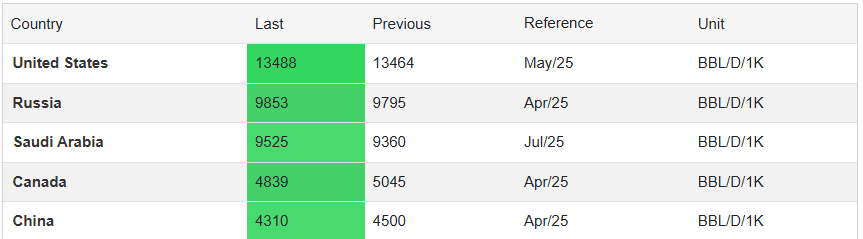
Source: TradingEconomics
In this sense, any further deterioration stemming from the conflict could generate a global supply imbalance, pushing crude prices to higher levels. As long as no robust peace agreement is in sight, buying pressure in the oil market could remain firm in the short term.
Is There Confidence in Oil?
Despite the geopolitical backdrop, confidence indicators do not yet show strong support for oil prices. The MM Sentiment Indicator reveals that only 11.81% of investors hold an optimistic outlook, compared with 43.06% neutral and 45.14% pessimistic expectations for the next three months. This reflects a climate of persistent indecision, where uncertainty prevails about the true impact of the conflict on global supply.

Source: MacroMicro
It is also worth noting that neutral sentiment has been increasing steadily in recent months. If this trend continues, the lack of clear direction could remain a feature of WTI price movements, until more decisive data provides clarity for a defined trajectory in the short term.
WTI Technical Outlook

Source: StoneX, Tradingview
- Neutral Bias Strengthens: The past few sessions have been pivotal for oil. What initially seemed like a bearish consolidation phase, following the breakdown of the previous uptrend, has not been confirmed. The barrel has failed to establish lower lows, suggesting that a sideways structure may be forming. Under these conditions, neutrality is likely to dominate price action until a stronger catalyst emerges.
- RSI: The RSI line remains on an upward slope and is gradually approaching the neutral 50 level, suggesting a potential balance between buying and selling momentum in the short term, reflecting a neutral market sentiment.
- MACD: The MACD indicator shows a similar pattern, with the histogram hovering near the 0 line, underscoring the lack of a clear direction in short-term moves.
Key Levels:
- $67 – Major Resistance: corresponds to the area where the 50- and 200-day moving averages converge. A sustained breakout above this zone would open the door to a more defined bullish bias.
- $64 – Immediate Resistance: aligned with the 61.8% Fibonacci retracement, this is the nearest barrier to watch for bullish moves. A breakout above this level could trigger renewed buying momentum.
- $60 – Key Support: a psychological level representing the most important floor. A breakdown below this zone would validate a stronger bearish scenario.
Written by Julian Pineda, CFA – Market Analyst
Follow him: @julianpineda25