
US futures
Dow futures -0.25%, S&P 500 futures 0.12% & Nasdaq futures 0.2%
European futures
FTSE 0.24%, DAX 0.15%
- US stocks are falling after a mixed performance last week
- US Fed rate hike expectations for October have fallen to 20%
- Treasury yields and oil prices remain elevated
- Oil falls as Middle East supply tops pre-war levels
U.S. Stocks slip as Treasury yields and oil remain elevated
U.S. stocks have opened mixed on Monday as investors await fresh clues on the outlook for interest rates while weighing elevated Treasury yields and oil prices.
Last week, the tech-heavy Nasdaq rose to a fresh record high after weaker-than-expected jobs data and continued demand for AI-related stocks lifted the index. This was in stark contrast to the Dow Jones, which fell across the week.
Markets now see an 80% probability that the Fed will leave interest rates unchanged in October, although there is still an 87% probability priced in that the Fed will hike rates by December.
The U.S. 10-year Treasury yield continues to trade above 5.2%, near multi-year highs, amid concerns over deteriorating government finances, heavy debt issuance, elevated energy costs and persistent inflationary pressures.
Attention is turning to ISM services PMI data later today, as well as speeches from top global central bankers, including Federal Reserve Governor Christopher Waller.
The FOMC minutes will be released on Wednesday and could provide further clues about the outlook for interest rates. The key question for stocks is whether weaker employment data will be enough to offset elevated yields and persistent inflationary pressures.
Corporate Movers
Cerebras Systems is rising more than 6% after OpenAI CEO Sam Altman said the chip designer is a close partner and that the companies have deep engagement.
Dow Jones Forecast – Technical Analysis
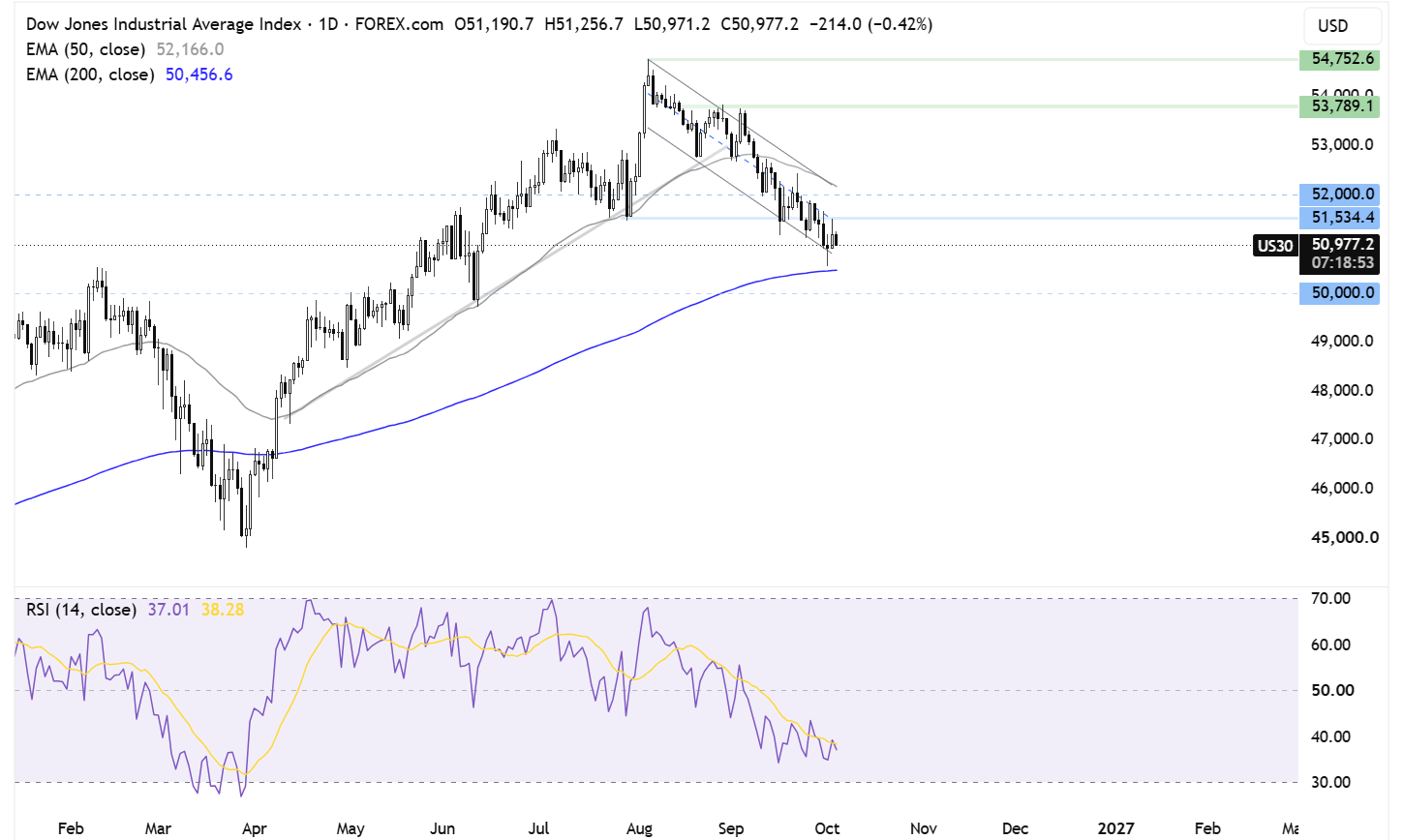
The Dow Jones trades within a descending channel. The index briefly broke below the lower band of the channel before finding support just above the 200 EMA around 50,540.
The hammer candlestick pattern and respect of the 200 EMA could point to a potential reversal of the recent downtrend.
Buyers would need to rise above resistance around 51,500, followed by 52,000. Above here, attention turns to 52,200, the 50 EMA and the upper band of the falling channel.
A sustained break above this zone would put the index on a firmer footing and bring 53,800 into focus.
Sellers will need to break below the 200 EMA around 50,500 to create a lower low and open the door towards 50,000.
FX Markets – Dollar Holds Near 18-Month High
The U.S. dollar has risen to an 18-month high despite the weaker-than-expected non-farm payroll report on Friday. U.S. Treasury yields remain elevated above 5.2%, while the Fed is still expected to hike rates before the end of the year. U.S. ISM services data will be in focus ahead of the FOMC minutes on Wednesday.
EUR/USD is falling to its lowest level in 15 months amid rising fiscal and political concerns in the region. French government bond yields are rising on Monday, remaining close to Friday's multi-year highs amid growing concerns over the country's indebtedness. Spanish government bond yields have also increased after the government announced a snap election.
These political and fiscal concerns come as the eurozone continues to struggle with rising inflation, elevated interest rates and high government borrowing costs.
GBP/USD is modestly lower amid a stronger U.S. dollar, with the pair hovering around its year-to-date low. UK services PMI came in at 52.1 in September, down from 52.5 in August and representing the joint weakest growth since June.
However, the data also showed that cost pressures rose last month as higher fuel prices drove up input-cost inflation. Employment fell for a 24th consecutive month, the longest period of decline since records began in 1997, while business sentiment edged lower from August's seven-month high.
Oil Prices Fall as Fuel Supply Concerns Ease
Oil prices are falling at the start of the new week as recovering Middle East crude exports and the release of oil stocks by the G7 ease concerns over supply.
President Trump also ruled out a diesel export ban, which would have tightened international product markets.
Adding to expectations of a looser crude market, Saudi Arabia reduced the official selling price of its Arab Light to Asia by $3 a barrel for November loading.
Still, tensions in the Middle East remain elevated, with several vessels coming under attack around the coast of Oman and Yemen. This could limit the downside in oil prices, particularly if disruptions to shipping or regional supply intensify.
For markets, the key question is whether improving crude supply can outweigh the geopolitical risk premium and keep oil prices under control. A sustained decline in energy prices would ease some of the inflation pressure currently complicating the outlook for central banks.