

As the week comes to a close, EUR/USD has posted a modest 0.2% gain during the latest session, with a noticeable stabilization in short-term price movements. Despite the release of strong U.S. labor data and continued divergence in monetary policy from both central banks, the pair has remained firmly neutral. The lack of volatility due to the U.S. Independence Day holiday has also contributed to this range-bound behavior toward the weekly close.

How Did the Recent Jobs Data Affect the Market?
On July 3, the U.S. Non-Farm Payrolls (NFP) report showed a stronger-than-expected result, with 147,000 jobs created in June, compared to the 111,000 forecast. This marks a significant recovery in the labor market, breaking a previously downward trend seen in prior months. The reading also exceeded the revised figure for the previous month, which was 144,000.
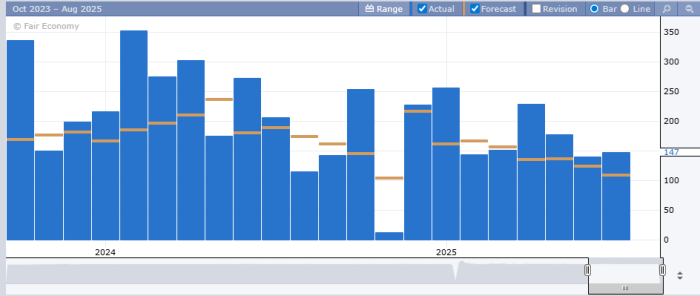
Source: Forexfactory
This surprise boost in employment supported the U.S. dollar during Thursday's session, although the holiday limited its continuation in the short term. A stronger labor market suggests the U.S. economy may not be weakening as expected, and that consumer spending could remain robust. However, this development could be concerning for the Federal Reserve, as increased economic activity may lead to more persistent inflation, potentially forcing the Fed to keep rates elevated for longer.
Indeed, the CME Group’s FedWatch Tool now shows a 95.3% probability that the Fed will hold its benchmark rate at 4.5% at its upcoming July 30 meeting, a figure that increased immediately after the jobs report.
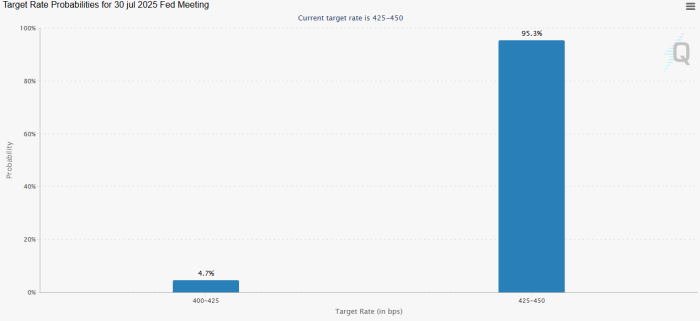
Source: CME Group
If the Fed interprets this labor rebound as an inflationary risk and communicates this in upcoming statements, market expectations for a more hawkish stance could grow. This would provide a temporary lift for the U.S. dollar, which has recently been one of the worst-performing major currencies. In such a scenario, the euro may lose ground, opening the door to short-term selling pressure on EUR/USD.
What’s Happening with the European Central Bank?
The European Central Bank (ECB) currently holds a much more dovish stance than the Federal Reserve. In its early June meeting, it cut the deposit rate to 2%, and signaled the possibility of additional rate cuts, as eurozone inflation remains within the ECB’s 2% target. Markets now price in a 74% probability of another cut at the July 23 meeting, which would bring the rate down to 1.75%.
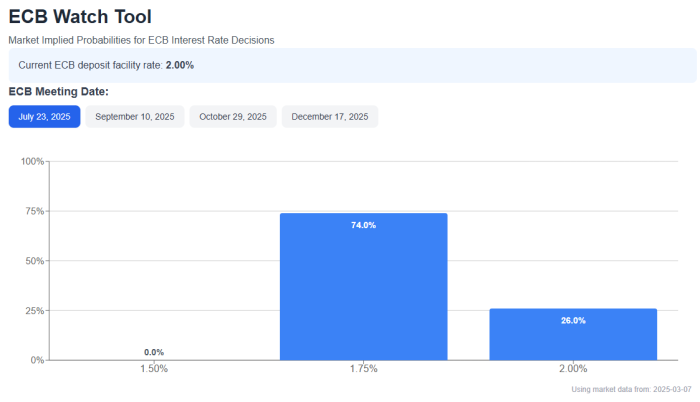
Source: ECB Watch
Against this backdrop, it's important to remember that the euro’s recent strength has mostly been driven by dollar weakness, rather than strong fundamentals from the eurozone. However, there is still a significant divergence in monetary policy: the U.S. holds rates at 4.5% with a neutral tone, while Europe has lower rates (2%) with a dovish bias. If this divergence persists, it could become a major catalyst for future movements in both currencies.
The higher yield offered by U.S. assets may continue to attract capital inflows into dollar-denominated instruments, especially Treasuries, supporting a possible rebound in the U.S. dollar after its extended downtrend. If the ECB continues to pursue an overly dovish approach, this could lead to capital outflows from the eurozone, triggering renewed selling pressure on EUR/USD in the short term.
EUR/USD Technical Outlook
Source: StoneX, Tradingview
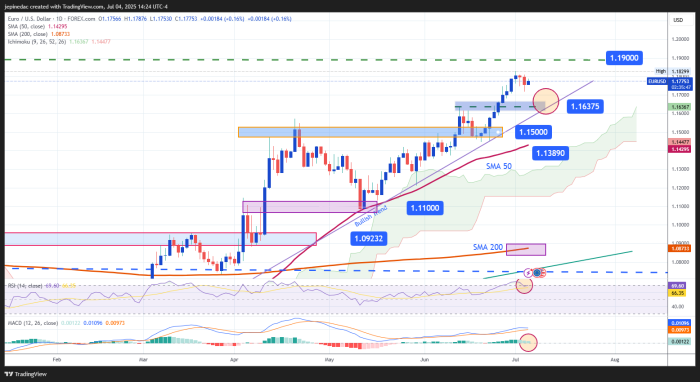
- Strong Uptrend Intact: The EUR/USD chart still shows a solid bullish structure since early March, with a series of consistent upward swings. So far, no significant pullbacks have challenged this trend, making it the dominant technical pattern to watch. However, indecision candles have begun to form near current highs, which may suggest potential exhaustion and a possible short-term correction.
- RSI: The RSI line remains above the 50 level, confirming bullish momentum. However, it is now in overbought territory (above 70), signaling a potential imbalance in market forces, which could trigger a short-term pullback.
- MACD: The MACD histogram remains above the zero line, indicating strong short-term momentum. However, it is beginning to flatten, suggesting the potential for a neutral or consolidative phase if this trend continues.
Key Levels:
- 1.16375 – Current Barrier: A recent neutrality level, which may act as minor support during potential pullbacks.
- 1.19000 – Major Resistance: A key psychological zone that may serve as a tentative resistance area. A breakout above this level would reinforce the bullish bias and could trigger a stronger upward trend.
- 1.15000 – Psychological Support: A former resistance level, now acting as key support. A break below this point would put the current bullish structure at risk, opening the way for a more bearish short-term bias.
Written by Julian Pineda, CFA – Market Analyst
Follow him: @julianpineda25